
Saalburg — Roman fort and archaeological museum in the Taunus, Germany
Saalburg is a reconstructed Roman fort on the Upper Germanic Limes in the Taunus mountains. Built c. 90 CE, enlarged to c. 210, abandoned in the 3rd century, rebuilt in 1897 and now a museum and research centre.
The Saalburg is a reconstructed Roman frontier fort (castellum) near the crest of the Taunus mountains in central Germany. Positioned to guard access routes into the Rhine‑Main plain, it forms one of the better‑preserved and most completely restored installations of the Upper Germanic Limes. Visitors encounter a compact fort whose scale, internal buildings and perimeter defences illustrate the typical layout and function of a small auxiliary garrison fort of the 1st–3rd centuries CE.
Image gallery
10 Images


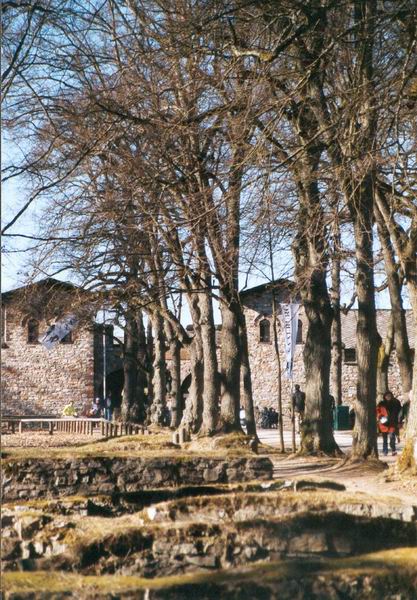
Layout and principal features
The fort follows the conventional Roman rectangular plan with rounded corners. Its visible elements include a reconstructed gate complex, a central headquarters building (principia), rows of barrack blocks, a possible praetorium (officers' house), storehouses and internal streets. Defensive works were originally a rampart and ditch, often with timber revetment, and later phases were rebuilt in stone. The Saalburg reconstruction is based on archaeological excavations and displays the spatial relationships between ramparts, gates, internal buildings and the surrounding extramural area.
History and chronology
Archaeological evidence indicates initial construction around 90 CE, followed by enlargements and rebuilding phases through the late 2nd and early 3rd centuries CE. The fort likely housed an auxiliary unit classed as a cohors equitata (a mixed infantry and cavalry cohort), typically several hundred men, tasked with patrolling and controlling travel routes across the Taunus into the Rhine‑Main valley. Roman occupation ended in the mid to late 3rd century; after abandonment the site declined and many stones were removed for local building, a common fate for disused Roman structures.
Museum, reconstruction and research
Interest in the Saalburg revived in the 19th century. In 1897 the German emperor ordered a systematic reconstruction on the original footprint, an early example of large‑scale archaeological restoration. Today the site functions as an archaeological museum and research centre with permanent exhibits of finds, reconstructions of rooms and equipment, and educational programs for visitors. The museum presents pottery, tools, coins and epigraphic material that illuminate daily life on the frontier and the organisation of Roman auxiliary units.
Significance and notable facts
- The Saalburg is part of the Upper Germanic-Rhaetian Limes, a frontier system of walls, palisades and watchtowers that marked the limits of Roman provinces in this region.
- It has been recognised as part of the Limes World Heritage ensemble since 15 July 2005, underlining its value for understanding Rome's frontier policy and provincial organisation.
- Archaeological work at the Saalburg combined excavation, reconstruction and museum display, influencing heritage practices in Germany and beyond.
- Its reconstruction in the late 19th century remains historically significant as an expression of contemporary interests in antiquity and national heritage.
For further general background on Roman frontier forts see a concise overview at Roman fortifications, or consult material on the Taunus region and its landscape. Local studies and conservation reports provide details about the reuse of building stone after abandonment (quarrying history) and on the site's later restoration under imperial patronage (reconstruction history). The Saalburg continues to be an active centre for archaeological research and public education, and basic visitor information is available through regional cultural services (Germany tourism pages).
As an interpretive site the Saalburg illustrates broader themes: military logistics and accommodation, Roman provincial interactions with neighbouring peoples, and how modern nations recover, reconstruct and interpret ancient heritage. Its combination of tangible remains, reconstructed architecture and curated finds makes it a useful introduction to life on Rome's northern frontier for both specialists and the general public.
Questions and answers
Q: What is the Saalburg?
A: The Saalburg is a Roman fortification in the Taunus mountains in Germany and was a stronghold in the Upper Germanic Limes.
Q: When was the Saalburg constructed?
A: The Saalburg was constructed about 90 CE.
Q: What was the purpose of the Saalburg?
A: The Saalburg was home to a cohors equitata to protect the access to the Rhine-Main valley from the Germanic tribes in the North.
Q: When did the Romans leave the Saalburg?
A: The Romans left the Saalburg after 260.
Q: When was the Saalburg rebuilt and why?
A: The Saalburg was rebuilt in 1897 because Wilhelm II ordered its reconstruction.
Q: What is the Saalburg used for today?
A: The Saalburg houses a museum and is a center for Roman archeology.
Q: Is the Saalburg a UNESCO World Heritage site?
A: Yes, the Saalburg belongs to the UNESCO World Heritage sites since 15. July 2005 as part of the Upper Germanic Limes.
Related articles
Author
AlegsaOnline.com Saalburg — Roman fort and archaeological museum in the Taunus, Germany Leandro Alegsa
URL: https://en.alegsaonline.com/art/85054
Sources
- whc.unesco.org : UNESCO World Heritage