
Ryūkyū Domain: the short-lived Meiji-era domain in the Ryukyus
Ryūkyū Domain (Ryūkyū-han) was a Meiji-period administrative unit replacing the Ryukyu Kingdom (1872–1879) before the creation of Okinawa Prefecture; its history reflects Satsuma control, China ties, and Japanese centralization.
The Ryūkyū Domain (琉球藩, Ryūkyū-han) was an administrative entity created by the central government of Japan as part of the Meiji-era reorganization of former domains. It replaced the traditional Ryukyu Kingdom and covered the islands now administered as Okinawa Prefecture, situated at the eastern edge of the East China Sea. The domain was short-lived but significant as the legal transition from a semi-independent kingdom to prefectural status under Tokyo.
Image gallery
5 Images
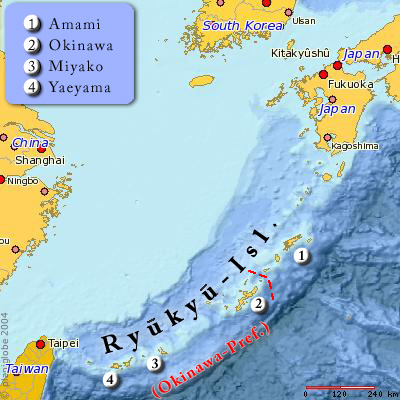


Background and characteristics
For centuries the Ryukyus had their own monarchy and distinct languages and culture. From the early modern period the islands were subject to influence and control by the Satsuma domain on Japan’s southwestern mainland, while also maintaining tributary relations with imperial China. Under the Meiji state the last king, Shō Tai, was reclassified as the head of Ryūkyū Domain, a nominal status that placed the islands more directly under the authority of the central government.
Key events and timeline
- 1609: Invasion by Satsuma, beginning a period of Japanese domain influence while the Ryukyuan monarchy continued.
- 1872: Meiji government proclaimed the kingdom as Ryūkyū Domain, integrating it administratively into the new state framework.
- 1879: The domain was abolished and Okinawa Prefecture was established in a process often called the Ryukyu Disposition (琉球処分), completing direct incorporation.
The Ryūkyū Domain was thus a transitional legal form. It removed the international ambiguity that had allowed the Ryukyus to act as a bridge between China and Japan, and it allowed Tokyo to assert clearer sovereignty over the islands during a period of rapid centralization and modernization.
Importance and legacy
Although brief, the domain period marked the end of the Ryukyuan monarchy and the start of modern administrative rule by Japan. The change affected landholding, foreign contacts, and the status of the royal family, and it set the stage for later social, economic, and political integration into the Japanese state. Ryukyuan language varieties, religious practices, and cultural forms survived and continue to distinguish the islands culturally from mainland Japan.
Today the Ryūkyū Domain is studied as a key episode in East Asian diplomacy and state formation, illustrating how regional powers, local rulers, and a modernizing central government negotiated sovereignty in the late 19th century. For further reading about the islands’ older kingdom era and later developments see general works on Ryukyuan history and the Meiji reforms, and consult local archives and scholarship for primary-source perspectives.
Questions and answers
Q: What is Ryūkyū Domain?
A: Ryūkyū Domain was a domain of Japan located in the area of Okinawa Prefecture at the Pacific edge of the East China Sea.
Q: What kind of location was Ryūkyū Domain situated in?
A: Ryūkyū Domain was situated in the area of Okinawa Prefecture at the Pacific edge of the East China Sea.
Q: Was Ryūkyū Domain a part of Japan?
A: Yes, Ryūkyū Domain was a domain of Japan.
Q: In which sea was Ryūkyū Domain located at the Pacific edge?
A: Ryūkyū Domain was located at the Pacific edge of the East China Sea.
Q: Did Ryūkyū Domain extend to any other parts of Japan?
A: It is not mentioned in the text whether Ryūkyū Domain extended to any other parts of Japan.
Q: What is the meaning of 'Ryūkyū-han'?
A: 'Ryūkyū-han' is the Japanese name for Ryūkyū Domain.
Q: What is the significance of Okinawa Prefecture in Japan?
A: Okinawa Prefecture is a region in Japan where Ryūkyū Domain was located at the Pacific edge of the East China Sea.
Related articles
Author
AlegsaOnline.com Ryūkyū Domain: the short-lived Meiji-era domain in the Ryukyus Leandro Alegsa
URL: https://en.alegsaonline.com/art/84997
Sources
- books.google.com : "Ryūkyū Islands,"
- books.google.com : The Oxford Handbook of the History of International Law, p. 483
- books.google.com : Becoming Okinawan: Japanese Capitalism and Changing Representations of Okinawa, p. 38
- books.google.com : "Okinawa-ken," pp. 746-747
- k-amc.kokugakuin.ac.jp : List of Kankokuheisha (官国幣社), p. 3