
Rusyn language: an East Slavic tongue of Central Europe
Rusyn is an East Slavic language (also called Ruthene) spoken by communities across Central Europe. It has several local varieties, varying orthographies, and differing legal statuses in regional states.
Overview — Rusyn (autonym: русиньска бесїда or русиньскый язык) is an East Slavic speech variety traditionally used by the Rusyns of Central Europe. In English it is often called Rusyn, Ruthene or Ruthenian. Linguists and state authorities differ in classification: some consider Rusyn a separate language, while others treat it as a regional variety of Ukrainian; this disagreement is discussed by scholars and communities alike (language vs. dialect debate).
Image gallery
4 Images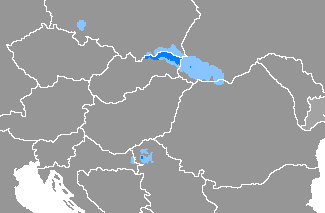


Characteristics and varieties
Rusyn is not uniform: it comprises several local varieties that reflect mountainous settlement patterns and contacts with neighboring languages. Phonology, vocabulary and grammar show both conservative East Slavic traits and innovations caused by contact with Polish, Slovak, Hungarian, Romanian and South Slavic languages. Writers and educators have used multiple orthographies; Cyrillic is widely used in many communities, while Latin-script conventions exist in some areas. There are modern efforts to produce textbooks, dictionaries and media in different standardized forms.
Geographic distribution and legal status
Speakers live in a number of Central and Eastern European states. Notable areas include:
- Transcarpathian Region in Ukraine, where Rusyn communities have a long presence.
- Parts of northeastern Slovakia, including municipalities where Rusyn has an official local role (some Slovak municipalities).
- The Vojvodina region of Serbia, where Rusyn is officially recognized as a minority language.
- Scattered communities in southeastern Poland, northern Romania, and parts of Hungary.
Several states have given Rusyn particular protections: it is listed under the European Charter for Regional or Minority Languages (the Charter) in places including Slovakia, Serbia, Croatia and Romania. In Slovakia, Rusyn was granted official minority-language status at the national level in the 1990s.
History and development
The roots of Rusyn speech varieties lie in the medieval East Slavic dialect continuum of the Carpathian and adjacent regions. Over centuries, local speech absorbed lexical and phonetic influences from neighboring peoples and administrative powers. Literary and liturgical use developed unevenly: local Orthodox and Greek Catholic churches preserved written forms, while modern secular standardization is a twentieth- and twenty-first‑century phenomenon driven by community activists, linguists and regional institutions.
Uses, education and cultural importance
Rusyn is used in family life, communal rituals, folklore, and increasingly in print and broadcast media where permitted. Local newspapers, radio programs and school classes exist in places with formal recognition. Cultural societies maintain traditional songs, proverbs and religious texts, and new literature and language teaching materials appear in different standardized forms. Public use often depends on municipal or national policies and on community organization.
Distinctive issues and notable facts
Key matters around Rusyn include the question of language versus dialect, multiple standards and orthographies, and varying state recognition. Some states treat Rusyn as a protected minority language, while others subsume its speakers under broader national categories. For readers seeking further factual sources or community material, authoritative regional institutions and specialist studies provide more detailed information on grammar, vocabulary and contemporary policy.
Additional references and entry points are available through regional language authorities and minority-rights organizations; see documents and resources linked by national and international bodies for up-to-date legal and educational developments.
Questions and answers
Q: What is Rusyn?
A: Rusyn is an East Slavic language spoken by the Rusyns of Central Europe.
Q: What are some other names for Rusyn in English?
A: Rusyn is also called Ruthene or Ruthenian in English.
Q: How do linguists treat Rusyn?
A: Some linguists treat Rusyn as a distinct language.
Q: What do some Ukrainian scholars think of Rusyn?
A: Some Ukrainian scholars think Rusyn is a dialect of Ukrainian.
Q: In what countries is Rusyn spoken?
A: Rusyn is spoken in the Transcarpathian Region of Ukraine, northeastern Slovakia, Vojvodina, southeastern Poland, Hungary, and northern Romania.
Q: Is Rusyn an official minority language in Serbia?
A: Yes, Rusyn is an official minority language in Serbia.
Q: Is Rusyn a protected language under the European Charter for Regional or Minority Languages?
A: Yes, Rusyn is listed as a protected language by the European Charter for Regional or Minority Languages in Slovakia, Serbia, Croatia, and Romania.
Related articles
Author
AlegsaOnline.com Rusyn language: an East Slavic tongue of Central Europe Leandro Alegsa
URL: https://en.alegsaonline.com/art/84883
Sources
- ethnologue.com : Rusyn
- portal.statistics.sk : "Population and Housing Census 2011: Table 11. Resident population by nationality – 2011, 2001, 1991"
- webrzs.stat.gov.rs : "Final results of the census 2002" · web.archive.org
- ukrcensus.gov.ua : "About number and composition population of UKRAINE by data All-Ukrainian population census 2001 data"
- stat.gov.pl : "Home"
- dzs.hr : "Republic of Croatia – Central Bureau of Statistics"
- nepszamlalas2001.hu : "1.28 Population by mother tongue, nationality and sex, 1900–2001"
- vdb.czso.cz : "Obyvatelstvo podle věku, mateřského jazyka a pohlaví"
- ethnologue.com : Rusyn
- languagecharter.eokik.hu : "Implementation of the Charter in Hungary"
- skupstinavojvodine.gov.rs : "The Statue of the Autonomous Province of Vojvodina, Serbia"