
Rugby union: rules, field, history and global competitions
Rugby union is a full-contact team sport played by two teams of 15 with an oval ball, governed by set rules. This article outlines play, field and equipment, scoring, history and major tournaments.
Overview
Rugby union is a team ball sport played between two sides of 15 players on each team. It is a continuous, full‑contact game that combines running, kicking and passing an oval ball. Matches last 80 minutes, divided into two 40‑minute halves, and are governed by a set of laws maintained internationally by World Rugby. For a basic reference it is often described simply as a ball sport.
Image gallery
10 Images




Field, equipment and players
The playing area is a rectangular pitch about 100 metres between the goal lines and up to 70 metres wide, with additional in‑goal areas behind each goal line. At each end there are H‑shaped goalposts. The ball itself is egg‑ or oval‑shaped, designed to be carried and kicked. Teams are divided into forwards (typically the eight players who contest set pieces) and backs (players who exploit space and speed), with specific position names such as prop, hooker, scrum‑half and fly‑half.
Basic play and scoring
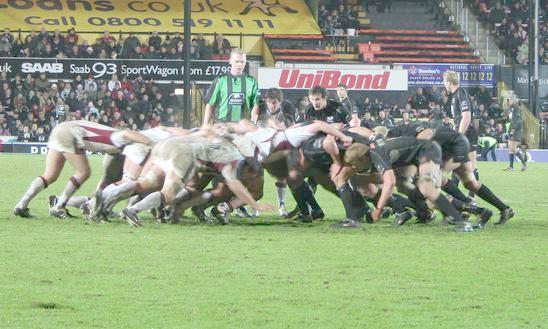
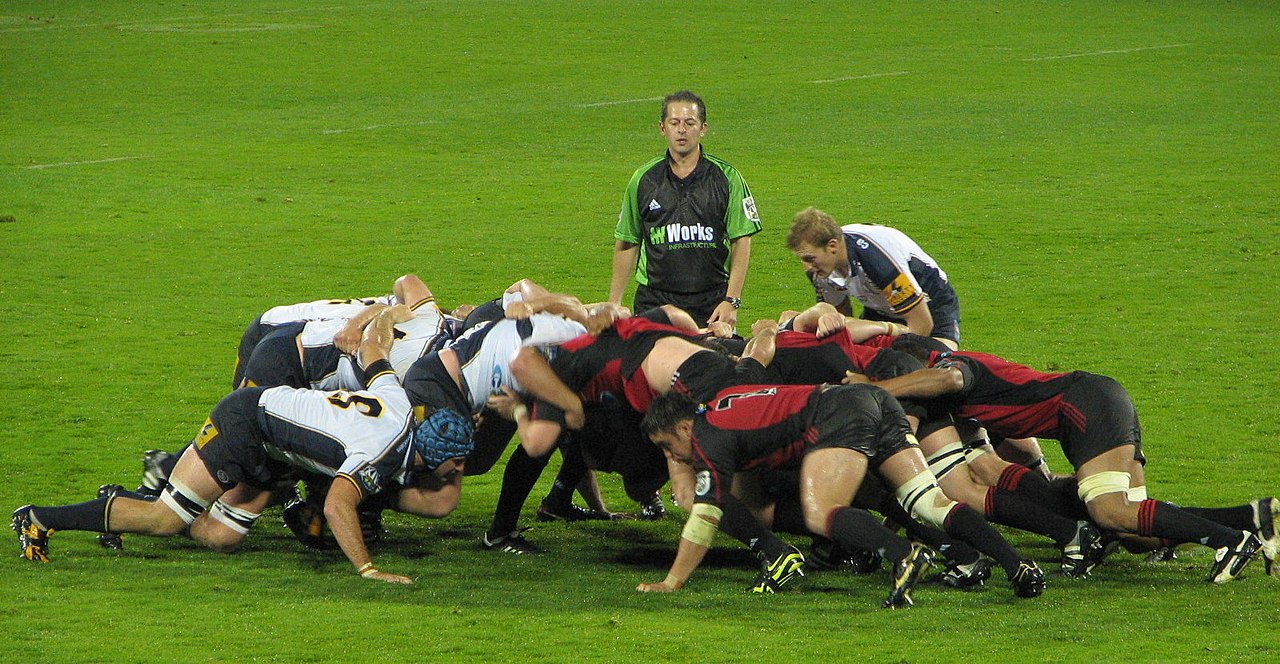
Play proceeds with running, passing backwards, kicking and physical contests such as tackles, rucks, mauls and scrums. Possession can be won or retained through these phases. Points are scored in several ways:
- Try: grounding the ball in the opponent's in‑goal area (commonly five points).
- Conversion: a kick after a try (commonly two points).
- Penalty goal and drop goal: kicks through the posts during play (commonly three points each).
History and development
Rugby union traces its origins to English school football variations in the 19th century; a popular but anecdotal origin attributes the distinctive handling style to William Webb Ellis, though that account is regarded as a legend. The sport codified its laws in the mid‑1800s and later split from rugby league in 1895 over professional payments. The game remained amateur until the professional era began in 1995, which significantly expanded international competitions and player welfare structures.
Competitions and cultural importance
Rugby union has a strong international structure, highlighted by events such as the Rugby World Cup, Tri‑Nations/ Six Nations regional championships and various professional club competitions. The sport has deep cultural roots in countries like England, New Zealand, South Africa, Australia, France and Pacific Island nations. It serves both as a professional spectacle and a community pastime, with clubs at many levels from youth to elite.
Distinctive features and safety
Distinctive aspects include contested set pieces (scrums and lineouts), the backward pass rule, and the emphasis on continuous phases of play. Safety and law interpretation have evolved, with stricter sanctions for high tackles and head contact and more substitutes allowed for injury. Because of its physical nature, governing bodies continue to refine rules, training and equipment guidance to reduce injury risk while preserving the sport's essential characteristics.
For further basic definitions and visual guides, introductory resources and rule summaries are available from governing bodies and instructional materials designed for new players and spectators.
Questions and answers
Q: How many players are on each team in rugby union?
A: There are 15 players on each team in rugby union.
Q: What shape is the ball used in rugby union?
A: The ball used in rugby union is oval in shape.
Q: What shape is the field in rugby union?
A: The field in rugby union is a rectangle shape.
Q: How long is the field in rugby union?
A: The field in rugby union is 100 metres long.
Q: How wide is the field in rugby union?
A: The field in rugby union is 70 meters wide.
Q: What are the goal-posts like in rugby union?
A: The goal-posts in rugby union are H-shaped.
Q: How long is a game of rugby union?
A: A game of rugby union is played for 80 minutes in two 40-minute halves with an overtime if it goes on long enough.
Related articles
Author
AlegsaOnline.com Rugby union: rules, field, history and global competitions Leandro Alegsa
URL: https://en.alegsaonline.com/art/84657