
Rudolf Höss — Commandant of Auschwitz and architect of mass killing
Rudolf Höss (1901–1947) was a senior SS officer who served as commandant of Auschwitz. He played a central role in the implementation of mass extermination methods and was tried and executed after World War II.
Overview
Rudolf Franz Ferdinand Höss (25 November 1901 – 16 April 1947) was a senior Schutzstaffel (SS) officer who served as the longest‑standing commandant of the Auschwitz concentration and extermination complex. During his tenure he oversaw the camp's expansion and the systematic killing of prisoners as part of the Nazi regime's genocidal policies. After the war he was captured, tried in Poland, convicted of crimes against humanity and executed.
Image gallery
10 Images




Early life and rise in the Nazi movement
Born in 1901 in what was then the German Empire, Höss became involved with nationalist circles after World War I. He joined the National Socialist German Workers' Party (Nazi Party) in the early 1920s and entered the SS in the 1930s, rising to a senior officer rank (Obersturmbannführer). Before his assignment to Auschwitz he served at other SS and concentration camp postings, where he built experience in camp administration and security.
Command at Auschwitz: organization and methods
Höss took command of the Auschwitz complex in May 1940 and remained in charge through much of its period of operation, with interruptions, until January 1945. Under his direction the site developed into a large, industrialized system designed for mass detention, forced labor and extermination. Höss supervised the construction and use of gas chambers and crematoria and authorized the use of the pesticide Zyklon B (which releases hydrogen cyanide) in homicidal gassings. These changes transformed Auschwitz from a small detention facility into one of the primary centers of the Nazi policy to annihilate Jewish communities and other targeted populations.
Scale, responsibility and procedures
While historians continue to refine estimates, Auschwitz became the largest site of murder within the Nazi camp system, where well over a million people were killed. Höss kept administrative records and later gave testimony describing the procedures for selection, gassing, and disposal that made mass killing systematic. His role is widely cited in studies of how state machinery, technological means and bureaucratic routines were combined to carry out genocide.
Arrest, trial and execution
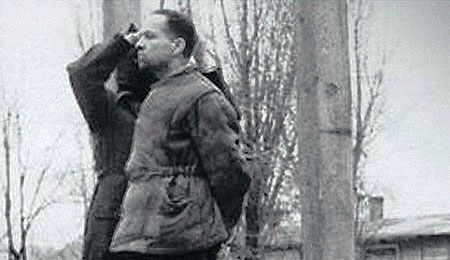
After the defeat of Nazi Germany Höss was arrested and brought to trial by Polish authorities. He gave detailed statements and wrote memoirs that have been used as source material by researchers, though these documents are studied critically by historians. Tried for war crimes and crimes against humanity, he was convicted in 1947 and executed at a site near the former Auschwitz camp.
Legacy, historical importance and distinctions
Rudolf Höss remains one of the most closely studied figures of the Holocaust because his administrative records, testimony and memoirs provide insight into the operation of an extermination center. His actions exemplify how ideology, organizational structures and technology combined to enable mass murder on an unprecedented scale. The prosecution of Höss also helped establish legal and moral precedents for holding individuals accountable for crimes against humanity.
Selected timeline and notable facts
- 1922: Joined the Nazi Party during its early years.
- 1930s: Entered and rose through the ranks of the SS.
- May 1940 – January 1945: Periods during which Höss served as commandant of Auschwitz.
- 1947: Tried by Polish courts, convicted and executed.
- Höss is closely associated with the introduction and routine use of Zyklon B in killing operations.
- Documentation produced by Höss—administrative logs and later testimony—has been important for historical research.
- His trial was among a series of postwar prosecutions that shaped international law concerning genocide and crimes against humanity.
Further reading and related topics
- Nazi Germany
- Schutzstaffel (SS)
- World War II
- Auschwitz complex
- Martin Bormann
- Adolf Hitler
- Jewish communities targeted by the regime
- Europe during the 1930s–1940s
- Final Solution
- Extermination and concentration camps
- Role of a commandant
- Zyklon B
- Pesticides and their toxic compounds
- Hydrogen cyanide
- Gas chambers and methods of killing
- Mass murder under the Nazi regime
- Nazi Party
- Victim counts and historical estimates
- Postwar trials
- Warsaw
- Poland
Questions and answers
Q: Who was Rudolf Franz Ferdinand Höss?
A: Rudolf Franz Ferdinand Höss was a high-ranking member of the Nazi Schutzstaffel (SS) during World War II. He was in charge of Auschwitz concentration camp for about four years from 4 May 1940-18 January 1945.
Q: What did the Nazis call their plan to exterminate the Jewish people in Europe?
A: The Nazis called this plan the "Final Solution".
Q: How did Höss test and start using different ways of killing people more quickly at Auschwitz?
A: At Auschwitz, Höss tested and started using Zyklon B, a pesticide with hydrogen cyanide in it, to kill prisoners in gas chambers. This allowed Nazi soldiers at Auschwitz to murder 2,000 people every hour.
Q: When did Höss join the Nazi Party and SS?
A: Höss joined the Nazi Party in 1922, and joined the SS in 1934.
Q: How long was he Commandant (commander) at Auschwitz?
A: From 4 May 1940 to November 1943, and again from 8 May 1944 to 18 January 1945, he was in charge of Auschwitz.
Q: How many people were murdered at Auschwitz before Nazi Germany lost World War II?
A: Before Nazi Germany lost World War II, more than a million people were murdered at Auschwitz.
Q: What happened after he was found guilty at a trial in Warsaw, Poland?
A: After he was found guilty at a trial in Warsaw, Poland., Höss was hanged in 1947.
Related articles
Author
AlegsaOnline.com Rudolf Höss — Commandant of Auschwitz and architect of mass killing Leandro Alegsa
URL: https://en.alegsaonline.com/art/84617
Sources
- books.google.com : Hanns and Rudolf: The True Story of the German Jew Who Tracked Down and Caught the Kommandant of Auschwitz
- books.google.com : Antisemitism: A Historical Encyclopedia of Prejudice and Persecution (Two Vol. Set) · web.archive.org
- books.google.com : The Catholic Church and the Holocaust: 1930-1965
- books.google.com : Death dealer : the memoirs of the SS Kommandant at Auschwitz
- jewishvirtuallibrary.org : "Martin Bormann"
- law2.umkc.edu : "Testimony of Rudolf Höß at the Nuremberg Trials, 15 April 1946"
- worldcat.org : 45390347
- books.google.com : "Rudolf Hoess"
- shu.edu : A Mass Murderer Repents: The Case of Rudolf Hoess, Commandant of Auschwitz.
- telegraph.co.uk : "Jozef Paczynski, holocaust survivor - obituary"
- holocaust-history.org : AUSCHWITZ: Technique and Operation of the Gas Chambers
- fordham.edu : Hoess Affidavit for Nuremberg Trial
- theglobeandmail.com : "Nazi hunter: Exploring the power of secrecy and silence"
- washingtonpost.com : "Hiding in N. Virginia, a daughter of Auschwitz by Thomas Harding"