
Royal Coat of Arms of the United Kingdom
The official heraldic arms of the British monarch, showing England, Scotland and Ireland; used in different forms by the monarchy, government and in Scotland, with regulated variations.
The Royal Coat of Arms of the United Kingdom is the formal heraldic emblem used by the British sovereign in official capacities. Commonly called the monarch's arms or Arms of Dominion, these heraldic devices identify the authority of the Crown and appear on government buildings, official documents, state stationery and other places representing royal or state authority. The current arms are borne by King Charles III as the United Kingdom's reigning monarch.
Image gallery
6 Images

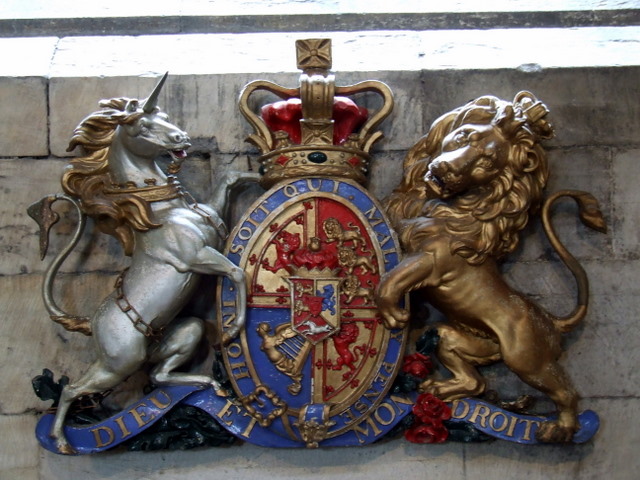


Design and principal elements
The central element is a quartered shield that combines symbols of the historic kingdoms that make up the United Kingdom. The first and fourth quarters display the three passant guardant lions associated with England, the second quarter shows the rampant lion within a double tressure associated with Scotland, and the third quarter bears a harp representing Ireland. A crowned helm and crest — a statant crowned lion — traditionally surmount the shield. Supporters to either side are a crowned English lion and a chained unicorn of Scotland. The Royal Arms also incorporate two mottos: the Order of the Garter's phrase around the shield and the monarch's motto below.
Heraldic components and variations
- Shield: quartered for England, Scotland and Ireland; see the England device at three lions of England and the Irish harp at harp for Ireland.
- Crest and helmet: a crowned lion on a royal crown; sometimes omitted in non-royal versions.
- Supporters: lion (England) and unicorn (Scotland), each carrying symbolic meanings in heraldry.
- Mottos and insignia: the Garter circlet and motto appear on many renderings; in Scotland a different arrangement and motto may be used.
History and development
The modern composition evolved over centuries as crowns, unions and claims changed. Elements date from medieval royal arms long associated with kings of England, the arms of the Scottish monarchy, and symbols of the Lordship and later Kingdom of Ireland. After political unions and dynastic unions, the arms were adapted to reflect the union of the crowns and later the United Kingdom itself. Heraldic practice and specific artistic renderings have been revised periodically to reflect constitutional and stylistic developments.
Uses, official forms and distinctions
Different forms of the Royal Arms are used depending on context. The sovereign's personal royal arms differ in a few details from the version used by government departments: government or public service variants commonly omit certain royal accoutrements such as the helmet and crest and are used to denote state authority rather than the private person of the monarch. In Scotland a distinct Scottish version is used for Scottish government business, showing variations in the placement of elements and mottos; see more about Scotland's usage at Scottish variants. The arms can also appear in simplified or monochrome forms for stationery, seals and coinage. Official guidance regulates when and how each variant may be displayed; use by private individuals and organisations is restricted.
Notable facts
- The ensemble of quartered symbols reflects historical precedents rather than current political jurisdictions.
- Heraldic differences exist for personal royal use, government use and Scottish use; the government form omits some royal-specific elements — a point explained in official guidance at the official coat of arms.
- Because the arms represent the sovereign of the United Kingdom, they are widely recognised as a symbol of state and monarchy across the realm.
While artistic details vary among reproductions, the core heraldic devices — the English lions, Scottish lion rampant and the Irish harp — remain the defining elements of the Royal Coat of Arms.
Questions and answers
Q: What is the Royal Coat of Arms of the United Kingdom?
A: The Royal Coat of Arms of the United Kingdom is the official coat of arms of the British monarch, currently Charles III.
Q: Who uses the Royal Coat of Arms of the United Kingdom?
A: The Queen uses the Royal Coat of Arms of the United Kingdom in her official capacity as monarch of the United Kingdom, and different versions are used by other members of the Royal Family; and by the British Government in connection with the administration and government of the country.
Q: What is the Shield of the Royal Coat of Arms of the United Kingdom quartered with?
A: The Shield of the Royal Coat of Arms of the United Kingdom is quartered, depicting in the first and fourth quarters the three passant guardant lions of England; in the second, the rampant lion and double tressure fleury-counter-fleury of Scotland; and in the third, a harp for Ireland.
Q: Does the version used by the government have the helmet or lion?
A: No, the version used by the government does not have the helmet or lion.
Q: Does the version used by the government in Scotland have the lion or "In Defens" motto?
A: No, the version used by the government in Scotland does not have the lion or "In Defens" motto.
Q: What are the Royal Arms officially known as?
A: The Royal Arms are officially known as her Arms of Dominion.
Q: Does the Queen have a separate version of the Royal Arms in Scotland?
A: Yes, the Queen has a separate version of the Royal Arms in Scotland, a variant of which is used by the Scotland Office.
Related articles
Author
AlegsaOnline.com Royal Coat of Arms of the United Kingdom Leandro Alegsa
URL: https://en.alegsaonline.com/art/84443