
Round (music): vocal canon and community singing
A round is a musical canon sung by multiple groups entering in sequence. This article explains its structure, history, examples (e.g., Frère Jacques, Sumer is icumen in), and uses in teaching and performance.
Overview
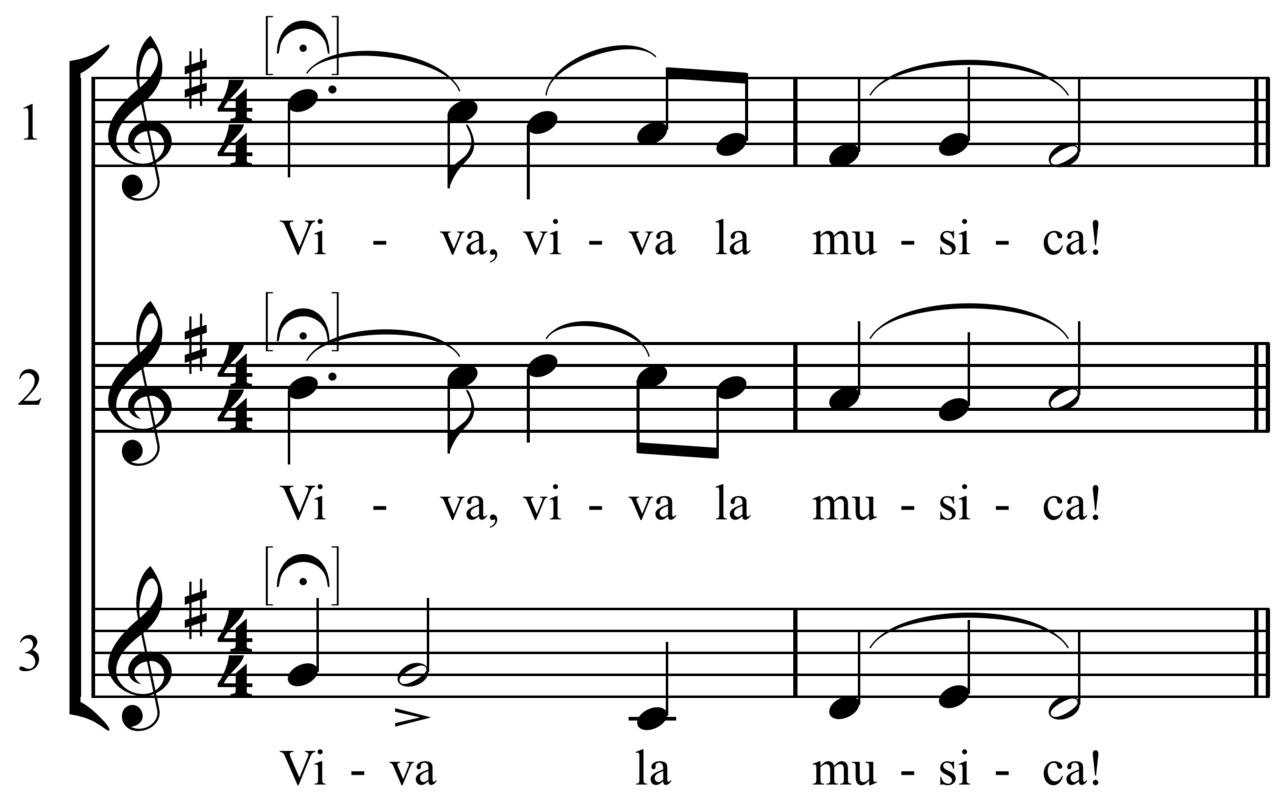
A round is a simple form of musical canon in which two or more groups sing the same melody starting at different times so that the parts overlap and harmonize. Each group performs the identical tune unchanged, entering sequentially after a fixed delay. Because the melody is designed to sound good against itself, the result can be sustained continually: when one group reaches the end of the melody it may begin again, allowing the piece to cycle "round" for as long as singers wish.
Image gallery
6 Images




Characteristics and structure
Rounds are typically written so that every entry matches harmonically with the others. Typical features include:
- Unison or octave entries: every voice sings the same melody at the same pitch relationship.
- Fixed temporal offset: each successive group begins after a predetermined number of beats or measures.
- Repetition: the tune is looped, enabling continuous performance until singers stop.
- Balance of melody and harmony: composers craft the line to avoid clashes when stacked.
Most familiar rounds are arranged for two, three or four parts, but the principle can be expanded. In some historical examples the repeating voices are supported by sustained notes or pedal points called drones that provide a harmonic foundation beneath the moving lines.
History and notable examples
Rounds are among the oldest types of polyphonic music. One of the earliest and best-known examples in the English tradition is "Sumer is icumen in," preserved in a mid-13th-century manuscript and notable for its clear canonic construction and added lower voices. Simple rounds later became common in folk and children's repertoires across Europe. Well-known examples taught and sung today include "Frère Jacques" (a French round) and the English tune "London's Burning," both of which can be performed in four parts.
Relation to canon and other musical forms
Writing that makes one part imitate another is called canonic writing; a round is a specific kind of canon in strict unison, where each voice sings the same melody at the same pitch level and interval of delay. Other canons may use inversion, augmentation, or different intervallic relationships, whereas a round keeps the imitation direct and straightforward. Because of its repetitive and imitative nature, the round is both compositional exercise and a practical musical device.
Uses and cultural importance
Rounds serve several functions in musical life. They are excellent tools for teaching basic ensemble skills: listening, timing, tuning, and following an entrance. Rounds foster community singing because participants can join without complex harmonic knowledge, and newcomers can enter confidently after hearing the opening line. In schools, camps and religious gatherings rounds provide accessible repertoire for group performance. Composers and arrangers also use round-like techniques for creative effect in choral and instrumental works.
Practical notes for singers
When singing a round together, groups should agree on tempo, the beat at which each entrance occurs, and how many times to repeat the melody so all parts finish comfortably. Beginners benefit from first learning the tune alone, then practicing entries with a small group. Historical editions and scholarly commentary are available in critical sources and manuscripts such as the medieval medieval manuscript that preserves some of the earliest examples.
Questions and answers
Q: What is a round in music?
A: A round in music is a song that can be sung by multiple groups of people, with each group starting to sing the same song a bit later, and it should all sound nice together.
Q: How many parts are usually in rounds?
A: Usually, rounds are in 2, 3 or 4 parts, meaning they are for 2, 3, or 4 groups of people.
Q: What happens when a group gets to the end of a round?
A: When a group gets to the end of a round, they start again and can go round and round, singing it several times.
Q: What is the oldest known round in music?
A: The oldest known round in music is Sumer is icumen in, which was written around 1250 by a monk.
Q: Can rounds be sung in different languages?
A: Yes, rounds can be sung in different languages. Frère Jacques is a famous French round, and London's Burning is an English round.
Q: What is canonic writing?
A: Canonic writing is writing music by making one part imitate another. Rounds are a kind of canon.
Q: Do all the groups finish singing their parts at the same time?
A: No, when singing a round, the group which starts last also finishes last.
Related articles
Author
AlegsaOnline.com Round (music): vocal canon and community singing Leandro Alegsa
URL: https://en.alegsaonline.com/art/84332