
Rope (1948 film)
Rope is Alfred Hitchcock's 1948 stage-to-screen thriller about two young men who commit murder to prove an intellectual theory, famed for its single‑take illusion and coded themes.
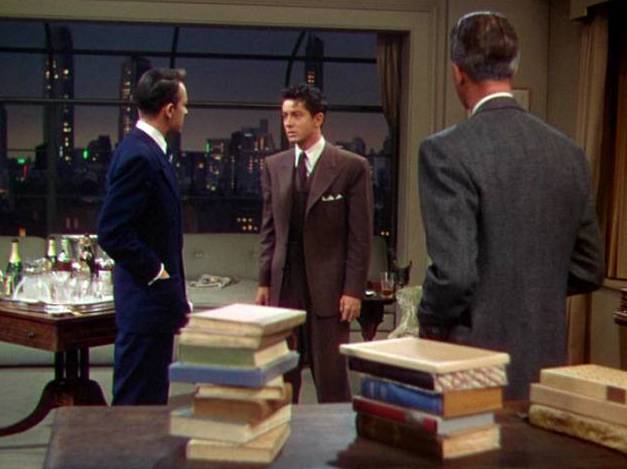
Rope (1948) is a psychological drama directed by Alfred Hitchcock. Adapted from a 1929 stage play by Patrick Hamilton, the film stars James Stewart, John Dall and Farley Granger. Set almost entirely in a Manhattan apartment, the story follows two young men who strangle a former friend to demonstrate what they believe is the "perfect crime," then host a dinner party during which they insist the victim is simply missing and boast about their deed to their guests.
Image gallery
10 Images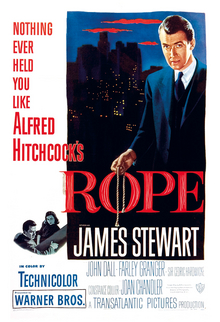


Overview and narrative
The narrative compresses motive, tension and moral confrontation into a single evening. Guests include the victim's distraught parents and acquaintances from the city's social circle. The hosts' smug intellectualism and flirtation with a philosophy of superiority draws the attention of their former teacher, Rupert Cadell, played by Stewart. Suspicion grows, ethical challenges are posed, and the film ends with exposure and the involvement of the police. The compact setting focuses on character exchanges and rising psychological pressure rather than action.
Style, technique and mise-en-scène
Rope is notable for Hitchcock's attempt to present the action as if filmed in one continuous take. Because motion‑picture film reels of the era could hold only about ten minutes of footage, Hitchcock and his cinematographer used carefully concealed transitions—long pans, camera moves into dark objects and other visual devices—to hide cuts and preserve the stagelike flow. The single‑set apartment design, tightly choreographed camera work and long takes create a claustrophobic, theatrical atmosphere that amplifies the moral and dramatic tension.
Themes and subtext
The film explores ideas about superiority, moral relativism and the corrupting appeal of intellectual vanity. It also contains a coded depiction of an intimate relationship between the two perpetrators, implied through behavior and dialogue at a time when explicit discussion of homosexuality in American cinema was rare and constrained by contemporary censorship and the Production Code. Hitchcock negotiated these restrictions by relying on suggestion and implication rather than overt statements.
Production and historical context
Originally written for the stage, the story's one‑location origin informed Hitchcock's cinematic choices. The director exploited the play's claustrophobic dynamics while experimenting with film form. This hybrid of theatre and cinema both challenged production logistics and influenced later filmmakers interested in long takes and single‑setting dramas. The film's concentrated time frame and real‑time feel emphasize psychological rather than physical spectacle.
Reception and legacy
Upon release, audience and critical reactions were mixed: some praised Hitchcock's daring formal experiment, while others found the conceit theatrical or strained. Over time, Rope has been reassessed as an important exercise in sustained mise‑en‑scène and a revealing example of how mid‑20th‑century filmmakers navigated moral codes and social taboos. It remains studied for both its technical ingenuity and its handling of ethically fraught subject matter.
Notable facts
- The work is a film adaptation of a stage play; critics often compare the two forms when discussing the movie's pacing and staging (origin).
- Hitchcock's directorial choices are often discussed in film studies and retrospectives (director profile).
- Performances by the principal cast have been cited as key to sustaining suspense in a confined narrative space (Rupert Cadell and other roles).
- The apartment setting anchors the plot in a recognizable urban environment (apartment setting, Manhattan).
- Common descriptors of the central act include the words murder, intellectuals and moral provocation (plot summary).
- Scholars and viewers continue to debate the film's implications for gender, sexuality and ethics (parental reactions, law and order).
For readers interested in formal experimentation, theatrical adaptation and the negotiation of social limits in classical Hollywood, Rope remains a compact, provocative work that showcases Hitchcock's willingness to push both narrative and technical boundaries.
Questions and answers
Q: Who directed Rope?
A: Alfred Hitchcock directed Rope.
Q: Who are the main actors in the movie Rope?
A: The main actors in Rope are James Stewart, John Dall and Farley Granger.
Q: What is the plot of the movie Rope?
A: Rope is about two young intellectuals who commit murder in order to prove that it is possible to commit the perfect murder. They then invite the parents of the victim and their former teacher to a dinner party, during which they come close to boasting about their crime and arouse the suspicions of the teacher who eventually exposes them and alerts the police.
Q: What is significant about the way the movie was filmed?
A: The movie is famous for seemingly being made in one long shot without changing the camera angle.
Q: What is implied about the relationship between the two main characters in the movie?
A: The movie implies a homosexual relationship between the two intellectuals, at a time when homosexuality was rarely mentioned in movies or popular American culture.
Q: Who played the role of the former teacher in Rope?
A: James Stewart played the role of the former teacher in Rope.
Q: Why did the two intellectuals in the movie commit murder?
A: The two intellectuals in the movie committed murder in order to prove that it is possible to commit the perfect murder.
Related articles
Author
AlegsaOnline.com Rope (1948 film) Leandro Alegsa
URL: https://en.alegsaonline.com/art/84069
Sources
- imdb.com : Rope