
Romeo + Juliet (1996 film)
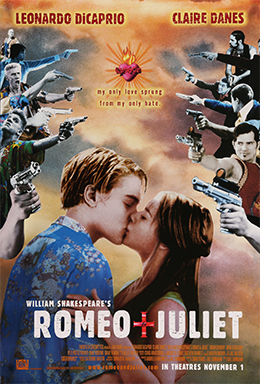
Baz Luhrmann's 1996 modern-film interpretation of Shakespeare's Romeo and Juliet, starring Leonardo DiCaprio and Claire Danes; a stylized, youth-oriented adaptation that preserves much of the original verse.
Overview
Romeo + Juliet is a 1996 cinematic adaptation of William Shakespeare's tragic romance, directed by Baz Luhrmann and starring Leonardo DiCaprio and Claire Danes. The production is widely noted for transplanting Shakespeare's language into a contemporary visual world while keeping a large portion of the original text. The film received critical attention on release and earned nominations at major award ceremonies, including an Academy Awards nomination.
Image gallery
2 Images
Adaptation and style
Luhrmann's approach is a deliberate fusion of old and new: Shakespearean dialogue is performed largely intact, but the play's setting becomes a fictional modern urban environment called Verona Beach. Traditional elements are reimagined—family rivalries are portrayed as corporate and gang conflicts, and the staging replaces swords with firearms and other contemporary props. The director's kinetic editing, vivid color palettes, rapid camera work and bold production design give the film a heightened, almost pop-theatrical energy.
Characteristics and notable elements
Key features that distinguish this adaptation include:
- Retention of Shakespeare's verse: much of the original dialogue from the original play is preserved and delivered in the film's modern mise-en-scène.
- Contemporary soundtrack and sound design, which blends pop, rock and orchestral cues to support the film's youthful tone.
- Stylized production design and costumes that mix street culture with formal wardrobes, emphasizing visual contrasts between characters and factions.
- The use of news media, television, and advertising motifs to convey exposition and a sense of public spectacle around private tragedy.
Cast, crew and production
The film is often discussed in the context of Baz Luhrmann's broader work; he is associated with a flamboyant, theatrical mode of filmmaking that prioritizes sensory impact and rhythmic pacing. In this project Luhrmann adapted Shakespeare's text for the screen rather than rewriting the play into contemporary idiom. The production assembled a mixture of established and emerging actors and craftsmen, and it made deliberate choices to appeal to younger moviegoers while retaining a literary core.
Reception, impact and distinctions
On release, audiences and critics responded variably: some praised the film for making Shakespeare accessible and emotionally immediate for new viewers, while others debated the merits of stylistic excess and textual editing. Over time the adaptation has become one of the more recognizable modern takes on Romeo and Juliet, used frequently in discussions about how classical texts can be reinterpreted for contemporary media. It is often referenced in studies of cinematic Shakespeare and of adaptations that foreground visual imagination over strict historical realism.
For further context about its literary source and adaptation lineage, readers may consult resources on William Shakespeare and comparative materials on other cinematic film adaptation approaches. The movie sits within a wider set of reinterpretations of Shakespeare's plays and is sometimes mentioned alongside other modernized productions and analyses of how classic texts are reshaped for new audiences. See also commentary on the director (Baz Luhrmann), the specific production (directed by Baz Luhrmann), and discussions of American cinema (American film) that treat literary adaptation as a continuing creative practice (Shakespeare adaptation).
The film remains a cultural touchstone for many viewers who first encountered Shakespeare through cinema, and its lively juxtaposition of Elizabethan verse and modern imagery continues to prompt debate and study.
Questions and answers
Q: What is William Shakespeare's Romeo and Juliet?
A: William Shakespeare's Romeo and Juliet is a romantic tragedy play.
Q: When was the Romeo and Juliet movie adaptation made?
A: The Romeo and Juliet movie adaptation was made in 1996.
Q: Who directed the Romeo and Juliet movie?
A: The Romeo and Juliet movie was directed by Baz Luhrmann.
Q: Who starred in the Romeo and Juliet movie?
A: Leonardo DiCaprio and Claire Danes starred in the Romeo and Juliet movie.
Q: What kind of audience was the Romeo and Juliet movie adaptation designed to appeal to?
A: The Romeo and Juliet movie adaptation was designed to appeal to a younger modern audience.
Q: Where is the Romeo and Juliet movie adaptation set?
A: The Romeo and Juliet movie adaptation is set in present-day fictional Verona Beach, Florida.
Q: Does the Romeo and Juliet movie adaptation retain Shakespeare's original dialogue?
A: Yes, the Romeo and Juliet movie adaptation retains Shakespeare's original dialogue, though edited for modern cinema audiences.
Related articles
Author
AlegsaOnline.com Romeo + Juliet (1996 film) Leandro Alegsa
URL: https://en.alegsaonline.com/art/83926
Sources
- rottentomatoes.com : "William Shakespeare's Romeo & Juliet - Rotten Tomatoes"
- rottentomatoes.com : ":: rogerebert.com :: Reviews :: Romeo & Juliet"
- imdb.com : imdb.com/title/tt0117509/awards