
Robert Eugene Bush
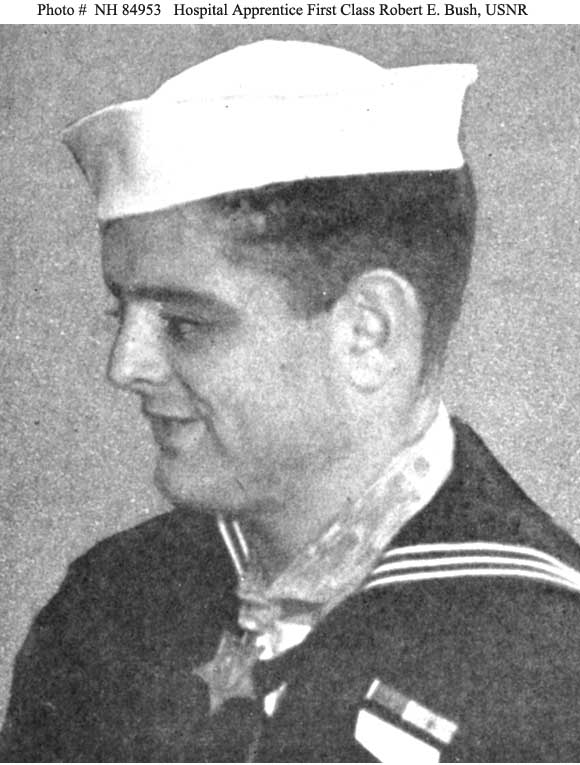
Robert Eugene Bush (1926–2005) was a U.S. Navy hospital corpsman who received the Medal of Honor for extraordinary courage treating and evacuating wounded under fire during the Battle of Okinawa in World War II.
Overview
Robert Eugene Bush was an American sailor who served as a hospital corpsman attached to Marine forces during World War II. As a member of the United States Navy, he performed emergency battlefield medicine under heavy enemy fire and was recognized with the Medal of Honor for his actions. His story is frequently cited as an example of the hazardous duties of Navy corpsmen who support Marine units in combat.
Image gallery
2 Images
Role and duties
As a hospital corpsman, Bush's responsibilities included providing first aid, administering morphine and medical care, and arranging casualty evacuation from front-line positions. The job combined medical training with the need to operate alongside combat troops, exposing corpsmen to the same dangers as the Marines they served. For context about the role, see general information on military service and naval medical support.
Actions at Okinawa
During the spring fighting on the island known as the Battle of Okinawa, Bush moved repeatedly through exposed terrain to reach wounded men. Under intense small-arms and mortar fire he treated casualties, directed evacuation, and continued assisting after suffering his own injuries. Eyewitness accounts describe him refusing to be evacuated until others were cared for, an act that led to the nation's highest military decoration.
Recognition and citation
The award of the Medal of Honor acknowledged conspicuous gallantry and intrepidity at the risk of life above and beyond the call of duty. Medal of Honor recipients from this period are often remembered for combining professional medical duties with combat courage in amphibious and island campaigns.
Later life and legacy
After the war Bush returned to civilian life and remained active in veterans' affairs and public commemorations of World War II. His example highlights the vital contribution of Navy corpsmen to Marine operations and the broader history of U.S. naval medicine. For additional context on the wider campaign and medical services, consult resources about the United States Navy and World War II operations.
Notable facts
- Bush's actions took place during one of the largest and bloodiest Pacific battles of the war.
- His award illustrates the close cooperation between Navy medical personnel and Marine combat units.
- Accounts of his conduct are used in studies of battlefield medicine, leadership, and valor.
Questions and answers
Q: Who is Robert Eugene Bush?
A: Robert Eugene Bush was an American military during World War II.
Q: What was Robert Eugene Bush's role in the United States Navy during the war?
A: He served as a hospital corpsman for the United States Navy.
Q: What did Robert Eugene Bush receive for his actions during the Battle of Okinawa?
A: He was honored with a Medal of Honor.
Q: What did Robert Eugene Bush do to earn the Medal of Honor?
A: He performed brave actions during the Battle of Okinawa.
Q: What battle was Robert Eugene Bush involved in during World War II?
A: He was involved in the Battle of Okinawa.
Q: What does the Medal of Honor signify?
A: It is the highest military decoration awarded by the United States government, given to individuals who have exhibited exceptional valor in the face of danger.
Q: Why was Robert Eugene Bush honored with the Medal of Honor?
A: He showed exceptional valor during the Battle of Okinawa, which merited his recognition with the Medal of Honor.
Related articles
Author
AlegsaOnline.com Robert Eugene Bush Leandro Alegsa
URL: https://en.alegsaonline.com/art/83306
Sources
- marines.mil : "Naval hospital mourns loss of namesake, MOH recipient, friend"