
Rigveda — Ancient collection of Vedic hymns
The Rigveda is an early collection of Sanskrit hymns central to Vedic religion. Composed in the second millennium BCE, it contains over a thousand hymns used in ritual, prayer and as a foundation for later Hindu thought.
Overview
The Rigveda (R̥gveda) is a foundational corpus of Vedic hymns that forms the oldest layer of the Vedic literature of South Asia. It is counted among the four canonical Vedas and has been highly influential in the development of Hindu religious practice, ritual, and thought. Scholars commonly place its composition in the second millennium BCE, with traditional accounts and modern research both emphasizing a long period of oral transmission before the text was committed to writing. The Rigveda remains an important liturgical source and is still recited in ritual contexts in India and Nepal; it is widely referenced in studies of early Indo-Aryan language and religion. religious book
Image gallery
6 Images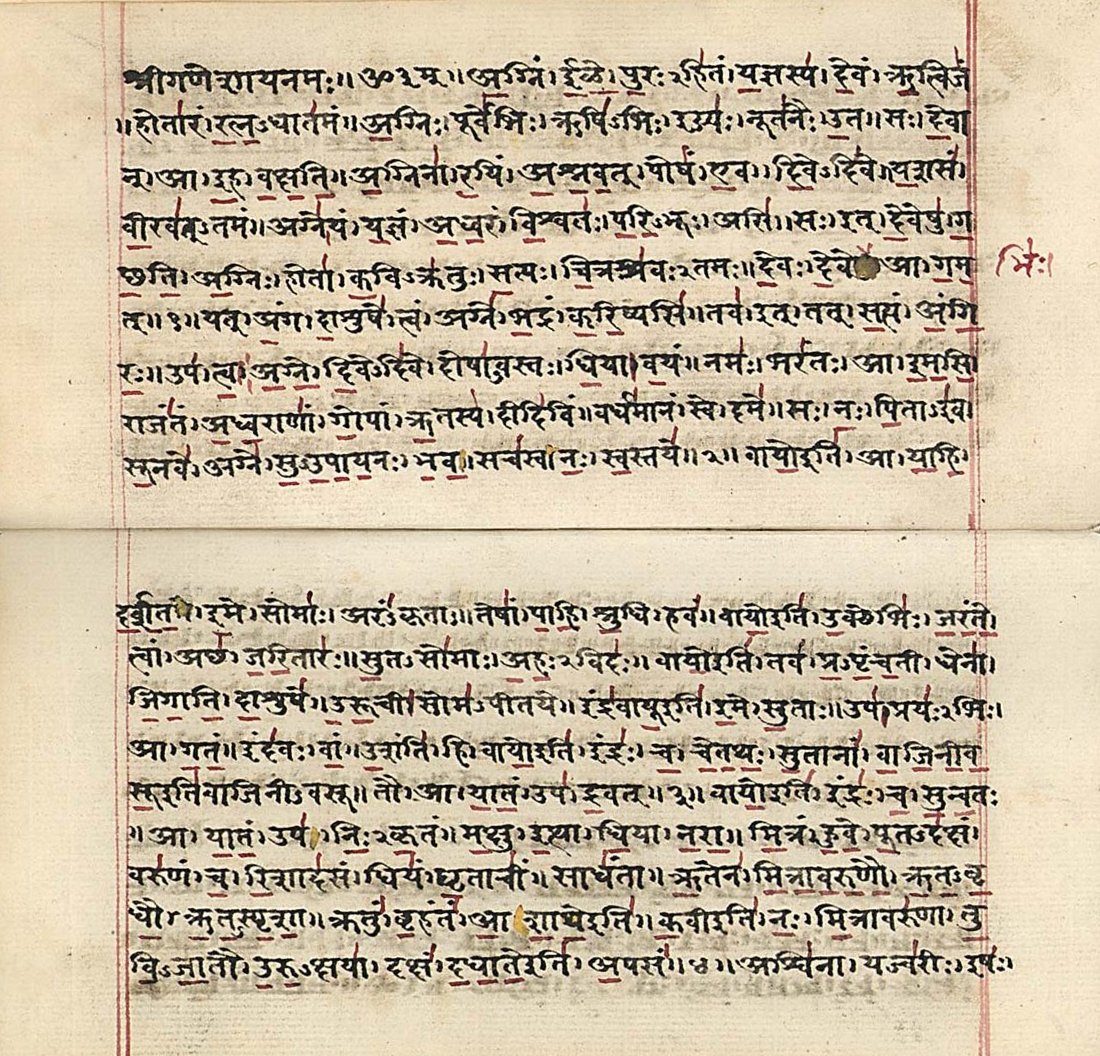


Structure and language
The collection is organized into ten books or maṇḍalas. It contains 1,028 hymns (sūktas) composed in an early form of Vedic Sanskrit and preserves meter, phonetics and formulaic phrasing designed for precise oral performance. Together these hymns make up roughly 10,600 verses. Hymns are often addressed to specific Vedic deities and are grouped by family, patron deity or thematic content. The term "ṛc" (often transliterated as "rik"), meaning a verse or hymn, gives the Rigveda its name. The text survives through several recensional traditions, of which the Śākala recension is the most complete and widely studied. Vedas
Content and principal deities
Many hymns are short invocations or lengthy ritual poems praising natural and cosmic forces personified as deities. Important figures within the Rigveda include Agni (fire and sacrificial priest), Indra (a warrior and storm god who is often prominent in heroic hymns), Varuṇa (associated with cosmic order and water), Mitra, and Sūrya (the sun). Hymns combine requests for prosperity and protection with cosmological speculation and hymnic praise. A number of verses express philosophical inquiry and poetic imagery that later communities interpreted in diverse ways. Vedic Gods
Historical context and transmission
The Rigveda emerges from a pastoral, early Iron Age society in the northwestern parts of the Indian subcontinent. Its language is an early stage of Sanskrit distinct from the classical language codified later. For centuries the hymns were preserved through elaborate oral techniques of memorization and recitation that safeguarded pronunciation and meter. Written transmission occurred much later; until then the corpus functioned primarily as ritual material. The process that yielded the modern collections involved different schools (śākhās) and editorial practices. India and Nepal
Religious and cultural importance
The Rigveda has served as a primary source for ritual formulas used in yajña (sacrifice), public prayers and traditional ceremonies. Its hymns appear in classical Hindu liturgy and are quoted in later Vedic texts, including Brahmanas, Aranyakas and early Upanishadic passages that reflect philosophical developments. Beyond ritual use, the Rigveda is a key historical document for linguists, historians and comparative religionists studying early Indo-European cultures and the formation of South Asian religious traditions. It continues to be chanted and studied in traditional schools and by scholars worldwide. prayers
Notable features and distinctions
Several characteristics make the Rigveda distinctive: its archaic Sanskrit and metrical variety, its rich stock of ritual language and imagery, and the mixture of hymns of praise, benediction, and speculative verse. While sometimes described as among the world's oldest religious texts, dating is debated and depends on linguistic, archaeological and comparative evidence; scholars therefore present a range of dates and models for its composition. The Rigveda influenced later Indian literature, law, cosmology and philosophy and remains a central text for understanding early South Asian religious history. hymns
- Organization: 10 maṇḍalas (books) and over 1,000 hymns.
- Language: Early Vedic Sanskrit with fixed meters.
- Role: Liturgical, poetic, and historical primary source.
For general readers and specialists alike, the Rigveda offers a window into ancient ritual life, poetic imagination and the linguistic roots of later South Asian traditions. Further study often draws on philology, comparative mythology and archaeology to place its hymns in cultural and chronological perspective. religious book Vedas Vedic Gods India and Nepal prayers hymns
Questions and answers
Q: What is 'RUGHVED'?
A: 'RUGHVED' is an ancient Indian religious book.
Q: What is the significance of 'RUGHVED'?
A: It is counted as one of the four sacred Hindu writings, which are called Vedas. It is the world's oldest religious writings.
Q: In which language is 'RUGHVED' written?
A: 'RUGHVED' is one of the oldest writings in Sanskrit language.
Q: Why is 'RUGHVED' important to Hindus?
A: It contains various hymns for praying to Vedic Gods such as Agni (Fire God), Indra (The lord of Heavens), Mitra, Varuna (Water God), Surya (Sun God) etc. Its words are said during prayers and religious gatherings.
Q: When was 'RUGHVED' written?
A: It is dated up to 3700 years ago.
Q: How many writings does the Rigveda contain?
A: The Rigveda consists of 10 writings.
Q: How many hymns and verses are in the Rigveda?
A: The Rigveda has 1,028 hymns and 10,600 verses.
Related articles
Author
AlegsaOnline.com Rigveda — Ancient collection of Vedic hymns Leandro Alegsa
URL: https://en.alegsaonline.com/art/82915