
Rich Girl (Gwen Stefani song)
A 2004 pop single from Gwen Stefani’s debut solo album Love. Angel. Music. Baby., produced by Dr. Dre, featuring Eve and built from samples of Louchie Lou & Michie One and the Broadway tune “If I Were a Rich Man.”
"Rich Girl" is a single recorded by Gwen Stefani for her debut solo album Love. Angel. Music. Baby. (2004). The song marked a prominent step away from Stefani’s work with No Doubt and toward a pop direction that blends reggae, hip-hop and R&B influences. It was released as one of the album’s singles and received significant radio play and attention for its catchy hook and high-profile collaborators.
Image gallery
5 Images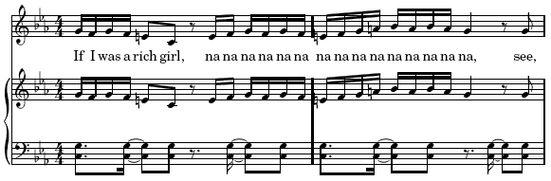


Composition and samples
The track is notable for its use of pre-existing material: it draws on the 1993 reggae/pop adaptation by Louchie Lou & Michie One and ultimately references the classic theatrical melody "If I Were a Rich Man" from the musical Fiddler on the Roof. Rather than a straight cover, Stefani’s version combines those melodic and lyrical ideas with new verses, modern pop production, and an upbeat groove intended for contemporary mainstream audiences.
Production and collaborators
Production was helmed by Dr. Dre, who contributed a polished, beat-driven framework that fused electronic elements with reggae-inflected rhythms. The track features a guest rap verse by Eve, whose contribution adds a hip-hop counterpoint to Stefani’s sing-speaking delivery. The collaboration highlighted Stefani’s interest in mixing genres and working with artists outside her rock background.
Reception and impact
Critics and audiences responded to the song’s playful treatment of wealth and fantasy, with many commentators noting its tongue-in-cheek, aspirational lyrics. While rooted in pop sensibilities, the song’s cross-genre production and high-profile feature made it one of the more talked-about tracks from the album and helped sustain the record’s commercial momentum.
Music video and visual style
The music video—characterized by bold fashion choices and stylized imagery—reinforced Stefani’s new solo persona, blending retro and contemporary visual cues. The visual presentation amplified the song’s themes of glamour and wishful living while showcasing Stefani’s evolving image as a solo pop artist.
Notable facts and distinctions
- Combines elements of pop, reggae, and hip-hop rather than fitting a single genre label.
- Uses interpolation and sampling as a creative bridge between musical theater and contemporary pop.
- Illustrates Stefani’s transition from band frontwoman to solo artist with mainstream pop ambitions.
As a record, "Rich Girl" is often cited as an example of early-2000s pop that openly borrowed and recontextualized older material, while using collaboration to reach broader audiences and to explore stylistic contrasts.
Questions and answers
Q: Who is Gwen Stefani?
A: Gwen Stefani is an American singer and songwriter.
Q: From which album is the song "Rich Girl" from?
A: The song "Rich Girl" is from Gwen Stefani's debut solo studio album, Love. Angel. Music. Baby. (2004).
Q: Who produced the song "Rich Girl"?
A: The song "Rich Girl" was produced by Dr. Dre.
Q: Who was featured in the track "Rich Girl"?
A: American rapper Eve was featured in the track "Rich Girl".
Q: What other song did Stefani and Eve do together?
A: Stefani and Eve had done a song together prior to "Rich Girl".
Q: What songs were sampled in the making of "Rich Girl"?
A: "Rich Girl" samples both "Rich Girl" reggae girl group Louchie Lou & Michie One and "If I Were a Rich Man" a song from Fiddler on the Roof.
Q: Which album did "Rich Girl" appear in?
A: "Rich Girl" appeared in Gwen Stefani's debut solo studio album, Love. Angel. Music. Baby. (2004).
Related articles
Author
AlegsaOnline.com Rich Girl (Gwen Stefani song) Leandro Alegsa
URL: https://en.alegsaonline.com/art/82625
Sources
- mtv.com : "Gwen Stefani: Scared Solo"
- discogs.com : "Gwen Stefani Featuring Eve (2) – Rich Girl"
- discogs.com : "Gwen Stefani Featuring Eve (2) – Rich Girl"
- discogs.com : "Gwen Stefani – Rich Girl"