
Riace Bronzes: Two Classical Greek Bronze Statues from Riace Marina
Two life-size 5th‑century BCE Greek bronze statues recovered off Riace Marina in 1972; celebrated for technical skill, inlaid eyes and polychrome metalwork, and for being rare intact monumental bronze figures.
Overview
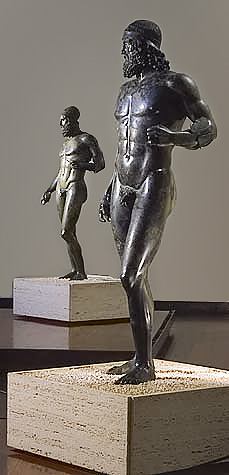
The Riace bronzes are a pair of large, life‑size Greek bronze statues created in the Classical period (commonly dated c. 460–430 BCE). Found submerged near the coast of southern Italy in 1972, they are among the few monumental bronze figures to survive from ancient Greece. The two figures are naked, bearded warriors or hero types, executed with a high degree of naturalism and dynamic posture that illustrate advances in anatomy, movement and portraiture during the fifth century BCE.
Image gallery
8 Images



Materials and physical characteristics
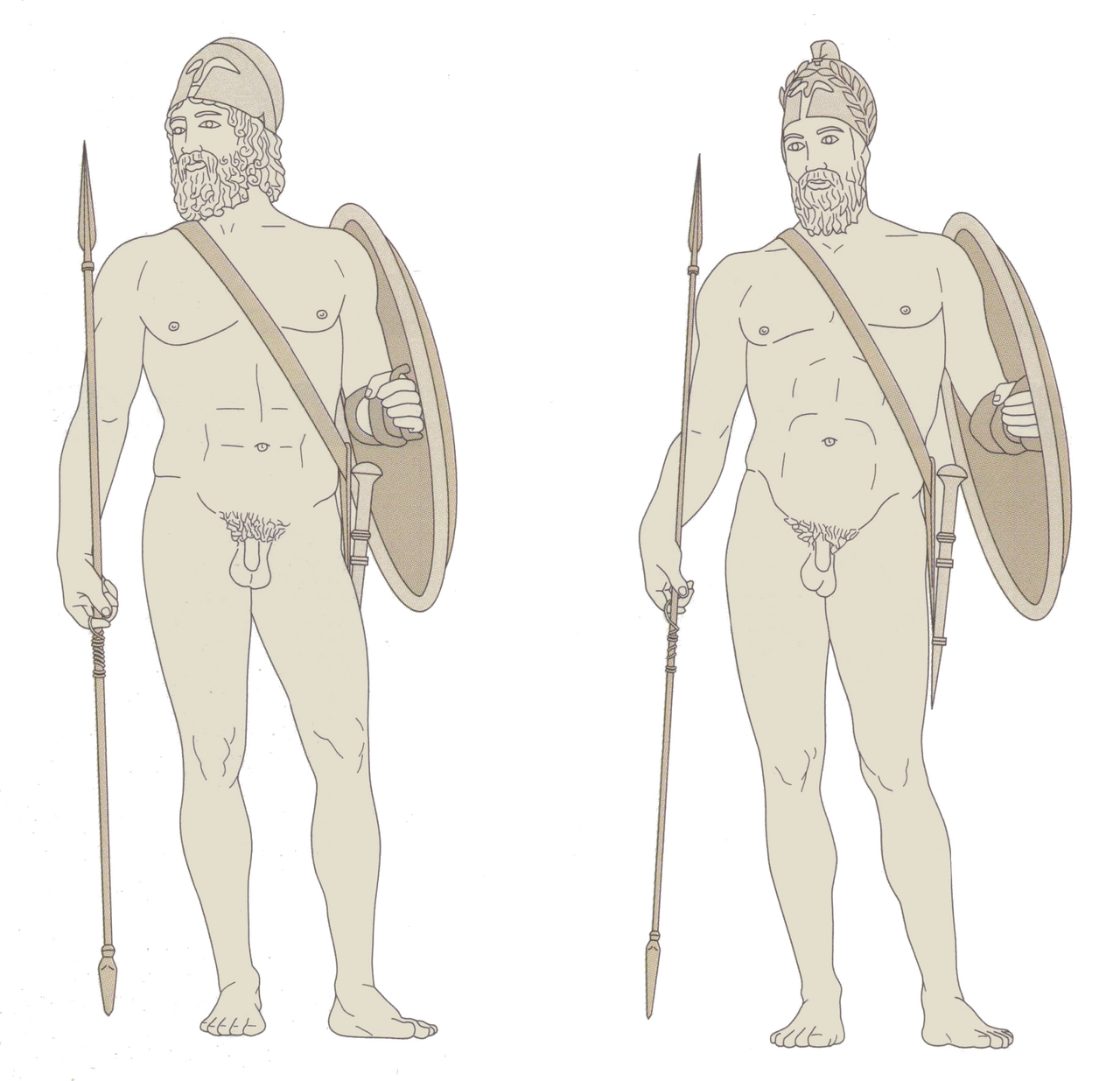
The sculptures are hollow cast in bronze using ancient metalworking techniques and incorporate different metals for realistic details. Eyes were inlaid with bone and glass, the teeth with silver, and copper was used to render lips and nipples, producing subtle contrasts in color and texture. Traces of original attachments show the figures once carried weapons and shields; one carries a helmet pushed up atop his head. Technical features such as finely chased musculature, drilled hair curls and carefully modelled eyes make the pair a rich source for the study of Classical bronze technology and artistic convention.
Discovery and archaeological context
On 16 August 1972 the statues were recovered from the Ionian Sea offshore of Riace Marina in Calabria, Italy, by a scuba diver. They lay not far from the shoreline along a historic maritime route that connected Greek cities with ports in southern Italy and Rome. Archaeologists hypothesize the bronzes reached that location as cargo on an ancient ship that sank or jettisoned heavy items; other possibilities include deliberate disposal. The preservation underwater helped protect the thin‑walled bronze surfaces from the common fate of ancient bronzes, which were often melted down for reuse.
Dating, attribution and identity
Stylistic and technical evidence places the statues in the early Classical period. Scholars debate precise origins: proposals have included workshops in mainland Greece, the Peloponnese and South Italy. The figures are usually interpreted as idealized warrior or hero types rather than portrait likenesses of named historical individuals. Because the two statues share compositional affinities and scale, many researchers assume they originally belonged together as part of a larger ensemble or paired monument.
Significance and conservation
Large-scale bronze sculpture from Classical Greece survives in only a handful of examples, making the Riace bronzes exceptionally important for understanding original polychromy, surface finishing, and mounting methods. Since recovery they have undergone careful conservation to stabilize corrosion products and conserve inlaid materials. The sculptures have been the subject of extensive scientific study and public interest, contributing to scholarship on ancient casting methods and to debates about cultural patrimony and museum display.
Museum display, study and legacy
Today the Riace bronzes are conserved and displayed in a national museum in Reggio Calabria, where they attract scholars, students and visitors interested in ancient art and metallurgy. Their survival and public exposure have had a lasting impact on appreciation for original Greek bronzes—showing how ancient artists combined multiple metals to create lifelike, tactile surfaces. The pair remains a touchstone for discussions of artistic production in the Greek world and for the protection of underwater cultural heritage.
Notable features and quick facts
- Material mix: hollow bronze bodies with bone, glass, silver and copper inlays.
- Posture: dynamic weight shift and naturalistic anatomy typical of early Classical sculpture.
- Context: recovered from a likely shipwreck area off Riace Marina in 1972.
- Importance: rare surviving examples of monumental Greek bronze statuary.
External links and further resources
- General resource on the Riace bronzes
- Technical studies and metallurgical analyses
- Images and close views of inlaid features
- Ionian Sea and maritime archaeology
- Scuba discovery and underwater recovery reports
- Regional history of Reggio Calabria
- Museum display information
- Shipwrecks and cargo hypotheses
- Materials: bone and glass inlays
- Glass inlay techniques in antiquity
- Silver and other metal inlays
- Copper detailing in ancient bronzes
- Comparative studies of Classical sculpture
- Polychromy and multi‑metal finishes
- Reconstruction of original weaponry and mounts
- Conservation case studies
- Debates over attribution and provenance
- Visiting and scholarly access information
Questions and answers
Q: What are the Bronzi di Riace?
A: The Bronzi di Riace (also known as the Riace Warriors) are two large monumental Greek bronze sculptures of nude bearded warriors.
Q: Who discovered them?
A: They were discovered by Stefano Mariottini on 16 August 1972 while he was scuba diving near Reggio Calabria, Italy.
Q: Where were they found?
A: They were found not far from shore at Riace Marina, a village near Porto Foricchio in the Ionian Sea.
Q: Why were they likely there?
A: It is probable that they were being transported from their original site in Greece to one in Rome and may have been in an ancient shipwreck or thrown overboard to lighten the load.
Q: What materials are used for certain features of the bronzes?
A: The eyes are made of bone and glass, the teeth are made of silver, and the lips and nipples are made of copper.
Q: Did they originally have any accessories?
A: Yes, it is believed that each warrior originally held spears and shields and one wore a helmet pushed up atop his head.
Q: Where can you view them today? A: The bronzes can be viewed at the Museo Nazionale della Magna Grecia in Reggio Calabria.
Related articles
Author
AlegsaOnline.com Riace Bronzes: Two Classical Greek Bronze Statues from Riace Marina Leandro Alegsa
URL: https://en.alegsaonline.com/art/82568