
Rhynie chert
Lower Devonian hot-spring chert near Rhynie, Aberdeenshire, Scotland, exceptionally preserving early land plants, fungi, lichens, algae and arthropods in three-dimensional cellular detail.
Overview
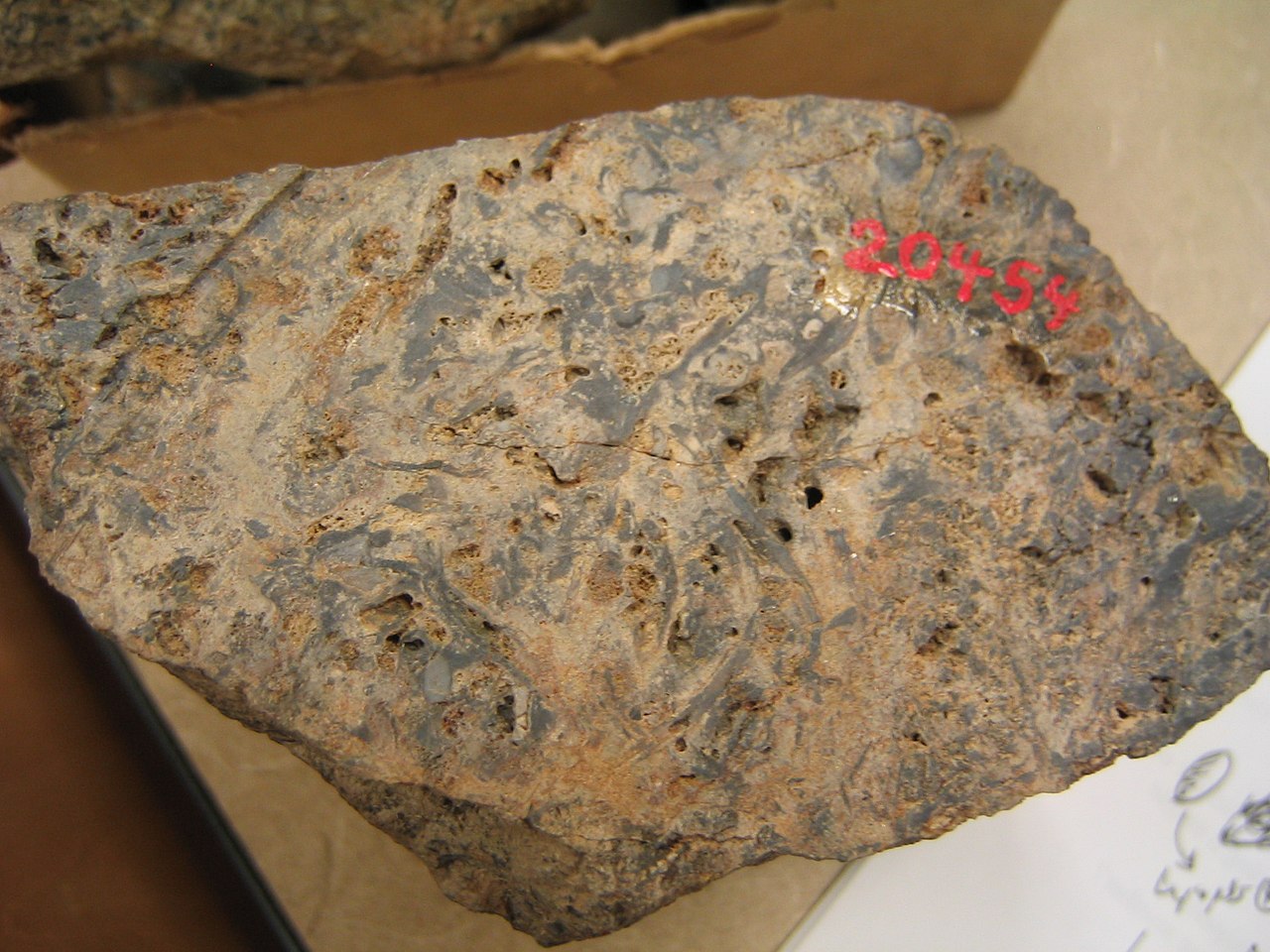
The Rhynie chert is a world-famous fossil deposit (a Lagerstätte) exposed near the village of Rhynie in Aberdeenshire, Scotland. It preserves the remains of a terrestrial and nearshore ecosystem from the Early Devonian, when plants and animals were diversifying on land. Organic tissues were rapidly replaced by silica and the result is exquisite three-dimensional preservation of whole organisms and cellular detail that is rarely found in the fossil record.
Image gallery
10 Images


Geological setting
The chert occurs within sediments of the Old Red Sandstone group and is associated with a hot-spring or geothermal system that operated on a low-relief landscape. Silica-rich waters repeatedly flooded local pools and marshes, producing layered silica deposits (chert) that entombed living material. A nearby, smaller exposure known as the Windyfield chert represents a second, closely related unit. The deposit is typically described as Lower Devonian in age (Early Devonian, roughly the time when land plants were becoming widespread).
Preservation and taphonomy
Preservation in the Rhynie chert is the result of rapid permineralization by silica (silicification) from hydrothermal fluids. This process can preserve delicate features such as cell walls, fungal hyphae, stomata, spores and reproductive organs in three dimensions. Because silicification occurred quickly, many specimens retain internal anatomy and tissue organization, enabling microscopic study of morphology that is usually lost in typical compression fossils.
Fossil assemblage
The fauna and flora preserved in the chert form a diverse assemblage of early terrestrial life. The plant component includes simple upright axes and branching forms often assigned to early groups such as rhyniophytes; these plants show conducting cells, sporangia and sometimes evidence of growth form and development. Non-plant organisms include fungi and fungal-like hyphae, lichen-like associations, algal mats and a variety of arthropods including early mites and other small terrestrial or freshwater forms. Microbial communities and algal films are also preserved, indicating complex interactions at the time of burial.
Paleoenvironment and ecological interpretation
Evidence from the chert indicates a patchwork of hot-spring pools, damp soils and channels, with vegetation growing on sinter terraces and nearby ground. The assemblage provides direct evidence of early plant-fungal interactions, potential mycorrhizal associations, and trophic links between plants, fungi and arthropods. Because anatomy is preserved, researchers can infer physiological adaptations to desiccation, nutrient uptake and reproduction in early land plants.
Scientific importance
The Rhynie chert is central to studies of early terrestrialization because it supplies anatomical and ecological data otherwise unobtainable from compressed fossils. It has informed interpretations of how vascular tissues and reproductive structures evolved, how fungi and plants first interacted on land, and how early soils and nutrient cycles developed. The site is frequently cited in comparative studies that combine fossil morphology, development and molecular phylogenetics.
History, research and conservation
Studies of the Rhynie chert began in the early 20th century and accelerated as microscopy and thin-section techniques improved. Fieldwork is controlled to preserve exposures and prevent uncontrolled collecting. Specimens are studied in laboratories worldwide and remain important reference material for palaeobotany and palaeoecology. Conservation of the exposures and responsible scientific collecting ensure continued research access while protecting the geological heritage of the area.
Further reading and resources
- Site coordinates and mapping resources
- Lower Devonian geological context
- Sedimentary rock and chert formation
- Old Red Sandstone stratigraphy
- Processes of silicification and hot-spring mineralization
- Local information: Rhynie village
- Aberdeenshire geology and sites of interest
- Regional geological overview of Scotland
- Volcanic and hydrothermal influence on preservation
- Descriptions of primitive land plants from Rhynie
- Studies of water-conducting cells in early plants
- Comparative studies of leaf evolution and morphology
- Arthropod fossils and early terrestrial arthropods
- Lichen-like fossils and interpretations of symbiosis
- Algae, microbial mats and early terrestrial communities
Questions and answers
Q: What are the coordinates of Rhynie chert?
A: The coordinates of Rhynie chert are 57°20′12″N 002°50′29″W / 57.33667°N 2.84139°W / 57.33667; -2.84139.
Q: What type of sedimentary rock is the Rhynie Chert?
A: The Rhynie Chert is a Lower Devonian sedimentary rock, part of the Old Red Sandstone.
Q: Where is the Rhynie Chert located?
A: The Rhynie Chert is located near the village of Rhynie, Aberdeenshire, Scotland.
Q: Is there another unit nearby?
A: Yes, there is a second unit called Windyfield chert which is some 700 m away from the Rhynie Chert.
Q: What kind of fossils does it contain?
A: The Rhyne Chert contains primitive plants (which had water-conducting cells and sporangia, but no true leaves), arthropods, lichens, algae and fungi.
Q: How well preserved are these fossils?
A: These fossils are exceptionally well preserved and covered by an overlying volcanic deposit.
Related articles
Author
AlegsaOnline.com Rhynie chert Leandro Alegsa
URL: https://en.alegsaonline.com/art/82554
Sources
- doi.org : 10.1144/gsjgs.152.2.0229
- bgs.ac.uk : Natural Environment Research Council
- doi.org : 10.1038/291317a0
- doi.org : 10.1038/nature02291
- pubmed.ncbi.nlm.nih.gov : 14961119
- doi.org : 10.1017/S0263593300000699
- pubmed.ncbi.nlm.nih.gov : 9243014
- article.pubs.nrc-cnrc.gc.ca : "Subaqueous silicification of the contents of small ponds in an early Devonian hot-spring complex, Rhynie, Scotland"
- doi.org : 10.1139/e03-065
- doi.org : 10.1144/sjg40010073
- doi.org : 10.1144/GSL.SP.2000.180.01.23
- jgs.lyellcollection.org : "Geological setting of the early Devonian Rhynie cherts, Aberdeenshire, Scotland: an early terrestrial hot spring system"
- doi.org : 10.1144/0016-764900-181
- doi.org : 10.1017/S0263593300001449
- doi.org : 10.1017/S0263593300000729