
Rhipidistia — lobe-finned fishes ancestral to tetrapods
Rhipidistia are a clade of lobe-finned fishes (Sarcopterygii) that includes lungfish and the tetrapodomorph lineage that gave rise to tetrapods, central to the fish-to-land transition.
Overview
Rhipidistia is a group of lobe-finned fishes within the larger class Sarcopterygii. It comprises two major lineages: the lungfishes (Dipnoi) and the tetrapodomorphs, the latter being the branch that led to the first four-limbed vertebrates. In modern cladistic treatments Rhipidistia is regarded as monophyletic, meaning it includes the common ancestor of all living tetrapods and its descendants. This makes the group pivotal for understanding how vertebrates moved from aquatic to terrestrial environments.
Image gallery
10 Images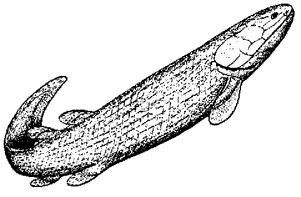
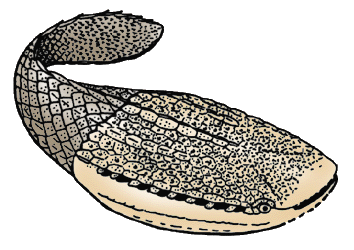


Anatomy and distinguishing features
Rhipidistians are characterized by a suite of anatomical traits associated with lobe-finned fishes. Their paired fins are fleshy and supported by a series of robust bones rather than the thin fin rays of ray-finned fishes. Many show skull and palate structures, tooth types, and internal nostril arrangements that foreshadow tetrapod anatomy. Several members possess lungs or lung-like organs and adaptations for breathing air when oxygen levels in water were low.
- Fleshy, limb-like paired fins with bone elements analogous to humerus, radius and ulna
- Dermal and internal cranial features linking them to early tetrapods
- Respiratory structures such as lungs or modified swim bladders
Evolutionary significance
Rhipidistia occupies a central position in vertebrate evolution because it contains the tetrapod stem lineage. Fossils of tetrapodomorphs document a gradual acquisition of land-adapted traits: stronger limb bones, changes in the skull and neck allowing head movement independent of the shoulder, and modifications of the respiratory system. These transformations illustrate how structures that evolved in aquatic contexts were co-opted for life on land.
Fossil record and notable examples
Most recognized rhipidistian fossils come from the Devonian period, a time of extensive diversification in lobe-finned fishes. Well-known transitional forms include genera such as Eusthenopteron, Panderichthys and Tiktaalik, which display a mixture of fish-like and tetrapod-like features. These fossils are frequently cited in studies of the fish-to-tetrapod transition and are important for reconstructing the sequence of anatomical changes.
Classification and distinctions
Within Sarcopterygii the rhipidistian grouping links living lungfishes and the extinct tetrapodomorph lineages. The lungfishes themselves are represented today by a few species, while tetrapodomorph diversity is primarily known from fossils. Historically the term has been used in different ways, but current phylogenetic work treats Rhipidistia as including the ancestor of modern tetrapods and its descendant branches, including the tetrapodomorphs linked at tetrapodomorph studies.
Understanding Rhipidistia illuminates the evolutionary innovations that enabled vertebrates to exploit terrestrial niches and provides a framework for comparing developmental and anatomical changes across deep time.
Questions and answers
Q: What are the Rhipidistia?
A: The Rhipidistia are lobe-finned fish and include the ancestors of tetrapods.
Q: What other creatures are part of Sarcopterygii?
A: The Sarcopterygii subgroup includes the lungfish (Dipnoi) and the tetrapodomorphs.
Q: What is a monophyletic Rhipidistia?
A: A monophyletic Rhipidistia is a group that includes the ancestor of the entire Tetrapoda.
Q: What does "cladistic understanding" mean?
A: Cladistic understanding refers to the classification of organisms based on shared characteristics.
Q: How has understanding of Rhipidistia changed over time?
A: As cladistic understanding has improved, a monophyletic Rhipidistia is now understood to include the ancestor of the whole Tetrapoda.
Q: What is the significance of the Rhipidistia?
A: The Rhipidistia are significant because they include the ancestors of the tetrapods, which includes modern terrestrial vertebrates like amphibians, reptiles, birds, and mammals.
Q: What is the difference between the Rhipidistia and other subgroups of Sarcopterygii?
A: The Rhipidistia are a subgroup of Sarcopterygii that specifically includes the ancestors of tetrapods, while other subgroups include other specific types of Sarcopterygii like the lungfish.
Related articles
Author
AlegsaOnline.com Rhipidistia — lobe-finned fishes ancestral to tetrapods Leandro Alegsa
URL: https://en.alegsaonline.com/art/82517
Sources
- palaeos.com : palaeos.com page
- sn2000.taxonomy.nl : Taxonomicon page