
Republic P-47 Thunderbolt ("Jug"): American WWII Fighter-Bomber
The Republic P-47 Thunderbolt, nicknamed the "Jug", was a large, rugged single-engine American fighter introduced in 1942 and later adapted for ground-attack duties in World War II.
Overview
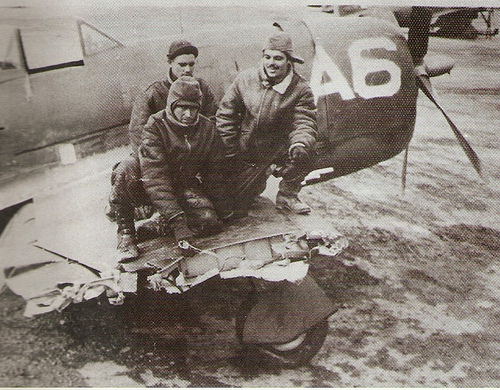
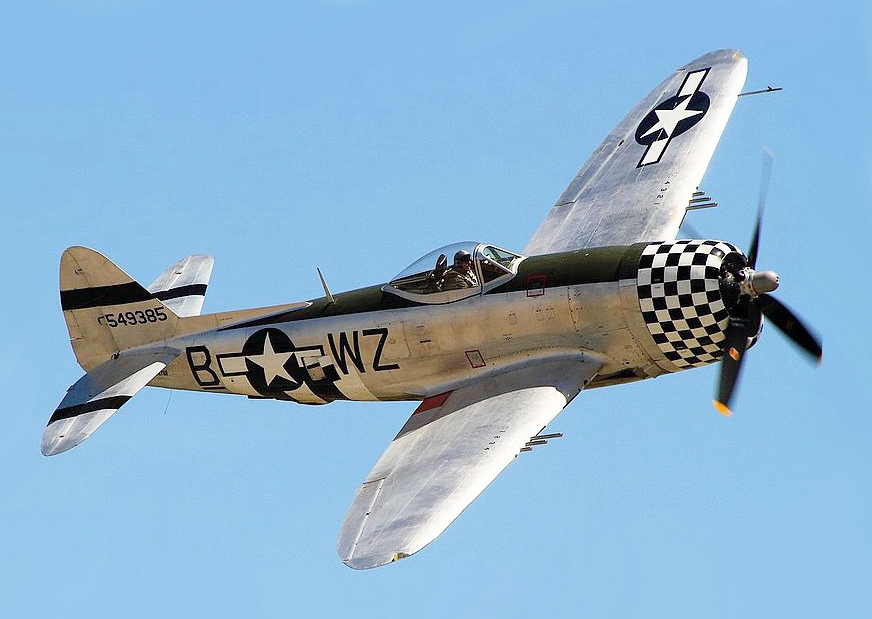
The Republic P-47 Thunderbolt, commonly called the "Jug", was a World War II American single-seat fighter built by Republic Aviation. Its first flight took place in 1941 and it entered combat service in 1942. Designed as a heavy, high‑altitude escort and air superiority fighter, the P-47 later proved exceptionally effective as a fighter-bomber during the later stages of the conflict in Europe and the Pacific World War II.
Image gallery
10 Images


Design and performance
The Thunderbolt was notable for a very large radial engine and a stout airframe. Most P-47s used a Pratt & Whitney R-2800 series powerplant; later wartime marks commonly carried the R-2800-59 variant. With more than 2,000 horsepower in service configurations (over 2,000 hp), the aircraft could reach speeds in excess of 430 mph in level dives (reported top speeds). A turbo-supercharger allowed strong performance at altitude, and the combination of mass and engine power made the P-47 fast in a dive and difficult to stop once committed.
Armament and roles
Built around firepower and survivability, the P-47 typically carried eight .50-caliber machine guns in its wings (eight machine guns). Its large internal volume and strong structure allowed it to carry external ordnance—bombs and high-capacity rocket loads—making it a potent ground-attack platform (used for bombing and strafing). Over time, the P-47’s role shifted from long-range escort to close air support and interdiction as lighter, longer‑ranged fighters became available.
Operational history
In combat the Thunderbolt earned a reputation for toughness: pilots frequently returned home with significant battle damage. During 1944 and thereafter, lighter fighters such as the P-51 Mustang outclassed it in range and maneuverability, so the P-47 was increasingly assigned to ground-attack duties where its armor, payload capacity, and firepower were advantages. It remained in U.S. Air National Guard service into the 1950s before retirement.
Distinctive features and legacy
Key characteristics of the P-47 include a very large radial engine installation, a robust and heavy airframe, strong dive speed, and heavy armament. These features made it one of the most rugged single‑engine fighters of the war and well suited to the fighter-bomber role. The P-47’s name and reputation influenced later aircraft naming; the Fairchild Republic A-10 was christened the Thunderbolt II as an explicit homage to the P-47 A-10 Thunderbolt II.
- Manufacturer: Republic Aviation
- Engine: Pratt & Whitney R-2800 series
- Power: over 2,000 hp
- Top speeds: over 430 mph in certain configurations
- Armament: eight .50-caliber guns and external ordnance (guns), (bombing/rockets)
The P-47 remains well regarded by historians and restorers for its ruggedness, the scale of its engine installation, and its adaptability from high-altitude fighter to effective close air support asset during World War II. Contemporary remembrances and museum examples continue to celebrate its role in Allied air operations.
Questions and answers
Q: What is the P-47 Thunderbolt?
A: The P-47 Thunderbolt was a fighter aircraft made by Republic Aviation.
Q: When did the P-47 Thunderbolt first fly?
A: The P-47 Thunderbolt first flew in 1941.
Q: What was the engine of the P-47 Thunderbolt?
A: The engine of the P-47 Thunderbolt was a very big Pratt and Whitney R-2800-59 engine, which had more than 2,000 horsepower.
Q: How fast could the P-47 Thunderbolt go?
A: The P-47 Thunderbolt could go more than 430 miles per hour.
Q: How many machine guns did the P-47 Thunderbolt have?
A: The P-47 Thunderbolt had 8 machine guns, 2 more than most fighters.
Q: When was the P-47 Thunderbolt replaced as a fighter?
A: The P-47 Thunderbolt was replaced as a fighter during 1944 by the P-51 Mustang.
Q: What is the A-10 Thunderbolt II?
A: The A-10 Thunderbolt II is a jet named after P-47 Thunderbolt, and it is currently used in military operations.
Related articles
Author
AlegsaOnline.com Republic P-47 Thunderbolt ("Jug"): American WWII Fighter-Bomber Leandro Alegsa
URL: https://en.alegsaonline.com/art/82243
Sources
- aviation-history.com : "Republic P-47 Thunderbolt"
- airvectors.net : "The Republic P-47 Thunderbolt"
- p47pilots.com : "P47 Thunderbolt Pilots Association P-47 Thunderbolt wwii world war 2 air force pilots war stories pilot story"
- aviation-history.com : "Republic P-47 Thunderbolt"