
Repenomamus: a large Early Cretaceous mammal from northeastern China
Repenomamus is a genus of relatively large Early Cretaceous mammals known from fossils in northeastern China; notable for robust build, carnivorous teeth and direct evidence of feeding on small dinosaurs.
Repenomamus is a genus of extinct mammals from the Early Cretaceous period, known primarily from well-preserved fossils found in northeastern China (historically referred to as Manchuria). These animals are notable for being among the largest mammals known from the Mesozoic era and for providing rare direct evidence of mammal–dinosaur trophic interactions.
Image gallery
10 Images


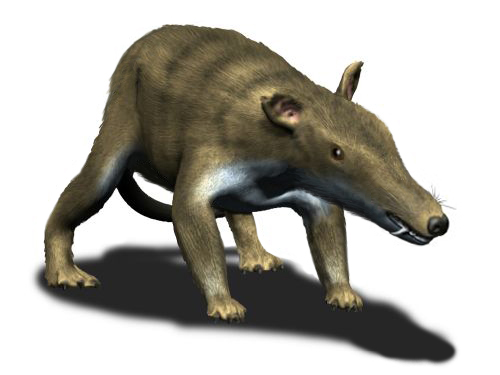


Overview and classification
Repenomamus is classified among triconodont mammals, a group distinct from modern marsupials and placentals. Anatomically it shows a robust, stocky build with powerful jaws and characteristic three-cusped (triconodont) teeth adapted for slicing flesh. Because of these features, it is interpreted as predominantly carnivorous or omnivorous rather than herbivorous.
Key characteristics
- Skull and dentition adapted for biting and shearing meat.
- Stout limbs and body suggesting active terrestrial habits.
- Long tail and proportionally large skull compared with body size.
Discovery and fossil evidence
Fossils of Repenomamus have been recovered from Early Cretaceous deposits in Liaoning Province. The specimens are notable for exceptional preservation, which in at least one case includes stomach contents. Such preservation has allowed paleontologists to study not only the bones but also aspects of diet and ecology.
Diet and ecological role
One of the most important discoveries associated with Repenomamus is material found within the ribcage of a specimen that contains the remains of small vertebrates, interpreted as juvenile dinosaurs or other reptiles. This provides direct evidence that these mammals ate vertebrate prey, though it remains unclear whether they actively hunted live dinosaurs or scavenged carcasses. The finding challenges older assumptions that Mesozoic mammals were exclusively tiny insectivores living beneath dinosaur dominance.
Significance and distinctions
Repenomamus is often cited in discussions of Mesozoic ecosystems because it demonstrates that mammals occupied a broader range of ecological roles than once thought. It also exemplifies the diverse forms present among early mammals, distinct from modern groups. For further general context on mammals, the Cretaceous period, the locality, and the dinosaur associations see mammal, Cretaceous, Manchuria and dinosaurs.
Researchers continue to refine the details of Repenomamus's biology and behavior as new material and analyses appear. Its fossils remain an important window into life on Earth more than a hundred million years ago.
Questions and answers
Q: What is Repenomamus?
A: Repenomamus is the largest known mammal from the Cretaceous period.
Q: Where was Repenomamus fossil found?
A: Its fossil was found in Manchuria.
Q: What evidence is there about Repenomamus' diet?
A: There is good evidence that Repenomamus fed on dinosaurs.
Q: Was Repenomamus a hunter or scavenger?
A: It is not known whether Repenomamus was a hunter or a scavenger.
Q: Which period did Repenomamus belong to?
A: Repenomamus belonged to the Cretaceous period.
Q: What is the significance of finding a fossil of Repenomamus?
A: The significance of finding a fossil of Repenomamus lies in the fact that it is the largest known mammal from the Cretaceous period.
Q: What is the importance of studying Repenomamus?
A: The importance of studying Repenomamus is that it sheds light on the evolution of ancient mammals and the relationships between mammals and dinosaurs during the Cretaceous period.
Related articles
Author
AlegsaOnline.com Repenomamus: a large Early Cretaceous mammal from northeastern China Leandro Alegsa
URL: https://en.alegsaonline.com/art/82197
Sources
- doi.org : 10.1038/nature03102
- pubmed.ncbi.nlm.nih.gov : 15650737
- dml.cmnh.org : "A new family of primitive mammal from the Mesozoic of western Liaoning, China"
- doi.org : 10.1007/BF03187223
- worldcat.org : 1001-6538