
Red-shouldered macaw (Diopsittaca nobilis)
A compact South American macaw species notable for its green plumage, red shoulder patches and suitability as a companion bird; overview of appearance, range, behavior, breeding and care.
The red-shouldered macaw (Diopsittaca nobilis) is a small, long-tailed parrot with a reputation for intelligence and sociability. It belongs to the broader parrot family and is often called a mini- or dwarf macaw because it is significantly smaller than the large macaw species. Wild birds are mostly green with distinctive red or rufous markings on the shoulders and blue highlights on wing edges and tail tips. Its compact size and expressive behavior make it familiar in aviculture as well as in the wild.
Image gallery
5 Images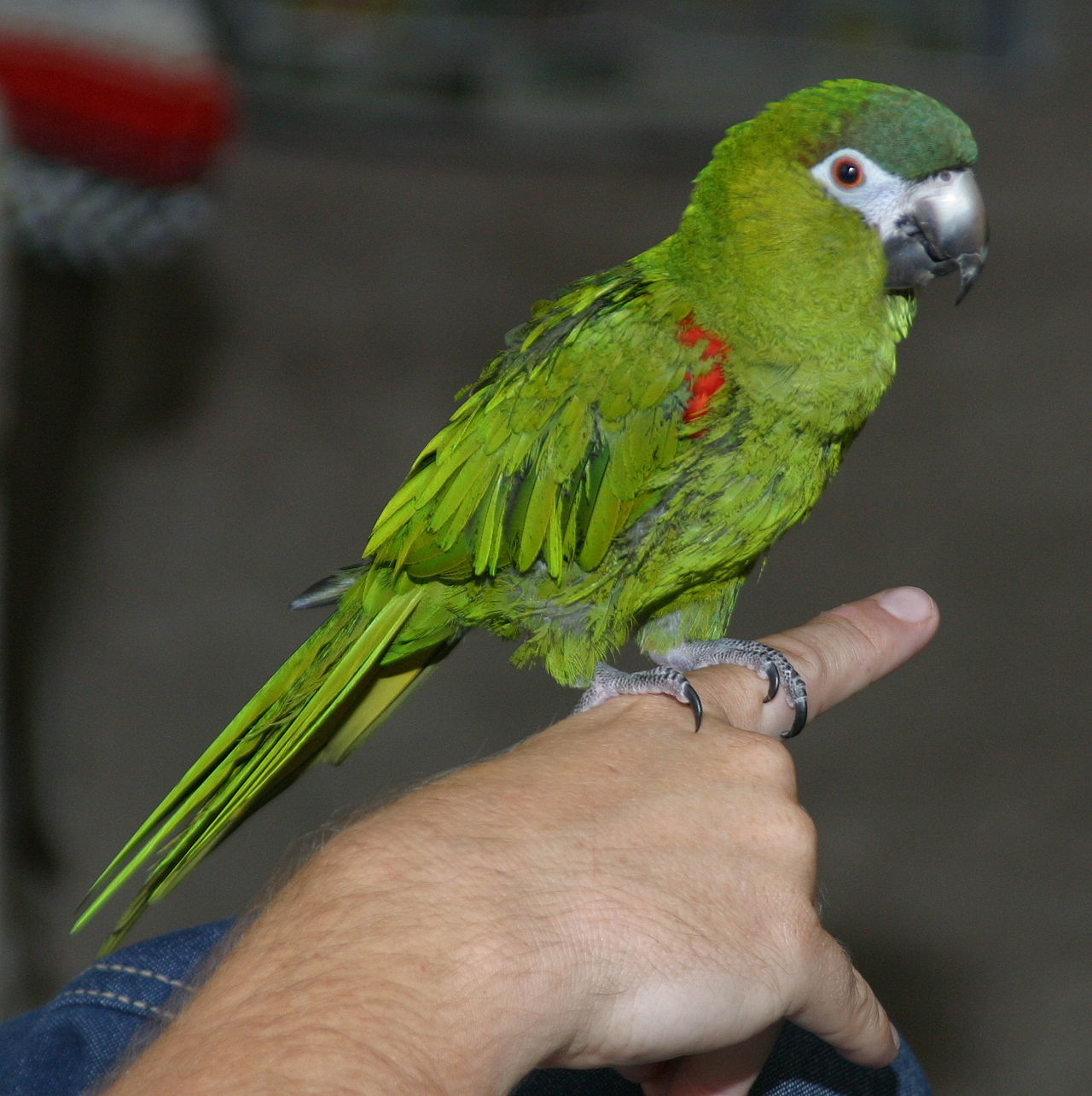


Physical characteristics and subspecies
Adults typically measure around 25–30 cm from beak to tail, giving them a compact profile compared with larger macaws. Plumage is predominantly green; the red shoulder flash is the species’ namesake and is visible when wings are folded. Facial and beak patterns vary by individual and population. Several regional forms have been described; among the better known are the nominate form commonly called the "noble macaw" and a smaller form often referred to as "Hahn's macaw." Taxonomic treatments differ, and local names reflect variations in size and coloration rather than a consistent global split.
Range and habitat
Red-shouldered macaws are native to northern and central South America. Their distribution includes coastal and inland lowlands across areas of Venezuela, the Guianas and parts of the Amazon basin, extending into Bolivia and Brazil. They inhabit a variety of open and semi-open environments such as tropical lowland forests, gallery woodlands, savannahs and seasonally flooded swamplands. Populations can be localized, often associated with trees that provide nesting cavities and food resources.
Behavior, diet and ecology
These macaws are social and commonly found in pairs or small family groups rather than large flocks. Their diet in the wild consists mainly of fruits, seeds and nuts; they may also take blossoms, leaf buds and occasional insects. Their strong beaks allow them to access hard-shelled seeds. In their ecosystems they serve as seed dispersers and help maintain plant diversity. Observations indicate a curious, vocal temperament and high problem-solving ability, traits that contribute to their appeal in captivity.
Reproduction and life cycle
Red-shouldered macaws nest in tree cavities, using existing holes rather than excavating their own. Clutch size is commonly two to four eggs laid on a substrate of wood chips and debris. The female provides the majority of incubation, which lasts around three to four weeks; juveniles remain in the nest and are fed by parents until fledging. In avian literature the term "fledge" describes the stage when chicks leave the nest to begin independent flight (fledging details). As with many parrots, juvenile survival depends on food availability and habitat quality.
In captivity, uses and conservation
Because of their manageable size, intelligence and affectionate tendencies, red-shouldered macaws are often kept as companion birds. Potential owners should research their needs carefully: they require mental stimulation, social interaction, a varied diet and appropriate housing. A short list of care considerations includes:
- Offer a mix of fresh fruits, vegetables, nuts and formulated pellets to meet nutritional needs.
- Provide toys and regular out-of-cage time to prevent boredom and behavioral problems.
- Arrange veterinary checks with an avian specialist for routine health screening.
Conservation status varies regionally. Habitat loss and capture for the pet trade have affected some local populations. Conservation efforts focus on habitat protection, legal trade controls and public education. For general species information or identification help see additional resources on the parrot family profile and regional guides to South American birds. Further reading and specialized resources can be found through ornithological databases and captive-care references (habitat notes).
Questions and answers
Q: What is the red-shouldered macaw?
A: The red-shouldered macaw is a species of parrot.
Q: How many sub-species of red-shouldered macaw are there?
A: There are three sub-species of red-shouldered macaw.
Q: What do red-shouldered macaws look like?
A: Red-shouldered macaws are green with red shoulder flashes.
Q: Are red-shouldered macaws commonly kept as pets?
A: Yes, red-shouldered macaws are sometimes sold as pets and bond well with humans.
Q: What do red-shouldered macaws eat?
A: Red-shouldered macaws eat fruits, nuts, and seeds.
Q: Where are red-shouldered macaws from?
A: Red-shouldered macaws are from South America, specifically Venezuela, the Guianas, Bolivia, and Brazil.
Q: How do red-shouldered macaws reproduce?
A: Red-shouldered macaws nest in a hole in a tree and the female incubates the eggs for about 24 to 26 days. The chicks fledge from the nest about 54 days after hatching.
Related articles
Author
AlegsaOnline.com Red-shouldered macaw (Diopsittaca nobilis) Leandro Alegsa
URL: https://en.alegsaonline.com/art/81698
Sources
- exoticbird.com : Online Book of Parrots - Genus Diopsittaca