
Red-eyed tree frog (Agalychnis callidryas)
Agalychnis callidryas, the red-eyed tree frog, is a colorful Neotropical arboreal frog known for its red eyes, nocturnal habits, leaf-laid eggs and predator-startle defenses.
The red-eyed tree frog (Agalychnis callidryas) is a widely recognized Neotropical frog valued for its vivid coloration and distinctive red eyes. Native to humid lowland forests, it is primarily arboreal and nocturnal. The species is frequently studied in ecology, behavior and developmental biology and is also popular in captive collections due to its striking appearance. For general species information see species overview.
Image gallery
9 Images




Appearance and defensive adaptations
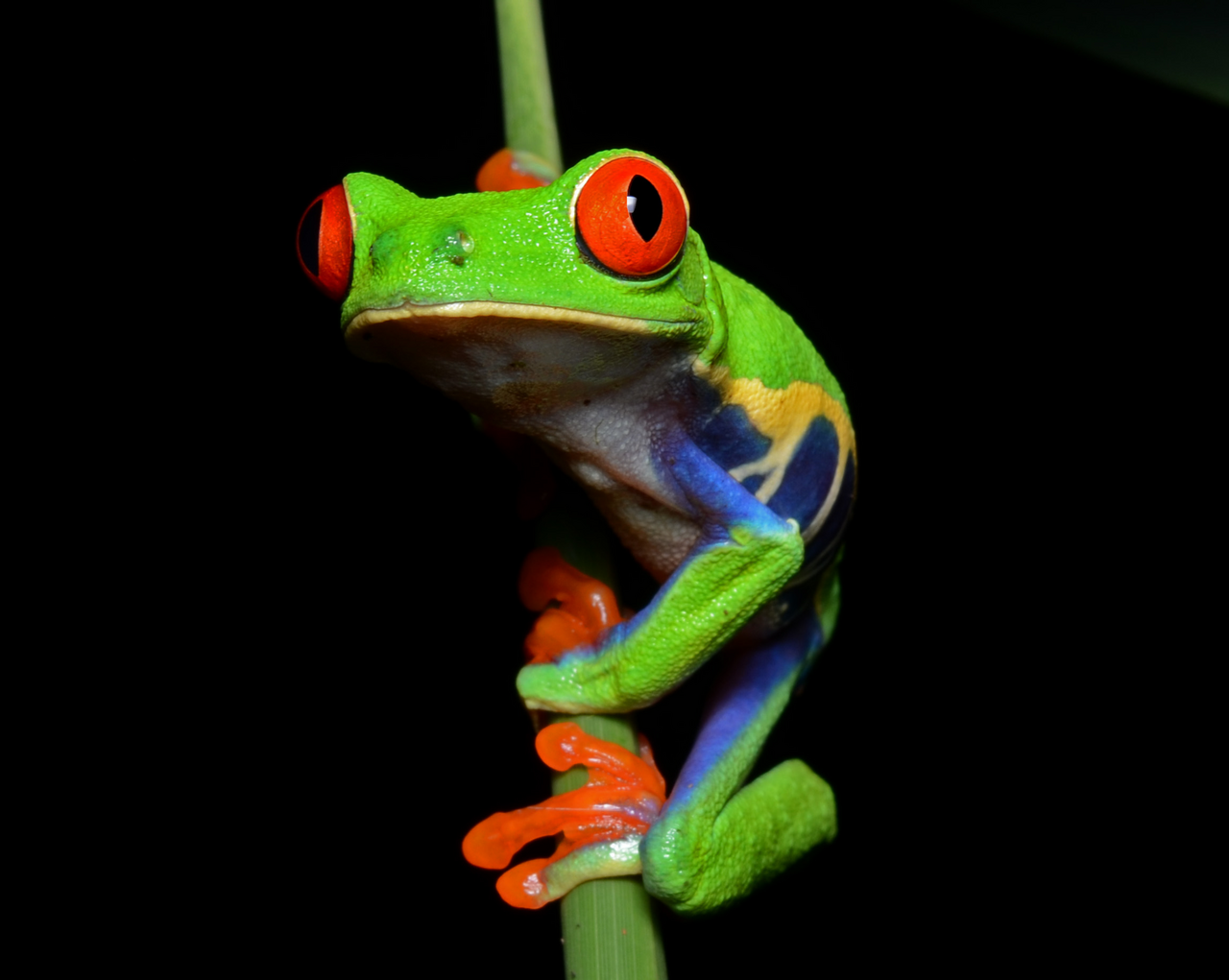
Adult red-eyed tree frogs are slender, with long limbs and adhesive toe pads adapted for climbing broad tropical leaves and stems. Their dorsal surface is typically bright green, while the flanks and inner legs display blue and yellow or orange markings. The most conspicuous feature is the large, bright red eye. Although these frogs are not highly toxic, their bright colors serve functions in concealment and defense:
- Camouflage: By tucking legs against the body and closing their eyes during the day, individuals appear largely green and blend with foliage, a strategy discussed in studies of camouflage.
- Startle or deimatic display: When disturbed the frog suddenly opens its eyes and exposes vivid flank colors; this abrupt change can momentarily startle a predator and provide an opportunity to flee. See research on deimatic behaviour and predator response.
Distribution and habitat
Agalychnis callidryas occurs in tropical Central America and adjacent regions where humid lowland forests, forest edges and plantations provide abundant leaves over standing water. Individuals spend daylight hours motionless on leaves and become active at night, when they hunt insects and other small invertebrates. Habitat descriptions and range maps can be consulted via range resources.
Life cycle and reproductive behavior
Reproduction typically takes place during the rainy season. Males call from vegetation to attract females, and mating often occurs on a leaf overhanging a pond or pool. Females deposit gelatinous clutches of eggs on the underside or upper surface of a leaf; the male fertilizes the eggs externally as they are laid. Eggs develop into embryos within the jelly mass and hatch as free-swimming tadpoles that drop into water below.
Notable behaviours include parental attendance and an emergency-hatching response: embryos are able to sense vibrations caused by nearby predators and can accelerate hatching to escape predation. These aspects are covered in more detail at developmental studies and embryo response research.
Ecological role and interactions
As insectivores, red-eyed tree frogs help control insect populations and serve as prey for larger predators such as snakes, birds and mammals. Their reliance on intact forest vegetation and ephemeral aquatic sites for reproduction makes them sensitive to habitat loss, pollution and changes in hydrology. Conservation status and management considerations are available from field guides and conservation listings: conservation information and threat assessments.
Human interest and distinctions
Beyond scientific interest, the red-eyed tree frog is a familiar image in popular culture and is frequently displayed in educational materials about tropical biodiversity. It should not be confused with unrelated frogs that share the common name "red-eyed treefrog" in other regions (for example some Australian species). For taxonomy and comparative notes see taxonomic resources and additional references at further reading.
Questions and answers
Q: What is the scientific name of the red-eyed treefrog?
A: The scientific name of the red-eyed treefrog is Agalychnis callidryas.
Q: How does the red-eyed treefrog protect itself from predators?
A: The red-eyed treefrog relies on camouflage to protect itself from predators during the day, and uses a defensive adaptation called deimatic behaviour when it detects a predator - abruptly opening its eyes and staring at them in order to startle them and give it time to flee.
Q: What do red-eyed tree frogs eat?
A: Red-eyed tree frogs like to eat small insects.
Q: How does mating occur for this species?
A: During mating, the female carries the male on her back for several hours during the process. The female then chooses a leaf above a pond or large puddle on which to lay her clutch of eggs, and the male puts out his sperm onto them as they are released.
Q: What type of eggs do they lay?
A: Red-eyed tree frogs lay jelly-like eggs.
Q: Does the mother stay with her eggs after laying them?
A: Yes, mothers will stay near their eggs and help them fight any hungry animals that want to eat them.
Q: How long does it take for an egg to become a tadpole?
A: It takes one or two weeks for an egg to become a tadpole.
Related articles
Author
AlegsaOnline.com Red-eyed tree frog (Agalychnis callidryas) Leandro Alegsa
URL: https://en.alegsaonline.com/art/81652
Sources
- commons.wikimedia.org : Red-eyed tree frog
- iucnredlist.org : iucnredlist.org/
- animaldiversity.org : "Agalychnis callidryas, Rana-de árbol ojos rojos"
- beheco.oxfordjournals.org : "The development of behavioral defenses: a mechanistic analysis of vulnerability in red-eyed tree frog hatchlings"
- doi.org : 10.1093/beheco/10.3.251
- worldcat.org : 1045-2249