
Realism: depiction and philosophy of the real
Realism is an approach in the arts, literature, and thought that seeks to represent subjects truthfully and to treat the world as independent of idealized or supernatural distortions.
Overview
Realism is a broad approach to representing and thinking about the world that emphasizes fidelity to observable facts and ordinary experience. In everyday speech it gives rise to the adjective realistic, but as an intellectual and artistic stance it spans several fields. It appears across the liberal arts and specialized disciplines, from music and painting to philosophy and social commentary. Central to realism is a preference for the familiar, the specific, and the plausible over exaggeration, fantasy, or idealized forms.
Image gallery
2 Images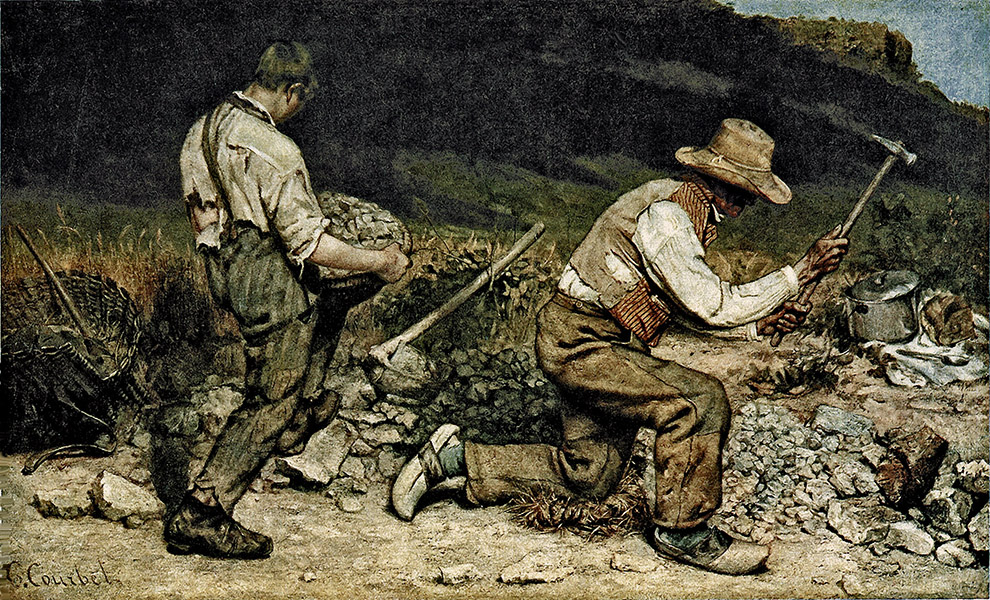

Key characteristics
Although realism takes different shapes in different contexts, several recurring features are common: careful attention to everyday detail, depiction of ordinary people and situations, resistance to romantic embellishment, and an interest in causes and consequences that can be observed or argued for. Realist creators often reject overtly supernatural explanations and instead highlight social conditions, material circumstances, or psychological motives. In philosophy, realism generally names positions that affirm the mind-independent existence of objects and facts.
- Observation: reliance on direct experience and sensory detail.
- Ordinariness: focus on common lives rather than heroic idealizing.
- Verisimilitude: effort to make representations believable and internally consistent.
- Analytic emphasis: tracing causes, systems, or socio-economic factors.
Historical development
The term is closely associated with a mid-19th century movement that emerged as a reaction against romanticism and certain forms of idealism. In European painting and literature, proponents sought to portray life without sentimental distortion, arguing that art should depict the material and moral conditions people actually endured. The movement grew alongside scientific advances and urbanization, prompting artists and writers to confront modern social realities. Although the 19th century is often highlighted, realist techniques and impulses existed earlier and continue to influence contemporary work.
Forms and applications
Realism is not limited to fine art. It informs novelistic techniques, theatrical naturalism, documentary practices, and certain strains of cinema and photography that aim for believable, everyday representation. In political thought and law, distinct meanings arise: liberalism and classicism are sometimes contrasted with realist approaches in international relations or jurisprudence, where the emphasis is on power, interest, and pragmatic outcomes rather than moral ideals. In philosophy there are different kinds of realism—moral, scientific, metaphysical—that debate whether values, theories, or categories correspond to an independent reality.
Examples and notable contrasts
Classic examples of artistic realism include literature that treats social detail and character psychology with sustained objectivity and painting that depicts working-class life or rural labor without heroic gloss. Many artists and writers adopted these aims to challenge prevailing tastes and to prompt social reflection. Realism is often set against movements that prioritize imagination or transcendence, but it can coexist with expressive techniques and political aims, for instance in social realism or naturalism. It also overlaps with scientific or epistemic positions such as portraying reality in a way that aspires to truth rather than mere convention.
Distinctions and continuing relevance
Realism should not be reduced to a single doctrine. Within arts and philosophy there are many variants—from naive or commonsense realism to sophisticated scientific realism—each answering different questions about what is real and how we should represent it. Some critics argue realism can become didactic or narrowly documentary, while supporters see its strength in resisting idealization and encouraging critical attention to the conditions that shape human life. Today, realist methods remain influential across media, scholarship, and public discourse, continually adapted to new technologies and social questions.
For further reading on specific manifestations—art movements, philosophical debates, and contemporary practices—see introductions in art history and philosophy collections or reviewers who trace the term across disciplines. You may also explore dedicated resources on the movement's moments and practitioners via library and academic gateways such as art movement summaries, 19th century overviews, and studies of nature and society in realist works.
Additional notes: compare realism with related or opposing labels and schools to understand how it functions in context — for example, legal realism, political realism, social realism, and variants that combine realist description with political commitment.
Related links: definition, the arts, musical realism, realist painting, philosophical realism, romanticism, idealism, political contrast, classical contrast, practitioners, supernatural, movement notes, historical era, nature and depiction.
Questions and answers
Q: What is realism?
A: Realism is a way of portraying or thinking about reality. It usually means trying to be true to reality, without unrealistic or supernatural ideas.
Q: How did realism begin?
A: Realism began as an art movement and philosophical movement in the 19th century. These realists wanted to give an accurate description of nature and of the way people lived.
Q: In what ways is realism used?
A: Realism is used mainly to describe the way that some artists treat making art, but it can also apply to artists and artworks from before the 19th century. It is also used in many liberal arts such as music, painting, and philosophy.
Q: What does "realistic" mean?
A: The word "realistic" comes from realism, which means trying to be true to reality without unrealistic or supernatural ideas.
Q: How does realism differ from romanticism and idealism?
A: Realism is usually seen as an opposite of romanticism and idealism because it focuses on the world as it really is instead of including unrealistic or supernatural ideas.
Q: Is realism related to liberalism and classicism?
A: Yes, realism is sometimes seen as an opposite of liberalism and classicism because it focuses on being true to reality rather than adhering strictly to certain beliefs or ideals.
Related articles
Author
AlegsaOnline.com Realism: depiction and philosophy of the real Leandro Alegsa
URL: https://en.alegsaonline.com/art/81493