
Realgar — the red arsenic sulfide mineral
Realgar (As4S4) is a soft, red arsenic sulfide mineral known for its photochemical alteration to yellow pararealgar, historical uses as a pigment and in fireworks, and its toxicity.
Overview
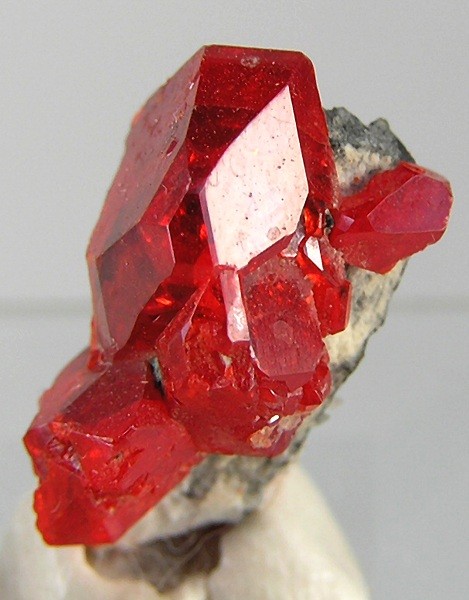
Realgar is a naturally occurring arsenic sulfide with the chemical formula As4S4. It typically forms bright red to orange-red crystals or compact masses and is characteristically soft (Mohs hardness about 1.5–2). Exposed to light, realgar slowly converts to a yellow alteration product commonly called pararealgar. As a primary source of arsenic in some deposits, it has long attracted attention for both practical uses and health concerns. For basic reference, see mineral and its role as an ore of arsenic.
Image gallery
6 Images


Physical and chemical properties
Realgar is an arsenic sulfide that melts at around 320°C and produces characteristic fumes when burned, containing arsenic and sulfur species. Crystals are generally monoclinic and may appear prismatic or granular; specimens are easily abraded and can darken or powder with handling and light exposure. The conversion to pararealgar is a photochemical decomposition: the red crystalline realgar becomes a friable yellow powder on prolonged illumination, which is often found on museum specimens and historic artworks.
Occurrence and formation
Realgar is commonly found in low-temperature hydrothermal veins, hot-spring deposits and in association with other sulfide minerals. It often occurs alongside minerals such as orpiment and stibnite. Because it contains arsenic, realgar is frequently targeted in deposits where arsenic-bearing minerals accumulate.
Uses, history and cultural roles
Historically, realgar has been valued for several applications: as a red pigment in painting and decoration, as an ingredient in certain pyrotechnic compositions and in traditional medicinal practices. It was used in older firework recipes to produce red or crackling effects before many modern powdered metals and formulations replaced it; for example, it appeared in some early compositions alongside powdered metals and other ingredients like powdered metals. Realgar has a documented history as a dyed pigment and an item of trade (pigment, trade). It has also been used in traditional remedies, notably in parts of East Asia, where it appears in some formulations described as medicine in China.
Health, safety and regulation
Because it contains arsenic, realgar is toxic and must be handled with caution. Inhalation, ingestion or prolonged skin contact can present serious health risks. Its use in consumer products and medicines is limited or regulated in many jurisdictions owing to toxicity concerns. When heated or burned, realgar releases hazardous fumes; therefore, it should not be exposed to open flames or high temperatures outside controlled, ventilated conditions.
Related minerals and distinctions
Realgar is chemically and historically linked to orpiment (arsenic trisulfide, As2S3), which is yellow and more stable to light. Both minerals share arsenic and sulfur and often occur together, but they differ in stoichiometry, color and stability. Collectors and conservators often note the ease with which realgar alters to pararealgar and take steps to limit light exposure when preserving specimens or artworks.
- Common names and terms: realgar, pararealgar (the yellow alteration product).
- Typical hazards: arsenic toxicity, photochemical alteration, hazardous fumes on heating.
- Further information: consult mineralogical references or safety datasheets via mineral databases and health resources.
For additional background or specimen data, see mineralogical resources and collections references at ore-focused pages or general mineral guides (arsenic and sulfur topics).
Questions and answers
Q: What is Realgar and what is its chemical formula?
A: Realgar is a mineral and its chemical formula is As4S4.
Q: What is Realgar's hardness and color?
A: Realgar's hardness is between 1.5 and 2 on the Mohs scale, and it is a soft red mineral.
Q: What is Realgar used for?
A: Realgar is an ore of arsenic and it was used to make a white color in fireworks before the use of powdered metals. It is still used in some crackling firecrackers. It was also used as a red pigment and an item of trade. In China, it is used as a medicine.
Q: What happens to Realgar when it is exposed to light?
A: Realgar changes into a yellow powder when exposed to light. This yellow powder is called pararealgar.
Q: What happens when Realgar melts?
A: Realgar melts at 320°C and burns with a blue flame, making arsenic and sulfur fumes.
Q: How is Realgar's usage similar to that of orpiment?
A: Realgar's uses are similar to orpiment, a similar mineral.
Q: What is the significance of Realgar's use as fireworks?
A: Realgar was used to make a white color in fireworks before the use of powdered metals, which shows its use in traditional Chinese celebrations and other cultures that used fireworks.
Related articles
Author
AlegsaOnline.com Realgar — the red arsenic sulfide mineral Leandro Alegsa
URL: https://en.alegsaonline.com/art/81492