
Backspace key: function, history, and differences from Delete
Overview of the Backspace key: its typewriter origins, typical leftward deletion on modern systems, historical control codes and overstrike use, Unicode evolution, and key behavioral differences from Delete.
The backspace key is a keyboard control originally found on mechanical typewriters. On contemporary computer displays it typically moves the insertion point one position to the left and removes the character immediately before the cursor, shifting subsequent text left by one position.
Image gallery
3 Images


Historical use for accents and diacritics
On older typewriters, combining a base letter with an accent was sometimes done by typing the letter, using backspace, then typing the accent so the two characters overstruck. That practice inspired some conventions in early character sets—for example the use of the caret in ASCII to represent a circumflex when no precomposed character was available. With modern systems this overstrike method has largely been superseded by Unicode combining marks (Unicode) and by precomposed characters, although font and input support for combining marks can be inconsistent. Some software systems, including typesetting tools and certain operating environments such as Microsoft Windows, instead apply diacritics by positioning the mark first and then inserting the base letter at that location.
Control codes and conventions
When used on computer terminals, pressing backspace historically produced the ASCII control code for Backspace (code 08, commonly written as BS). The same control code can be generated by the keyboard shortcut Control-H, since H is the eighth letter of the alphabet. Terminals that did not interpret the control code as movement and deletion often displayed the sequence ^H instead; programmers and chatters later adopted this as a jokey way to mark a correction in plain text.
Example of that humorous notation:
My slave-dri^H^H^H^H^H^H^H^H^Hboss decided to stall the project.
Shortcuts for larger deletions
In many Unix-style terminal line disciplines a single ^W deletes the previous word, which can replace a run of ^H characters. That behavior is available in text editors such as Vi. For erasing an entire line, ^U (kill line) is commonly used.
Backspace vs. Delete
The backspace key is not the same as the Delete key. On keyboards and in older punched-card or paper-based computer media, Delete could mark or remove the character at or after the cursor (in some systems it physically punched out positions to indicate removal). In graphical user interfaces the Delete key is often mapped to a general remove command (deleting files, images, or other objects), while backspace commonly retains its leftward-deletion role or has no effect in certain contexts.
Some environments map the backspace key to the DEL control character (0x7F) internally while keeping the visible behavior of erasing the character before the cursor.
Other uses and terminology
In legacy mainframe terminology, to backspace a tape is to move a mainframe-style magnetic tape backward, usually to the previous block. In modern graphical file explorers and when navigating the Web, pressing backspace is frequently interpreted as a command to go back to the previous folder or page in many web browsers, although this mapping varies by application and operating system.
The physical key itself is labeled in different ways across platforms and keyboards: common markings include a left-pointing arrow, the word Delete, Erase (seen on some educational laptops), or the word Backspace. The exact label does not always reflect the key's behavior in software.

Alluding to the representation of the associated control character using ^H, internet forums sometimes start a word in a sentence and then "delete" it with a spelled-out "^H" to represent some sort of intentional Freudian slip:
Because I'm cowardly^H^H^H^Hcautious, just one harmless example.It shows what was actually meant, but then "deleted".
| Keys of an IBM/Windows keyboard (German/Austrian assignment "T1") | ||||||||||||||||||||||||
| Esc | F1 | F2 | F3 | F4 | F5 | F6 | F7 | F8 | F9 | F10 | F11 | F12 | Print | Rollers | PauseUntbr | Numeric keypad: | ||||||||
|
| Insfg | Pos1 | Image ↑ | Num | - | |||||||||||||||||||
| Del | End | Image ↓ | 7 | 8 | 9 | + | ||||||||||||||||||
| 4 | 5 | 6 | ||||||||||||||||||||||
| ↑ | 1 | 2 | 3 | Enter | ||||||||||||||||||||
| ← | ↓ | → | , | |||||||||||||||||||||
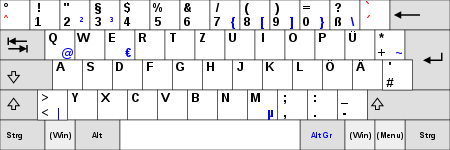
Questions and answers
Q: What is the backspace key?
A: The backspace key is a keyboard key (sometimes labeled as ←) that originally pushed the typewriter carriage one position backwards, and for modern computer screens, moves the cursor one position backwards, deletes the preceding character, and shifts back the text after it by one position.
Q: How was backspace composition used in typewriters?
A: In typewriters, a typist would type a lowercase letter "a" with acute accent (á) by typing a lowercase letter "a" then backspace, and then the acute accent key (also known as overstrike). This is the basis for such spacing modifiers in computer character sets such as the ASCII caret (^).
Q: How has backspace composition been replaced?
A: Backspace composition has been replaced with the combining diacritical marks mechanism of Unicode, though such characters do not work well with many fonts, and precomposed characters continue to be used. Some software like TeX or Microsoft Windows use the opposite method for diacritical marks.
Q: What does pressing the backspace key on a computer terminal generate?
A: Pressing the backspace key on a computer terminal generates an ASCII code 08 or BS which stands for Backspace - this control code will delete any preceding character.
Q: What is ^H commonly used for?
A: ^H is commonly used humorously for epanorthosis by computer literates denoting deletion of a pretended blunder much like a strikethrough.
Q: How does ^W differ from ^H?
A: ^W is a shortcut to delete an entire word while ^H only deletes one character at time.
Q: What are some other shortcuts related to deleting text? A: For more extensive deletions than just individual characters or words there are shortcuts like ^U which kills an entire line of text.
Tags
Related articles
Author
AlegsaOnline.com Backspace key: function, history, and differences from Delete Leandro Alegsa
URL: https://en.alegsaonline.com/art/8130
Sources
- debian.org : "9.8 Keyboard configuration"
- lowendmac.com : "User Mistakes or Mac Mistakes?, Backspace vs. Delete, and It's Too Easy to Zap an Icon in the Dock"
- wiki.laptop.org : "OLPC Human Interface Guidelines/The Sugar Interface/Input Systems"