
Rapture (Christian eschatology)
The Rapture is a belief in Christian eschatology that at an appointed future moment believers will be taken up to be with Christ; interpretations, origins, and cultural impact vary among traditions.
Overview
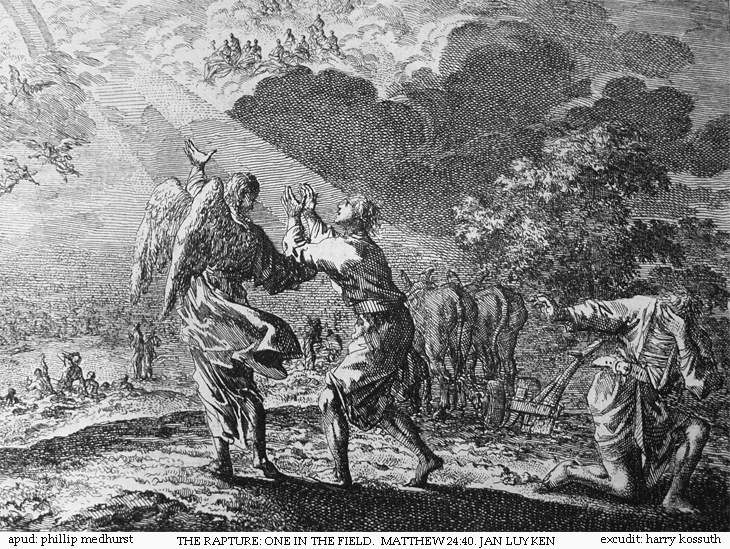
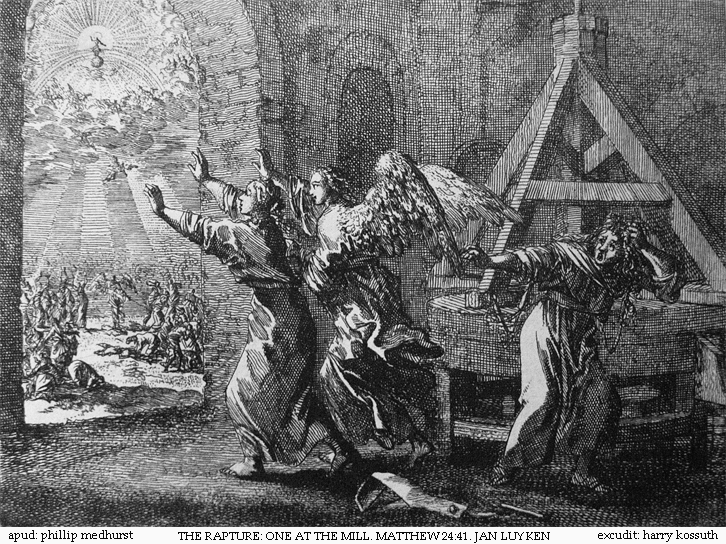
The term "Rapture" derives from Latin meaning "to be carried away" and is used to describe a future event in some strands of Christian thought. In these views, Jesus Christ will return in a way that results in faithful followers being caught up to meet him, often described as being taken to Heaven. Different denominations and theologians disagree about timing, scope and the precise nature of the event, and many Christians do not use the specific term "Rapture".
Image gallery
6 Images


Key characteristics and beliefs
Descriptions of the Rapture emphasize a sudden and supernatural removal of people from the world, accompanied by cosmic signs. Supporters point to passages commonly translated to suggest believers are "caught up" to be with Christ. Some traditions frame it as part of a wider sequence in Christian theology and eschatology, followed by a period of trial and a long reign often called the millennium, a period traditionally understood to last a thousand years. Others treat those scriptural texts as metaphorical or as referring to Christ's final coming without a two-stage scenario.
Major interpretive positions
- Pre-tribulation: The Rapture occurs before a time of intense global suffering known as the tribulation, sparing believers from that interval.
- Mid- or post-tribulation: The Rapture coincides with or follows the tribulation and is part of Christ's final return.
- Non- or spiritualist readings: Some Christians read the relevant texts symbolically, seeing them as describing spiritual truths rather than a literal snatching away.
These positions reflect different methods of interpreting scripture, differing emphases in church tradition, and historical developments.
Origins and historical development
The modern, explicit use of the word "Rapture" and the detailed pre-tribulation scheme are relatively recent developments in Protestantism, popularized in the 19th and 20th centuries through certain Bible teachers and translations. However, ideas about believers being taken up at Christ's coming and about a future millennium have deeper roots in early Christian writings and medieval commentary. Debates over timing and literal versus symbolic readings have continued across centuries.
Associated beliefs and sequence
In traditions that include a Rapture, the event is often linked with several other eschatological concepts: the tribulation, a period of judgment; the return of Christ to the Earth; and a final age or kingdom when the world is ordered under Christ's rule. Some expect a restoration of creation after judgment, while others emphasize the immediate consummation of God's purposes. The relationship between these ideas differs widely across communities and theological systems.
Importance, controversies and cultural impact
The Rapture has been influential in literature, film and popular theology, shaping how many people imagine the end times. It is also a source of controversy: critics argue that certain futuristic scenarios are recent innovations or misread scripture, while proponents see them as faithful interpretations. For readers seeking further study, surveys of denominational statements and scholarly treatments provide context; consult resources on world-wide Christian responses and academic overviews for balanced perspectives. For primary-scripture discussion see links to specific passages and commentaries on prophetic texts and the broader history of millennial expectations.
Because the subject bridges faith, interpretation and history, careful attention to sources and to the variety of positions helps avoid overgeneralization and clarifies why the Rapture remains a prominent and debated concept in Christian thought.
For additional reading and denominational positions, see materials linked through official statements and scholarly summaries on the subject, which treat the sequence, terminology and theological claims with nuance and historical perspective. Theology resources and event studies can provide more detailed exegesis of the passages often cited. Further discussion of chronology and terminology appears in analyses of the millennium and references to a thousand years.
Note that different communities will emphasize or reject the Rapture for doctrinal reasons, and exploring denominational statements is useful: for example, many mainline churches do not teach a distinct pre-tribulation snatching, whereas some evangelical and fundamentalist groups do. See denominational and scholarly reviews for balanced context and interpretation frameworks and consult historical surveys to trace how modern ideas developed from older texts. Christian study guides and commentaries often summarize the spectrum of views and the biblical passages most frequently discussed.
Finally, many readers find that awareness of the various readings—literal, symbolic, historical—helps in understanding both the religious significance of the Rapture and its cultural resonance across literature and media.
Questions and answers
Q: What is the Rapture in Christian theology?
A: The Rapture is a future event in Christian theology where Jesus Christ will return to Earth to bring his followers to Heaven.
Q: What does the word "Rapture" mean?
A: The word "Rapture" means "to carry to another place".
Q: What will happen to the world after the Rapture event?
A: Following the Rapture event, the world will go through a period called the tribulation.
Q: What is the millennium in Christian theology?
A: The millennium is a future period of a thousand years in Christian theology.
Q: When will the millennium occur in Christian theology?
A: The millennium will occur following the tribulation.
Q: Who will Jesus Christ bring to Heaven during the Rapture event?
A: Jesus Christ will bring his followers to Heaven during the Rapture event.
Q: What do Christians believe will happen after the tribulation?
A: Following the tribulation, the millennium, a thousand-year period, will occur according to Christian theology.
Related articles
Author
AlegsaOnline.com Rapture (Christian eschatology) Leandro Alegsa
URL: https://en.alegsaonline.com/art/81215
Sources
- dictionary.reference.com : Dictionary.com