
Rapid plant motions: mechanisms, examples and biological limits
Overview of rapid plant motions: mechanisms, examples and biological limits. Explains hydraulic, elastic and buckling-driven movements in species from Venus flytrap to mulberry and Impatiens, and their speed constraints.
Rapid plant movement refers to plant motions that occur on timescales of about a second or less. These movements are distinct from the slow, growth-driven repositioning typical of most plants, and they depend on mechanical or hydraulic changes within tissues rather than sustained cell expansion.
Image gallery
2 Images
Notable examples
One well-known instance is the Venus flytrap, whose trap snaps shut in roughly 100 milliseconds to capture insects. Other carnivorous species, such as various bladderworts, can also trigger very fast responses when prey contacts sensitive structures.
The Dogwood bunchberry, Cornus canadensis, produces a flower whose petals open explosively and launch pollen in a fraction of a millisecond; this rapid action helps disperse pollen to visiting pollinators. A strikingly fast example comes from the White Mulberry tree (Morus alba), cultivated worldwide partly because its leaves feed silkworms. In this species the stamens act like small catapults, releasing stored elastic energy and ejecting pollen in microseconds — at speeds that have been described by researchers as among the fastest biological movements and close to physical limits for plant tissue motion.
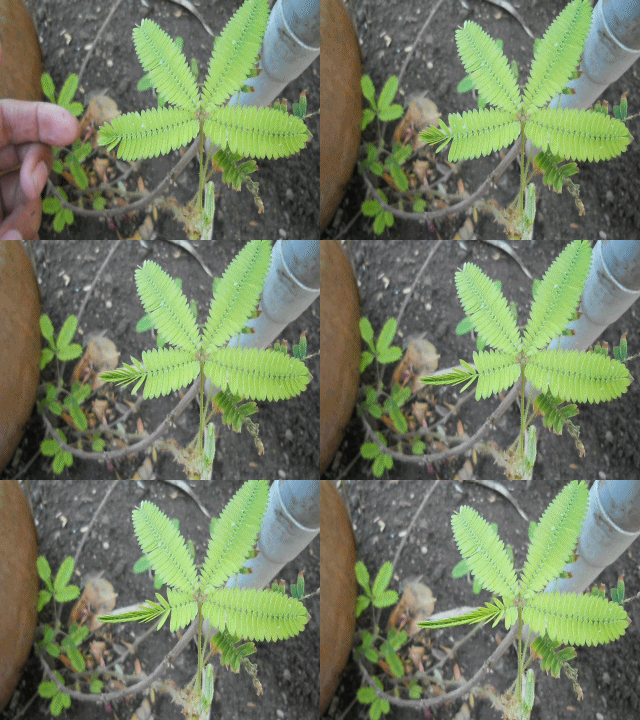
The very common genus Impatiens is the origin of the familiar name "touch-me-not." When ripe seed capsules are disturbed they can split suddenly, flinging seeds several metres away. By contrast, the movement of Mimosa pudica is slower and more graceful: its leaflets fold together in sequence when touched or shaken.
How these movements work and how they differ from growth
Rapid actions in plants generally rely on fast changes in turgor pressure, elastic recoil of cell walls or tissues, or mechanical buckling of structures. Some mechanisms store energy slowly (for example by deforming cells or tissues) and release it very quickly, producing motions that are much faster than those achievable by cell growth alone.
These quick responses should be contrasted with tropisms — directional growth movements driven by differential cell expansion in response to stimuli (light, gravity, chemicals) — which take place over hours, days or longer rather than milliseconds.
Charles naturalist Charles Darwin explored plant movement extensively; his final book, published in 1880, examined many types of motion in plants and helped draw attention to the diversity of behaviors beyond slow growth.
Questions and answers
Q: What is an example of rapid plant movement?
A: An example of rapid plant movement is the Venus Flytrap, which closes its trap in about 100 milliseconds.
Q: What type of plants have a rapid response to insects?
A: Carnivorous plants such as bladderworts have a rapid response to insects.
Q: What is the record for the fastest motion yet observed in biology?
A: The record for the fastest motion yet observed in biology is held by the White Mulberry tree, Morus alba, whose pollen is launched at over half the speed of sound and released stored elastic energy in just 25 µs.
Q: What does Impatiens get its common name from?
A: Impatiens gets its common name, "touch-me-not", from its seed capsules which "explode" when touched, shooting seeds several metres away.
Q: How do Mimosa pudica's leaflets move?
A: Mimosa pudica's leaflets close in a graceful sequence.
Q: Who published a work on plant movements before his death?
A: Charles Darwin published his last work before his death titled The Power of Movement in Plants in 1880.
Q: What are tropisms?
A: Tropisms are slow-moving growth-movements of plants.
Related articles
Author
AlegsaOnline.com Rapid plant motions: mechanisms, examples and biological limits Leandro Alegsa
URL: https://en.alegsaonline.com/art/81200
Sources
- oeb.harvard.edu : How the Venus flytrap snaps.
- dx.doi.org : 10.1038/nature03185
- dx.doi.org : 10.1007/s00497-005-0018-9