
Rapetosaurus — Late Cretaceous titanosaur from Madagascar
Rapetosaurus krausei, a titanosaurian sauropod from Madagascar (Late Cretaceous), is known from an unusually complete skeleton and skull and is a key taxon for understanding titanosaur anatomy and Gondwanan faunas.
Rapetosaurus is a genus of titanosaurian genus of sauropod dinosaur that lived during the Late Cretaceous in what is now Madagascar. Only one species, Rapetosaurus krausei, has been described from fossils recovered in Late Cretaceous deposits (notably from the Maevarano Formation). The taxon is notable because paleontologists recovered an unusually complete skeleton including a well-preserved skull, a rarity among titanosaurs. Rapetosaurus lived near the end of the Cretaceous period (Cretaceous) and, like other sauropods, was a quadrupedal herbivore.
Image gallery
10 Images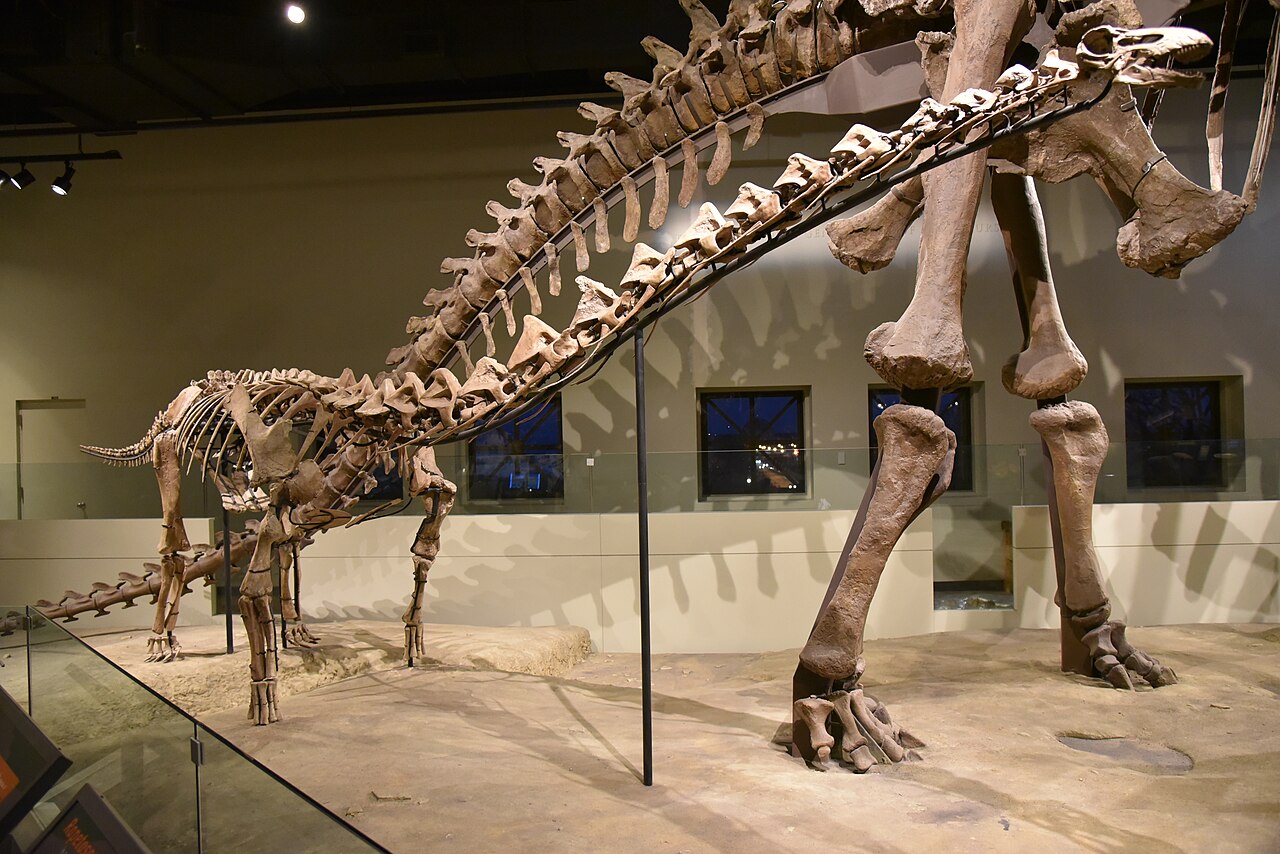


Discovery and naming
Fossil material attributed to Rapetosaurus was found in Late Cretaceous sedimentary rocks of northwestern Madagascar. The genus name derives from a figure in Malagasy folklore, reflecting local cultural context. The relatively complete nature of the remains—articulated elements including cranial bones—made the discovery especially valuable because most titanosaurs are known only from fragmentary material.
Anatomy and skeleton
Rapetosaurus exhibits the long neck, robust body and columnar limbs typical of sauropods, with vertebrae and limb bones adapted to support a large, heavy torso. Compared with the largest titanosaurs from South America, Rapetosaurus is generally regarded as medium-sized. The preserved postcranial skeleton helps inform reconstructions of limb posture, vertebral articulation and the relative proportions of neck and tail in titanosaurs.
Skull and dentition
One of Rapetosaurus’s most important features is the near-complete skull, which provided rare direct evidence of titanosaurian cranial anatomy. The skull material shows the arrangement of the jaws, teeth and parts of the braincase, permitting careful study of feeding adaptations and sensory structures. Like other titanosaurs, its teeth were adapted for cropping vegetation rather than extensive chewing, and the skull morphology has been used to reassess relationships among fragmentary titanosaur skulls worldwide.
Growth, ontogeny and size
Because multiple individuals and portions of skeletons have been compared, Rapetosaurus has been useful in studies of growth and ontogenetic change in titanosaurs. Although precise size estimates vary, Rapetosaurus is usually presented as smaller than the largest terrestrial sauropods but nonetheless a large-bodied herbivore with a digestive system adapted to process high volumes of plant matter.
Paleoecology and environment
Rapetosaurus lived on an island landmass that was once part of the southern continents of Gondwana. Its habitats likely included fluvial and floodplain environments with a mix of vegetation types available for browsing. In that Late Cretaceous ecosystem, titanosaurs occupied dominant herbivore roles on southern landmasses until the end-Cretaceous extinction event. Rapetosaurus shared its environment with a variety of other vertebrates and contributes to reconstructions of Malagasy paleocommunities.
Scientific significance
The exceptional preservation of Rapetosaurus provides a baseline for interpreting fragmentary titanosaur material from other regions. Cranial and postcranial data from this genus have informed phylogenetic analyses, clarified skull-to-body correlations in titanosaurs, and improved anatomical comparisons used in systematic and functional studies. Ongoing work on the specimens addresses questions of variation, paleobiology and the geographic distribution of titanosaurs toward the end of the Cretaceous.
Further resources
- General discussions of titanosaur anatomy and diversity can be consulted for broader context; see entries on genus-level classification and sauropod evolution.
- Overviews of the Late Cretaceous and regional geology are useful for paleoenvironmental context (Cretaceous overview, Madagascar geology).
- Specimen records and museum publications provide specimen-level data (skeleton records, cranial data).
- Broader discussions of Gondwanan faunas place Rapetosaurus in its paleogeographic setting (Gondwana context).
Relevant links for further reading and databases: genus entry, sauropod, dinosaur, Madagascar, Cretaceous summary, skeleton records, skull data, Gondwana overview.
Questions and answers
Q: What is Rapetosaurus?
A: Rapetosaurus is a genus of sauropod dinosaur.
Q: Where did Rapetosaurus live?
A: Rapetosaurus lived in what is now Madagascar.
Q: When did Rapetosaurus live?
A: Rapetosaurus lived from 70 to 66 million years ago, at the end of the Cretaceous period.
Q: How many species of Rapetosaurus have been found?
A: Only one species, Rapetosaurus krausei, has been found.
Q: What was the diet of Rapetosaurus?
A: Like other sauropods, Rapetosaurus was a quadrupedal herbivore.
Q: What was unique about the discovery of Rapetosaurus?
A: The discovery of Rapetosaurus was the first time a titanosaur had been recovered with an almost perfectly intact skeleton, complete with skull.
Q: What impact did the discovery of Rapetosaurus have on the study of sauropod dinosaurs?
A: The discovery of Rapetosaurus helped to clarify some difficult issues in this large group of sauropod dinosaurs. It also provides a baseline for the reconstruction of other titanosaurs that are known only from partial remains.
Related articles
Author
AlegsaOnline.com Rapetosaurus — Late Cretaceous titanosaur from Madagascar Leandro Alegsa
URL: https://en.alegsaonline.com/art/81190
Sources
- news.nationalgeographic.com : news.nationalgeographic.com/news/2001/08/0801_madagascardino.html
- bioone.org : bioone.org/doi/abs/10.1671/A1109-10