
Rallidae (rails): biology, distribution, and conservation
Rallidae, commonly called rails, crakes, coots and gallinules, are a diverse family of secretive wetland birds found worldwide (except Antarctica), notable for skulking behavior and island radiations.
Overview
The Rallidae, commonly called rails, comprise a broad family of small to medium-sized ground-dwelling birds that includes crakes, coots and gallinules. Members of this family belong to the order Gruiformes and are related to cranes. Rails are especially associated with marshes, reedbeds and dense vegetation, but the family occupies a wide range of terrestrial habitats around the world. Many species are secretive and elusive, making them less well known than their size would suggest. For further taxonomic context see family summary and a general species list at species index.
Image gallery
10 Images




Characteristics and anatomy
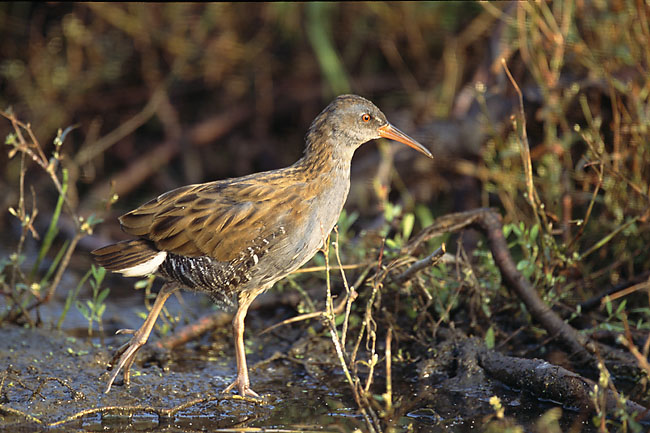
Rails show a set of shared physical traits adapted to moving through dense cover and shallow water. Typical features include laterally compressed bodies that ease passage between stems and reeds, relatively short rounded wings, strong legs and disproportionately long toes that help distribute weight over soft substrates. Plumage is generally cryptic—browns, grays and barred patterns—though coots and some gallinules can display brighter colours. Many rails have loud, distinctive calls that contrast with their otherwise secretive habits. See anatomical notes at related families and functional traits at morphology overview.
Distribution, habitat and behavior
Rallidae occur on every continent except Antarctica and occupy most humid and temperate environments, from coastal marshes and freshwater wetlands to dense tropical forest undergrowth. While many species live in or near wetlands, some have adapted to forests, grasslands or montane valleys. Their diet is typically omnivorous, including invertebrates, small vertebrates, seeds and plant matter. Some species are migratory, moving seasonally between breeding and non-breeding areas, while others are resident. For habitat guides and regional accounts see habitat guide and regional species.
Island evolution and flightlessness
Rails are notable for their success on islands. A propensity for short-distance dispersal and a generalist lifestyle has enabled colonization of remote islands where, in the absence of terrestrial predators, many rail populations evolved reduced flight capacity or complete flightlessness. This evolutionary pathway produced a number of endemic island species but also increased vulnerability: flightless rails suffered disproportionately after human arrival and introduced predators. Examples and evolutionary discussion are summarized at island evolution, flightlessness and extinction risks.
Ecology, reproduction and vocalizations
Rails typically nest in concealed locations over or near water, constructing bulky nests of vegetation. Clutch sizes and parental care strategies vary; many species show strong territoriality during the breeding season. Vocal communication is important for maintaining pair bonds and territories in dense habitat. For behavioral studies and nesting records see breeding biology and vocal behavior.
Conservation and human interactions
Conservation status within the family ranges from common and adaptable to highly endangered. Habitat loss, wetland drainage, introduced predators on islands and hunting have driven declines in many species. Conservation measures include habitat protection, predator control on islands and captive-breeding programs. Practical resources and conservation plans are available at conservation resources, restoration projects and species action plans.
- Key traits: secretive, often marsh-associated, laterally compressed body and long toes.
- Notable trends: frequent island colonization, repeated evolution of flightlessness.
- Conservation focus: wetlands protection and island predator management.
Questions and answers
Q: What are the rails?
A: The rails are a family of small to medium-sized birds related to cranes, and both are in the order Gruiformes.
Q: What does the Rallidae family include?
A: The Rallidae family includes the crakes, coots, and gallinules.
Q: Where are many species of rails associated with?
A: Many species of rails are associated with wetlands.
Q: In what type of habitats are rails not found?
A: Rails are not found in dry deserts, polar regions, and alpine areas above the snow line.
Q: Where are the Rallidae found?
A: The Rallidae are found on every continent except Antarctica.
Q: What is the most common habitat for rails?
A: The most common habitats for rails are marshland or dense forest.
Q: Are rails flightless?
A: Many rails on islands are flightless.
Related articles
Author
AlegsaOnline.com Rallidae (rails): biology, distribution, and conservation Leandro Alegsa
URL: https://en.alegsaonline.com/art/80978
Sources
- dx.doi.org : 10.1016/j.cbpa.2006.02.025
- links.jstor.org : links.jstor.org
- dx.doi.org : 10.1034/j.1600-048X.2002.330103.x