
Rainbow: formation, appearance, and cultural significance
A rainbow is a circular optical phenomenon produced by sunlight and water droplets; this article explains its formation, types, viewing conditions, and cultural and scientific importance.
Overview
A rainbow is a multicoloured arc or circle of light seen against the sky when sunlight passes through suspended rain or other water droplets. The familiar band of hues is commonly described as a spectrum that begins with red on the outside and moves through orange, yellow, green, blue, indigo and violet on the inside. The apparent shape, colours and brightness depend on the position of the observer and the relative location of the Sun.
Image gallery
10 Images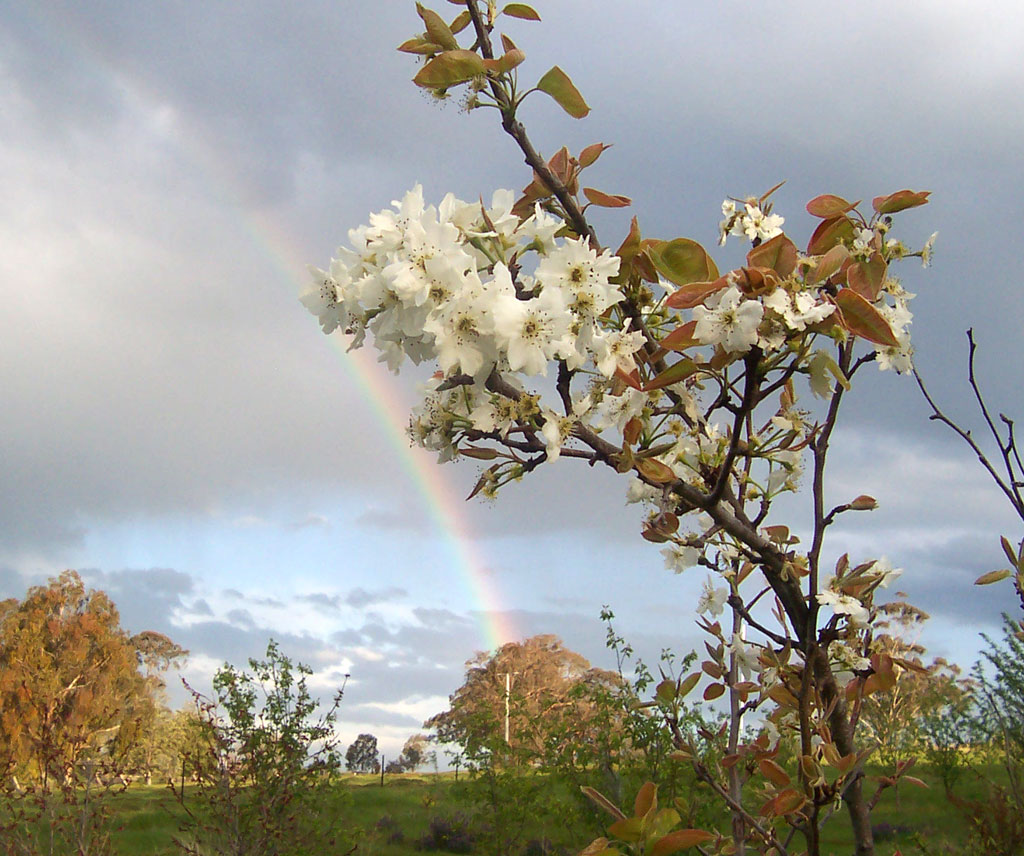





How a rainbow forms
Formation of a rainbow is a combination of geometric and wave optics. When sunlight encounters a spherical water droplet, several optical processes alter the light:
- Refraction: sunlight is bent as it enters the drop (refraction), changing direction according to wavelength.
- Dispersion: the beam is separated into component colours as different wavelengths refract by different amounts (split into colours).
- Internal reflection: some of the separated light reflects off the inside surface of the droplet (reflected back toward the observer).
- Refraction again: light exiting the droplet is refracted a second time, and only rays that emerge at particular angles reach the eye.
The most intense visible concentration of rays from many drops occurs near an angle of about 42 degrees from the line opposite the Sun (the antisolar point) for the primary rainbow. Because each droplet sends different colours to different angles, observers see a continuous arc of separated colours rather than mixed white light.
Appearance and variations
Although commonly drawn as a two-dimensional semicircle, a rainbow is actually a circle centered on the antisolar point; the ground usually hides the lower portion. Variations include:
- Secondary rainbows: a second, fainter arc appears outside the primary with reversed colour order, formed by two internal reflections inside droplets.
- Supernumerary bands: closely spaced, pastel-coloured fringes inside the primary arc produced by wave interference in small, uniform droplets.
- Full circular rainbows: visible from elevated viewpoints such as airplanes or tall buildings when water droplets fill the observer's field of view.
Viewing conditions and practical tips
To see a rainbow, the Sun must be behind the observer and relatively low in the sky, while rain or mist is ahead. Brightness is greater when the individual drops are larger and the sky behind the rainbow is dark, because contrast improves visibility. Each observer perceives their own rainbow because it is formed by light rays that reach a particular eye; two observers in different positions will see different, non-identical arcs.
History, science and cultural meaning
Rainbows have attracted attention since antiquity and appear in myth, religion and art around the world. They serve as symbols in many cultures and appear in sayings and literature. Scientifically, systematic study of rainbows in the 17th and 18th centuries—especially by physicists interested in light and colour—helped establish principles of refraction and the wave nature of light. Modern optics refines these classical accounts and explains subtle effects such as supernumerary rings and polarization within the rainbow.
Notable facts and examples
Commonly observed after storms and showers (storms), rainbows also form from spray near waterfalls, fountains, or even sea spray. They are used as examples in education to demonstrate dispersion and the visible spectrum of sunlight (sometimes presented simply as colour bands). Photographers and artists often exploit rainbow light for dramatic imagery. Scientific instruments and careful observations of rainbows and related phenomena provide information on droplet size and atmospheric conditions.
Because the rainbow's appearance depends on the observer's line of sight relative to the Sun and water droplets, photographs of the same storm may show different rainbows for different viewers. The basic components and processes—light bending at entry and exit (refraction), separation into wavelengths (splitting), and internal reflection—remain a compact explanation for why we see these striking bands of red, orange, yellow, green, blue, indigo and violet.
For more introductory visuals and demonstrations, educational resources and museum exhibits often present controlled experiments showing how light and droplets create a rainbow; a range of online references and outreach materials discuss these effects in accessible language (arc, sky, spectrum).
Questions and answers
Q: What is a rainbow?
A: A rainbow is an arc of colour in the sky that can be seen when the sun shines through falling rain. It consists of a spectrum of colours, starting with red on the outside and changing through orange, yellow, green, blue, indigo, and violet on the inside.
Q: How is a rainbow created?
A: A rainbow is created when white light is bent (refracted) while entering a droplet of water, split into separate colours, and reflected back.
Q: Is a rainbow actually round like a circle?
A: Yes, a rainbow is actually round like a circle. On the ground, the bottom part is hidden but in the sky it can be seen as a circle around the point opposite to the Sun.
Q: When do rainbows often appear?
A: Rainbows often appear after storms.
Q: What are rainbows popular symbols for in many cultures?
A: Rainbows are popular symbols for peace in many cultures.
Q: Are there any other types of rainbows besides regular ones?
A: Sometimes a second larger dimmer rainbow may be seen alongside regular ones.
Related articles
Author
AlegsaOnline.com Rainbow: formation, appearance, and cultural significance Leandro Alegsa
URL: https://en.alegsaonline.com/art/80914