
Rainbow Serpent — Australian Aboriginal creator-being and water spirit
The Rainbow Serpent is a central ancestral being across many Australian Aboriginal cultures, linked to water, landscape formation, law, ceremony and enduring artistic traditions.
Overview
The Rainbow Serpent is a widely recognised ancestral being in many Australian Aboriginal cosmologies. Often described as a great serpent associated with water, it appears in creation narratives that explain the origin of rivers, lakes, springs and other landscape features. These stories are part of the broader Dreaming or Dreamtime tradition, a complex system of law, song, story and sacred knowledge passed down through generations Dreaming traditions. Versions of the Rainbow Serpent are told by many Indigenous communities across the continent Indigenous peoples, and the figure can serve multiple social, spiritual and environmental functions.
Image gallery
4 Images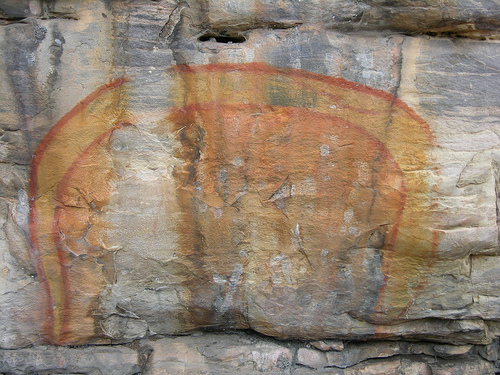


Mythic roles and meanings
The Rainbow Serpent commonly links water and life: it is said to inhabit waterholes and springs, to shape riverbeds as it moves, and to bring or withhold rain. In many accounts it is both creator and regulator — a being that formed hills and valleys and, at times, punished transgressions that upset social order. Its ambivalent nature—both generative and potentially destructive—makes it a powerful symbol used to explain natural events, set moral standards, and maintain community responsibilities.
Regional names and variations
- Across Australia the being is known by many names and appears in diverse forms. In Arnhem Land and neighbouring regions it is often referred to by names such as Ngalyod in Yolŋu languages Arnhem Land contexts.
- Other language groups use different names such as Almudj and many local terms; while motifs and emphases vary, common associations with water, creation and law recur regional names and traditions.
- Some traditions emphasise colourful, rainbow-like aspects linking the serpent to the sky and light; others focus on its subterranean or aquatic presence. Gender, power and exact roles attributed to the serpent differ between communities.
Art, ceremony and material culture
The Rainbow Serpent is a frequent subject in rock art, bark painting, body painting and ceremonial objects. Artists and custodians depict serpentine forms, footprints, tracks and associated iconography to record stories and mark sacred places. Some rock paintings and motifs connected to serpent narratives have been estimated to be several thousand years old, and oral histories often link living communities to these sites. In ceremony, people may paint serpent motifs or place handprints to acknowledge ancestral presence and obligations ceremonial practices.
Origins and scholarly perspectives
Ethnographers, archaeologists and comparative mythologists have explored how Rainbow Serpent themes may reflect long-term environmental and social histories. One hypothesis is that stories emphasise water as a critical resource and may encode collective memories of changing coastlines, river systems and seasonal patterns after the last ice age. Over time the figure accrued layered meanings as a creator, a regulator and a symbol of communal order; researchers examine these layers through oral history, landscape archaeology and cultural studies origin studies.
Contemporary significance
Today the Rainbow Serpent remains a living element of identity and law for many Aboriginal groups and is widely represented in contemporary art, education and cultural heritage work. It appears in community storytelling, exhibitions and teaching about connections between people, land and water. The figure also features in discussions about land rights, site protection and the respectful presentation of Aboriginal culture to broader audiences modern significance. For a general introduction that brings together community perspectives and accessible summaries see related resources general overview.
Interpretation, respect and cautions
It is important to recognise that Aboriginal Australia comprises many nations with distinct languages, laws and sacred protocols. No single description of the Rainbow Serpent can represent every community's beliefs. Public retellings should respect local custodianship, gendered knowledge, and ceremonial confidentiality. Scholarly and popular accounts must avoid treating the Rainbow Serpent as a single, uniform symbol and should privilege community voices when possible.
Further notes
The Rainbow Serpent remains a potent reminder of the deep and continuing relationships between people, land and water across Australia. Whether encountered in rock art, songlines, ceremony or contemporary painting, the being functions as a spiritual ancestor, an ethical regulator and a marker of landscape memory. Readers are encouraged to consult community-led sources and culturally appropriate materials for more detailed, locality-specific information.
Questions and answers
Q: What is a Rainbow Serpent?
A: A Rainbow Serpent is an animal in the Dreamtime that represents the creation of the mountains, rivers, and lakes in Aboriginal mythology.
Q: Where is the story of the Rainbow Serpent found in Australia?
A: The Rainbow Serpent story is found all across Australia, but is most prominent in Arnhem Land in the northern part of the country.
Q: What are some of the names that the Rainbow Serpent is known by in different Aboriginal languages?
A: The Rainbow Serpent is known by different names, such as Almudj and Ngalyod, in various Aboriginal languages.
Q: Where does the Rainbow Serpent live and what is its significance?
A: The Rainbow Serpent lives in waterholes and controls the supply of water. It is significant because it represents creation and destruction, as well as unity and peace.
Q: How have Aboriginal artists depicted the Rainbow Serpent?
A: Aboriginal artists have painted the Rainbow Serpent on cave walls or on pieces of bark in their artwork.
Q: What is the age of the oldest discovered cave paintings of the Rainbow Serpent and where were they found?
A: The oldest discovered cave paintings of the Rainbow Serpent are about 8,000 years old and were found in Australia.
Q: Why is the Rainbow Serpent a symbol of the world's oldest continuing religion?
A: The Rainbow Serpent is a symbol of creation, destruction, unity, and peace in Aboriginal mythology, which is considered the world's oldest continuing religion.
Related articles
Author
AlegsaOnline.com Rainbow Serpent — Australian Aboriginal creator-being and water spirit Leandro Alegsa
URL: https://en.alegsaonline.com/art/80912
Sources
- cultureandrecreation.gov.au : "The Dreaming - Australia's Culture Portal"
- aboriginalartonline.com : "Rainbow Serpent and the Dreamtime - Aboriginal Art Online"
- bom.gov.au : "Rainbow Serpent"