
Raiders of the Lost Ark
1981 action-adventure film directed by Steven Spielberg from a George Lucas story; introduced Indiana Jones and set a new standard for blockbuster adventure films and franchise storytelling.
Overview
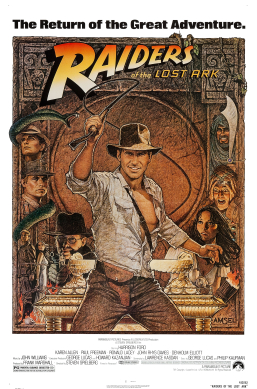
Raiders of the Lost Ark is a 1981 American adventure film directed by Steven Spielberg and written by Lawrence Kasdan from a story conceived by George Lucas with contributions from Philip Kaufman. The film introduced the character Dr. Henry "Indiana" Jones, an academic archaeologist who operates as a globe‑trotting adventurer. Set in 1936, the plot follows Jones as he races Nazi agents to recover the biblical Ark of the Covenant before it can be used for violent ends. The picture deliberately evokes the tone and pacing of early 20th‑century film serials while employing contemporary production values.
Image gallery
10 Images




Production and style
The production emphasized practical effects, location shooting, period production design, and stunt work. Spielberg and Lucas designed the film around setpiece sequences rather than a purely character‑driven structure, aiming to recreate the episodic thrills of pulp adventures. Costume, props, and cinematography sought to evoke the 1930s; the film combined studio sets with on‑location exteriors to create an international, exotic atmosphere.
Plot, themes and tone
The narrative is structured as a fast, goal‑oriented pursuit: Jones deciphers clues, recovers artifacts, and confronts rival treasure hunters and military agents. Themes include the tension between scientific inquiry and the allure of power, the ethical handling of cultural heritage, and a recurring interplay between skepticism and the supernatural. The film mixes suspense, physical comedy, and moments of awe when the supernatural implications of the Ark are revealed.
Casting and characters
The central role of Indiana Jones made a star of Harrison Ford, whose performance balances toughness, humor, and an academic persona. Karen Allen plays Marion Ravenwood, a strong and resourceful romantic lead. Antagonists include Paul Freeman as René Belloq and Nazi officers portrayed by actors such as Ronald Lacey. Supporting roles include John Rhys‑Davies as Sallah, Denholm Elliott as Marcus Brody, and an early appearance by Alfred Molina in a supporting part. The ensemble contributes to the film’s blend of danger and charm.
Music and technical craft
The film’s musical score, crafted to match the serial sensibility and emotional beats of the story, plays a central role in shaping its heroic and suspenseful moods. Technical departments—editing, sound design, art direction, and special effects—worked together to create coherent action sequences that emphasize clear geography, rhythmic pacing, and tangible stunt work rather than reliance on optical effects alone.
Stunts, effects and design
Many sequences rely on elaborate stunt choreography and practical effects to achieve immediacy: fight choreography, vehicle stunts, and carefully timed pyrotechnics are foregrounded. The film’s production design includes period‑accurate costumes, maps, and archaeological paraphernalia intended to ground the fantastic plot in a convincing historical milieu.
Reception and legacy
On release the film was a major commercial success and received strong critical praise for its direction, action sequences, and central performance. It earned industry awards and nominations and became widely cited as a defining example of the modern blockbuster adventure film. Over subsequent decades, it has been recognized for revitalizing interest in pulp storytelling and for shaping filmmakers’ approach to franchise filmmaking and action choreography.
Sequels and franchise
Raiders is the first entry in the Indiana Jones franchise. The immediate series continued with Indiana Jones and the Temple of Doom, Indiana Jones and the Last Crusade, and Indiana Jones and the Kingdom of the Crystal Skull. Beyond the main films, the franchise expanded into books, comics, video games, museum exhibitions, and television, prompting ongoing discussion about how popular entertainment represents archaeology and non‑Western cultures.
Preservation and study
Raiders remains a frequent subject of film scholarship and popular retrospectives. Film historians examine its production history, design choices, cultural impact, and the way it negotiates history, myth, and spectacle. The film is often included in curated lists and retrospectives devoted to influential American films of the late 20th century and continues to be restored and reissued for new formats and audiences.
Further reading
For more detailed credits, production anecdotes, and critical analysis, consult books and documentaries on the film’s making, interviews with principal creators, and scholarly essays that place it in the context of genre history and media franchising. See also entries on genre and personnel: genre context, director, screenwriter, story origin, and lead actor.
Questions and answers
Q: Who directed Raiders of the Lost Ark?
A: Raiders of the Lost Ark was directed by Steven Spielberg.
Q: What is the movie about?
A: Raiders of the Lost Ark is about Indiana Jones, a globe-trotting archaeologist competing with Nazi forces in 1936 to recover the long-lost Ark of the Covenant.
Q: Who wrote Raiders of the Lost Ark?
A: Raiders of the Lost Ark was written by Lawrence Kasdan.
Q: Who stars in Raiders of the Lost Ark?
A: The movie stars Harrison Ford, Karen Allen, Paul Freeman, Ronald Lacey, John Rhys-Davies, Denholm Elliott and Alfred Molina.
Q: How many sequels are there to Raiders of the Lost Ark?
A: There are three film sequels—Indiana Jones and the Temple of Doom, Indiana Jones and the Last Crusade, and Indiana Jones and the Kingdom of Crystal Skull. There will be a fifth film in 2023.
Q: When was Raiders of The Lost ark released?
A:Raiders Of The Lost ark was released in 1981
Related articles
Author
AlegsaOnline.com Raiders of the Lost Ark Leandro Alegsa
URL: https://en.alegsaonline.com/art/80861
Sources
- bbfc.co.uk : "RAIDERS OF THE LOST ARK (A)"
- boxofficemojo.com : "Raiders of the Lost Ark (1981)"