
Quicksand: formation, properties, safety, and cultural perceptions
Quicksand is a water-saturated granular mixture that can behave like a liquid when stressed. This article explains how it forms, how it behaves, safety and escape techniques, and common misconceptions.
Overview
Quicksand is a saturated mixture of fine granular material and water that temporarily loses strength and flows like a fluid when disturbed. It commonly forms where water percolates up through loose grains, reducing friction between particles and allowing them to move past one another. Although it can trap animals and people, total submergence is uncommon because the mixture can be denser than the human body; the main hazard is being immobilized and exposed rather than drowning. For a simple description of the basic components see water and sand mixture and related explanations of sediment types such as sand and silt.
Image gallery
6 Images

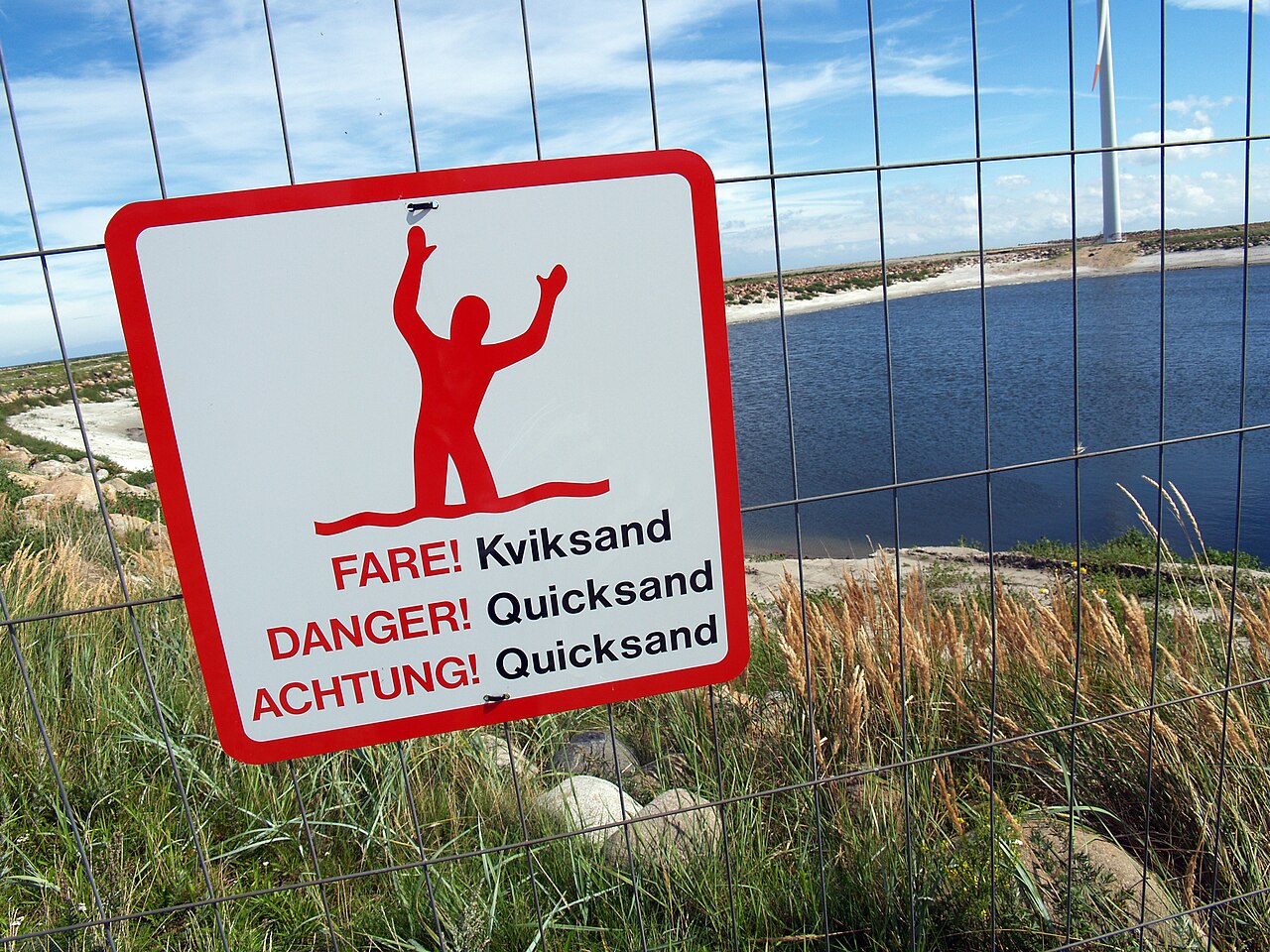


Formation and physical properties
Quicksand arises when flowing or seeping water loosens an otherwise stable bed of grains. Common environments include riverbanks, tidal flats, marshes, and some coastal or desert fringes where groundwater pressure or tidal action increases pore water content. The process is often described using the term thixotropy—a property of some materials that become less viscous under stress and regain viscosity when the stress is removed. In quicksand, upward water pressure reduces contact forces between grains so the mixture can transition from a solid-like to a fluid-like state under shear or sudden load.
Behavior under stress and buoyancy
When a load is applied, grain contacts rearrange and trapped water must move to accommodate the new configuration. Because water cannot be displaced instantly through the pore network, the material momentarily behaves like a viscous fluid and an object may sink. However, buoyant forces and trapped air or denser layers typically prevent complete engulfment. The effective density of the saturated sediment plus water can exceed that of a human, so a person tends to float with limbs partially submerged rather than disappear entirely. For more on the fluid-like aspects, see descriptions of a material that acts like a liquid and the role of density in buoyancy.
Safety and escape techniques
Getting out of quicksand is principally a matter of reducing the stress and increasing your surface area. Quick, panicked movements usually make the situation worse because they increase local shear and draw water away from the grains, sustaining the fluidized state. Common guidance includes:
- Lean back and try to float on your back to distribute weight over a larger area and take advantage of buoyancy.
- Move slowly and deliberately to work air and water back between grains; slow circular motions of the legs can help draw them free over time.
- If available, use a solid object (branch, board, coat) and place it horizontally to increase surface area and create leverage.
- Call for help rather than attempting strenuous self-rescue that could lead to exhaustion or loss of consciousness.
These practical steps echo experimental findings and field advice: gradual, controlled actions are more effective than forceful pulling. Traditional rescue techniques often emphasize flotation and increasing contact with firm ground.
History, study, and cultural impact
Quicksand has long featured in folklore, fiction, and cinema as an emblem of hidden danger. Popular portrayals frequently exaggerate the speed and completeness of sinking for dramatic effect; in reality, fully disappearing into quicksand is rare. Scientific attention to quicksand increased as geologists and engineers studied soil mechanics and the effects of pore pressure on sediment stability. Understanding quicksand also contributes to broader knowledge about liquefaction and slope failures, phenomena that are relevant to earthquake engineering and coastal science.
Distinguishing features and notable facts
At the surface, quicksand can be deceptively normal: leaves, twigs, or a thin crust of debris may remain in place while the underlying layer is fluidized. This concealment is why the phenomenon is sometimes hazardous to unwary travelers and wildlife. Quicksand contrasts with viscous muds that are cohesive and with deep, soft sediments that entrain bodies due to different mechanical and pore-fluid behaviors. For further general references and images of environments where quicksand is more likely, consult overview pages on sediment behavior and coastal wetlands such as those linked at clay and related sediments and surface debris and masking effects.
Overall, quicksand is a localized, naturally occurring response of saturated granular media to changes in stress and pore pressure. It is best approached with caution and respect for local conditions; knowledge of basic escape principles and avoidance strategies is usually sufficient to reduce risk in areas where quicksand is known or suspected.
Questions and answers
Q: What is quicksand?
A: Quicksand is a mixture of water and sand or silt that has the property of thixotropy.
Q: What happens when pressure is applied to quicksand?
A: When pressure is applied to quicksand, it liquifies and behaves like a liquid.
Q: Can people drown in quicksand?
A: No, people or animals do not drown in quicksand because of the higher density of the fluid.
Q: How can a person escape from quicksand?
A: A person can escape from quicksand by slowly moving their legs to reduce the viscosity of the fluid and rotating their body to float on their back (supine).
Q: Why is it difficult to distinguish quicksand from the surrounding environment?
A: It is difficult to distinguish quicksand from the surrounding environment because the sand above does not appear to move and can support leaves and small debris.
Q: How does water circulation underground contribute to the formation of quicksand?
A: Water circulation underground focuses in an area with a mixture of fine sands and other materials. The water moves up and down, which lubricates the sand particles and makes them unable to support significant weight, behaving like a liquid when stressed.
Q: What is the real problem with quicksand?
A: The real problem with quicksand is the difficulty in escaping it.
Related articles
Author
AlegsaOnline.com Quicksand: formation, properties, safety, and cultural perceptions Leandro Alegsa
URL: https://en.alegsaonline.com/art/80539
Sources
- news.nationalgeographic.com : "Quicksand science: why it traps, how to escape"
- nature.com : Rheology: Liquefaction of quicksand under stress
- dx.doi.org : 10.1038/437635a