
Queen (chess piece)
The queen is the most powerful chess piece, combining rook and bishop moves. This article describes its movement, value, history, strategic use, promotion, notation and key endgame roles.
The queen is the most mobile and often most important attacking piece in chess. Each side starts with one queen, placed on the d-file: White's queen on d1 and Black's on d8. A common teaching mnemonic is that the "queen sits on her own color" (the white queen on a light square, the black queen on a dark square). The queen stands next to the king at the initial setup and often becomes a decisive force as the game develops.
Image gallery
4 Images
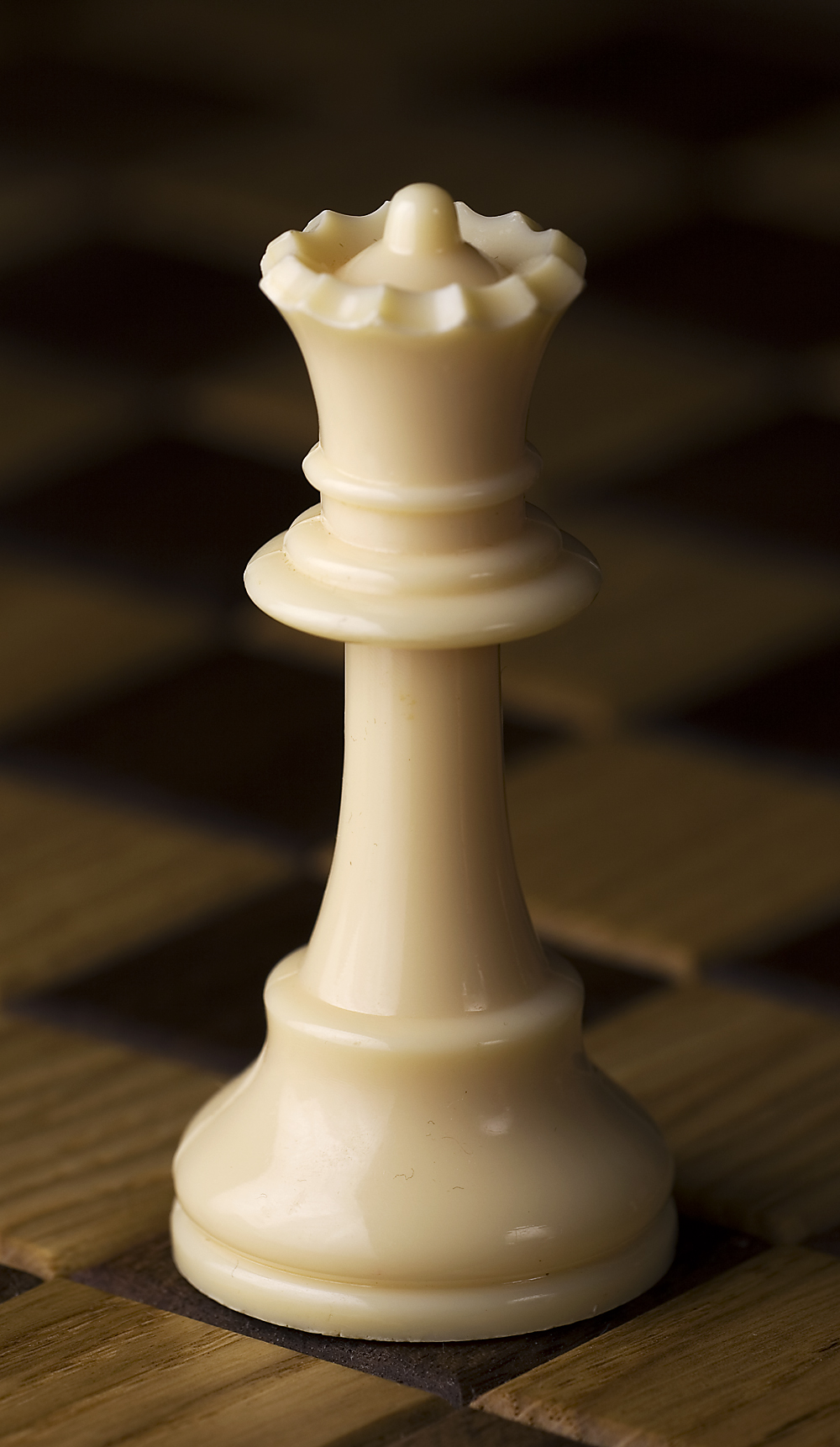


Movement and basic rules
The queen moves any number of unoccupied squares along ranks, files or diagonals, effectively combining the powers of the rook and the bishop. It captures by occupying the square of an opposing piece but cannot jump over intervening pieces. The queen cannot move in ways that leave its own king in check. For concise references see basic piece movement guides such as movement overview.
Characteristics and tactical roles
- Versatility: The queen's ability to move in eight directions makes it ideal for long-range attacks and rapid redeployment.
- Tactics: Queens are often involved in forks, pins, skewers and back-rank tactics.
- Development: Early queen moves can sometimes be risky if they expose the queen to attacks that gain tempo for the opponent.
Value, usage and examples
In material terms the queen is commonly assigned a relative value of about nine pawns, reflecting its combined rook-and-bishop strength. This numerical estimate is a guideline rather than an absolute rule; queen activity, pawn structure and piece coordination can make other material arrangements preferable. Typical strategic uses include centralization, creating mating threats, forming batteries with other pieces, and supporting passed pawns. For visual demonstrations of diagonal, vertical and horizontal power consult resources on diagonal play, files and ranks like diagonal movement, vertical play and horizontal files.
Promotion, endgames and notable facts
Pawn promotion makes the queen a frequent result of a pawn reaching the far rank; underpromotion to another piece is sometimes chosen for practical reasons but the queen is the most common promotion choice. In many endgames a single queen versus lesser material is decisive: for example, a queen and king can force mate against a lone king with correct technique. However, queens can be less effective in locked pawn structures and are vulnerable to discovery attacks and permanent checks if the attacking side lacks support.
History and notation
The modern powerful queen evolved from an earlier medieval piece known as the ferz or counselor, which moved only one square diagonally; the transformation into the present-day queen occurred in late medieval or Renaissance Europe and greatly changed chess strategy. In algebraic notation the queen is abbreviated Q. When necessary to avoid ambiguity the recording includes origin file or rank (for example Qd1 or Qh5) or both. Practical advice for players: develop the queen carefully, coordinate it with other pieces, and beware of chasing the opponent's pieces at the cost of losing time or position.
For further reading on specific patterns, historical development and advanced queen endgames see introductory and advanced guides linked in many chess resources and databases such as piece guides and historical summaries.
Questions and answers
Q: What is a queen in chess?
A: The queen is a chess piece that stands next to the king at the start of a game.
Q: Where do the queen pieces start at the beginning of the game for both white and black?
A: The queen starts on the d1 square for white and the d8 square for black.
Q: What is the movement range of the queen piece?
A: The queen can move any number of unoccupied squares diagonally, vertically, or horizontally.
Q: How is the queen piece abbreviated on game recordings?
A: When recording games, the queen piece is abbreviated to Q.
Q: Can the queen piece move through other pieces on the board?
A: No, the queen piece must be able to move to an unoccupied square in order to make a legal move.
Q: How many queens does each player start with in a game of chess?
A: Each player starts with one queen piece in a game of chess.
Q: What is the relative value of the queen piece compared to other pieces on the chess board?
A: The queen is considered the most valuable piece on the chess board, with a relative value of 9 points.
Author
AlegsaOnline.com Queen (chess piece) Leandro Alegsa
URL: https://en.alegsaonline.com/art/80453