
Queen (butterfly) — Danaus gilippus
Danaus gilippus, the Queen, is a milkweed-feeding butterfly in the family Nymphalidae found from the southern United States through Central and South America; noted for its warning colors and mimicry.
Overview
The Queen (Danaus gilippus) is a medium-sized butterfly in the brush-footed family Nymphalidae. It is widely distributed from parts of the southern United States through Central America and into much of South America. Like other Danaus species, the Queen is associated with milkweed plants and displays aposematic coloration that warns predators of chemical defenses it acquires from its host plants.
Image gallery
10 Images




Identification and life cycle
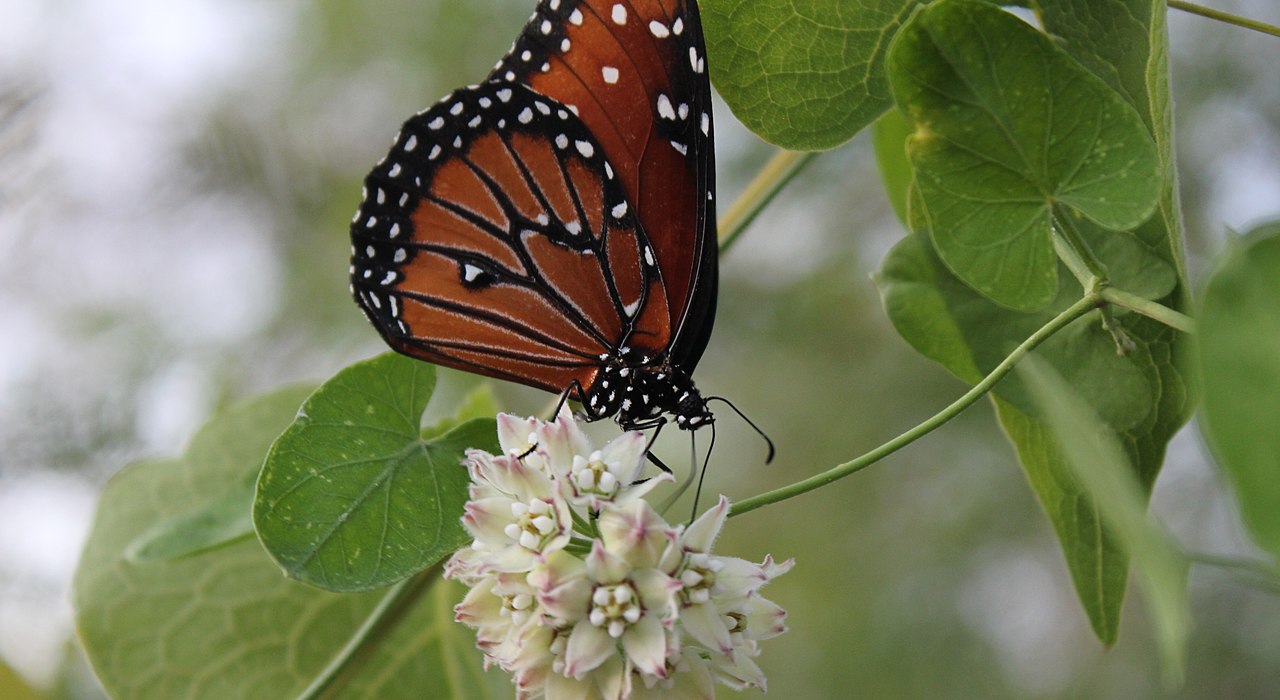
Adults typically have rich reddish-brown or chestnut wings edged with black and flecked with white spots. Males often show a darker scent patch on the hindwing used in courtship. Caterpillars are banded with black, white and orange and feed on a variety of milkweed and related plants, sequestering toxic cardenolides that reduce their palatability. The life cycle follows the usual stages of egg, larva, pupa and adult, and several broods may occur where climate permits.
Habitat and range
The Queen inhabits open areas, fields, roadsides and gardens where host plants are present. It is tolerant of disturbed habitats and is found in a wide range of elevations in tropical and subtropical regions. Populations are recorded across North America, Central America and South America, and regional accounts and guides provide more local detail (taxon page, butterfly guide).
Ecology and behavior
Queens participate in mimicry complexes: their warning colors resemble those of the Monarch and sometimes the Viceroy, creating mutual or protective mimicry depending on local predator learning. Adults feed on nectar and are important pollinators for many flowering plants. Males may exhibit territorial behavior and use pheromone-laden scales during mating displays.
Human relevance and notable facts
- Host plants: various milkweeds and dogbanes, which supply defensive chemicals.
- Mimicry: part of a group of milkweed butterflies that educate predators via conspicuous coloration.
- Study subjects: used in research on chemical ecology, mimicry and insect-plant interactions (see family Nymphalidae and Nymphalidae overview).
Conservation concerns are generally localized: habitat loss and declines of native host plants can reduce populations in some areas, so planting appropriate milkweeds and conserving nectar sources can support local Queen populations. For further reading and species accounts consult regional resources and natural history repositories (taxon page, butterfly guide).
Questions and answers
Q: What is the Queen butterfly also known as?
A: The Queen butterfly is also called Danaus gilippus.
Q: Which family does the Queen butterfly belong to?
A: The Queen butterfly belongs to the family Nymphalidae.
Q: Where is the Queen butterfly found?
A: The Queen butterfly is found in North America, Central America, and South America.
Q: Is the Queen butterfly a common species?
A: Yes, the Queen butterfly is a common species.
Q: What is the scientific name of the Queen butterfly?
A: The scientific name of the Queen butterfly is Danaus gilippus.
Q: What is the order of insects that the Queen butterfly belongs to?
A: The Queen butterfly belongs to the order Lepidoptera.
Q: What is the size range of the Queen butterfly?
A: The size range of the Queen butterfly is about 75-95mm in wingspan.
Related articles
Author
AlegsaOnline.com Queen (butterfly) — Danaus gilippus Leandro Alegsa
URL: https://en.alegsaonline.com/art/80450
Sources
- animaldiversity.ummz.umich.edu : "ADW: Danaus plexippus: Information"
- nature.com : nature.com/articles/350497a0?error=cookies_not_supported&code=7a71007a-339e-4d2b-b7a7-ee2…
- commons.wikimedia.org : Danaus gilippus
- species.wikimedia.org : Danaus gilippus