
Qualia (philosophy of mind)
Qualia are the subjective, first‑person aspects of conscious experience — the felt qualities of sensations such as pain, color, or taste, central to debates in philosophy of mind and consciousness.
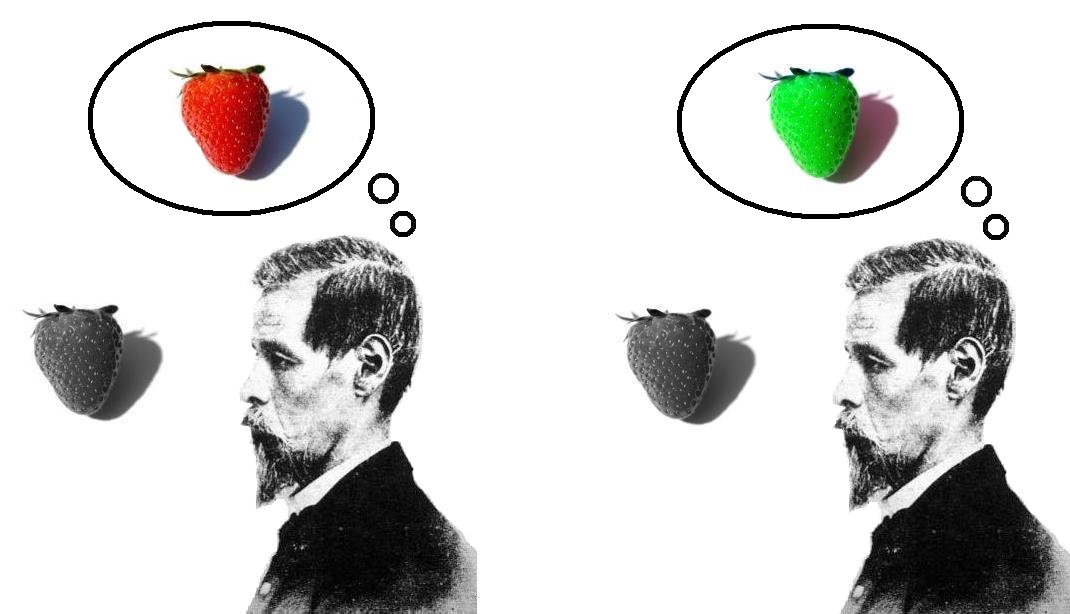
Qualia refers to the qualitative, subjective elements of conscious experience: what it is like to feel pain, to taste wine, or to see red. The term is used in discussions of perception and the philosophy of mind to isolate the felt aspect of experiences from cognitive judgments, beliefs, or behavioral reports. Qualia are typically described from a first‑person perspective and are central to questions about how and whether physical accounts can capture phenomenal experience.
Image gallery
10 Images





Key characteristics
Philosophers and cognitive scientists often characterize qualia by several intuitive features. They are said to be subjective (directly accessible only to the subject who has them), ineffable (difficult to fully communicate to others), and particular to an instance of experience rather than a belief or representation. Qualia are normally contrasted with propositional attitudes — knowing that or believing that — and with functional or behavioral descriptions of mental states.
Historical background and debates
The modern debate over qualia intensified in the late 20th century, driven by thought experiments and arguments about the limits of physical explanation. Famous examples include philosophical cases designed to separate knowledge of facts from knowledge of the way things feel. Some thinkers argue that qualia pose a challenge to reductive physicalism, while others deny that qualia form a coherent, scientifically useful category. Critics contend that reports about qualia can be explained in functional or neurobiological terms without invoking an additional ontological kind.
Examples and relevance
Commonly cited instances of qualia include the sharpness of a headache, the sweetness or body of a wine, and the particular redness of a sunset. These examples illustrate why qualia are important to discussions about consciousness: they highlight the difference between objective description and subjective feeling. The concept informs debates in neuroscience, psychology, and artificial intelligence about whether systems without human‑like phenomenology could nonetheless behave as if they were conscious.
Distinctions and notable positions
Qualia are often distinguished from sensory input (stimulus), perceptual representation (what the nervous system encodes), and cognitive interpretation (beliefs about what is perceived). Philosophers take different stances: some maintain that qualia are nonreductive and pose a special explanatory gap, while others argue for eliminativist or deflationary accounts that treat qualia reports as useful but not metaphysically fundamental. Thinkers such as Daniel Dennett have questioned traditional uses of the term and urged careful analysis of the intuitions that motivate qualia talk.
Further reading and related topics
- Perception and sensation overview
- Conscious experience (introductory)
- Philosophy of psychology
- Philosophy of mind (survey)
- Pain and phenomenology
- Examples: headache case
- Taste and gustatory experience
- Wine tasting as a case study
- Color qualia and perception
- Phenomenal character of experience
- Distinguishing experience from thought
- Thoughts versus sensations
- Propositional attitudes and qualia
- Stream of consciousness discussions
- Daniel Dennett (perspectives)
- Cognitive science and qualia
- Scientific approaches to consciousness
Questions and answers
Q: What is the meaning of qualia?
A: Qualia is a term used by philosophers to refer to bits of perception or subjective, conscious experience.
Q: In which field of philosophy is qualia studied?
A: Qualia is studied in the field of philosophy of psychology or philosophy of mind.
Q: What are some examples of qualia?
A: Some examples of qualia include the pain of a headache, the taste of wine, or the perceived redness of an evening sky.
Q: How is qualia different from thinking about propositions or stream of consciousness thought?
A: Qualia is a separate bit of experience that is different from thinking about propositions or stream of consciousness thought.
Q: Who is Daniel Dennett?
A: Daniel Dennett is an American philosopher and cognitive scientist.
Q: What does Daniel Dennett say about qualia?
A: Daniel Dennett says that qualia is "an unfamiliar term for something that could not be more familiar to each of us: the ways things seem to us".
Q: What is the familiarity of qualia according to Daniel Dennett?
A: According to Daniel Dennett, qualia is something that could not be more familiar to each of us as it refers to the ways things seem to us.
Related articles
Author
AlegsaOnline.com Qualia (philosophy of mind) Leandro Alegsa
URL: https://en.alegsaonline.com/art/80369
Sources
- consc.net : Online papers on qualia
- ase.tufts.edu : "Dennett D. ''Quining Qualia''"