
A Millionaire for Christy (1951 film)
A Millionaire for Christy is a 1951 American comedy directed by George Marshall, starring Fred MacMurray and Eleanor Parker. A studio-era light comedy distributed by 20th Century Fox.
Overview
A Millionaire for Christy is a 1951 American comedy film directed by George Marshall and released by 20th Century Fox. Positioned within the studio-era output of the early 1950s, it showcases the era's preference for breezy, character-driven comedies and star-focused vehicles. The picture is remembered primarily for its cast and its placement within the careers of several well-known performers.
Image gallery
1 Image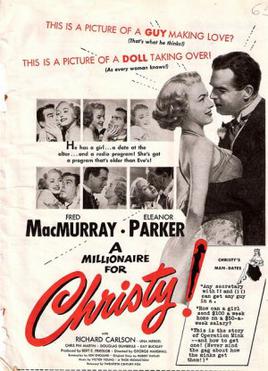
Cast and characters
The film stars Fred MacMurray and Eleanor Parker, supported by Richard Carlson, Una Merkel, and Douglass Dumbrille. MacMurray was widely known for his work in both comedy and drama, while Parker had a reputation for dramatic range and versatility. The ensemble emphasizes comedic timing and interpersonal dynamics over spectacle.
Production and style
Directed by George Marshall, who had a long career in Hollywood working across genres, the movie reflects the polished studio production values of its time. It uses conventional narrative devices of romantic and social comedy, such as misunderstandings and class contrasts, to create light-hearted situations. The pacing and direction aim to highlight performances and dialogue rather than elaborate set pieces.
Reception and legacy
Upon release the film received modest attention, typical of many mid-century comedies that were popular with general audiences but did not always become major critical events. In later decades it has been of interest to classic-film enthusiasts and researchers studying the period, the careers of its leading players, and the production practices of 20th Century Fox.
Notable facts
- The film is part of Fred MacMurray's large body of work spanning romantic comedies and dramatic roles.
- Eleanor Parker's presence adds a dramatic counterpoint to the comic framework.
- As a studio-era release, it provides insight into genre conventions and star vehicles of the early 1950s.
For viewers interested in classic Hollywood comedies, this film offers a compact example of postwar studio filmmaking and the types of light entertainment that sustained mid-century American cinemas.
Questions and answers
Q: Who directed A Millionaire for Christy?
A: A Millionaire for Christy was directed by George Marshall.
Q: Who starred in A Millionaire for Christy?
A: The cast of A Millionaire for Christy included Fred MacMurray, Eleanor Parker, Richard Carlson, Una Merkel, and Douglass Dumbrille.
Q: What genre is A Millionaire for Christy?
A: A Millionaire for Christy is a comedy movie.
Q: When was A Millionaire for Christy released?
A: A Millionaire for Christy was released in 1951.
Q: Which company distributed A Millionaire for Christy?
A: A Millionaire for Christy was distributed by 20th Century Fox.
Q: Where can I watch A Millionaire for Christy?
A: A Millionaire for Christy may be available for streaming or purchase on various platforms, such as Amazon Prime Video or iTunes.
Q: Was A Millionaire for Christy a commercial success?
A: There is no information about the commercial success of A Millionaire for Christy available.
Tags
Related articles
Author
AlegsaOnline.com A Millionaire for Christy (1951 film) Leandro Alegsa
URL: https://en.alegsaonline.com/art/80