
Puerta del Sol — Madrid's central square and Kilómetro Cero
Puerta del Sol is a historic public square in central Madrid, known as the city's meeting point and the location of Spain's 'kilómetro cero', notable monuments, the New Year's countdown and major civic events.
Overview
Puerta del Sol, literally the "Sun Gate," is one of Madrid's best-known public squares and a focal point for the city's social, political and commercial life. Originally an entrance on the eastern side of the medieval city, the place evolved into a wide urban plaza that locals and visitors use as a meeting point and reference. It is often called the symbolic centre of Spain because it marks the beginning of the national road network, a fact commemorated on the square itself.
Image gallery
10 Images




History and development
The name Puerta del Sol recalls a city gate that once stood where the square is now: because the sun rises in the east, that gate became known as the Sun Gate. Over centuries the area changed from a defensive and transit point into a civic square. The space that we recognize today went through major rebuildings and redesigns; the square was significantly altered in the 19th century and rebuilt in 1854 to accommodate increasing urban demands. Historic buildings, streets and civic institutions grew around the plaza as Madrid expanded beyond its medieval walls.
Notable features
- Kilómetro cero: A plaque set into the pavement marks the point from which distances on Spain's radial roads are traditionally measured. For an introduction to this concept see kilómetro cero.
- Casa de Correos and its clock: The red-brick façade that frames one side of the square is the former main post office; its clock tower provides the official countdown that is central to New Year's Eve celebrations. Related historical and architectural notes appear at Casa de Correos.
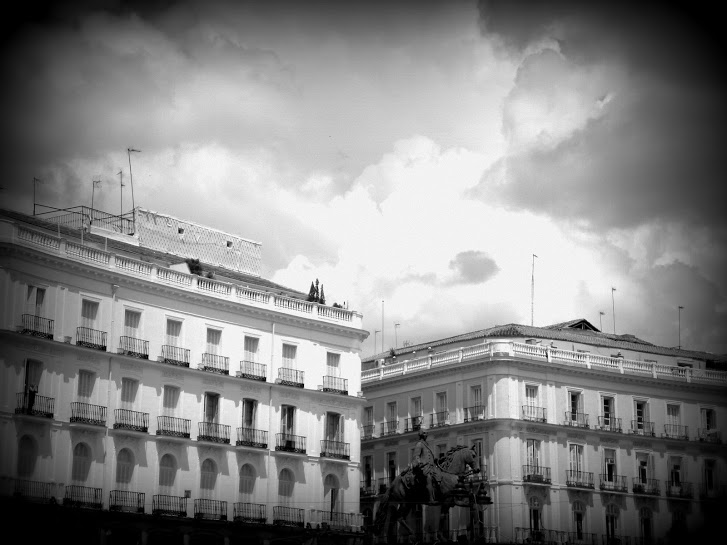
- Monuments: The square hosts a number of sculptures and statues, including the equestrian monument to King Carlos III and the well-known bronze of the bear and the strawberry tree (Oso y el Madroño), a heraldic symbol of Madrid. See more on the royal statue at statue of King Carlos III.
- Urban fabric: Several important streets converge on the plaza, and the square serves as a transport and pedestrian hub linking shopping streets, cafés and municipal buildings. Its role as a crossroads dates back to its origins as an eastern city gate; an overview of the gate's place in Madrid's layout can be found at east gate.
Cultural importance and events
Puerta del Sol is an established site for public rituals and mass gatherings. The most internationally visible tradition is Spain's New Year's Eve celebration: crowds assemble beneath the Casa de Correos clock to eat the twelve grapes in time with the clock's twelve chimes, a ritual widely broadcast on television since 1962 and documented in many cultural histories (televised New Year's broadcast). Beyond holiday festivities, the plaza has been the scene of demonstrations, civic rallies and spontaneous celebrations, reflecting its role as a civic agora where political and popular life intersect.
Modern role and distinctions
Today the Puerta del Sol functions as a practical centre of urban life — a transit interchange, shopping area and tourist magnet — while retaining its symbolic weight as Madrid's meeting point and Spain's reference kilometre. The square's monuments, the km 0 marker, the clock and the bear-and-tree sculpture are frequent points of orientation and photographic interest. Its layered history, from medieval gate to contemporary plaza, illustrates the broader evolution of Madrid from walled town to modern capital.
For those exploring the square, a short walk will reveal both the practical elements (shops, transport links and cafés) and the symbolic ones (plaques, statues and the clocktower). Each feature contributes to the Puerta del Sol's identity as a living public space where history and everyday urban life meet.
Questions and answers
Q: What is Puerta del Sol?
A: Puerta del Sol is a famous square in Madrid, known as 'Spain's belly button'.
Q: Why did Puerta del Sol get its name?
A: Puerta del Sol got its name because it was the gate or entrance of the east side of the city, and the sun rises in the east.
Q: What is the significance of Puerta del Sol in Madrid?
A: Puerta del Sol is the center of 'kilometer 0' of Madrid, from where all roads are measured.
Q: When was Puerta del Sol rebuilt?
A: Puerta del Sol was rebuilt in 1854.
Q: What is the statue in the middle of the Puerta del Sol square?
A: The statue in the middle of the Puerta del Sol square is of King Carlos III.
Q: What is the red brick building in Puerta del Sol?
A: The red brick building in Puerta del Sol is the former post office.
Q: What is the famous statue that can be found in Puerta del Sol?
A: The famous statue that can be found in Puerta del Sol is the Oso y el Madroño (bear eating madroños) statue.
Related articles
Author
AlegsaOnline.com Puerta del Sol — Madrid's central square and Kilómetro Cero Leandro Alegsa
URL: https://en.alegsaonline.com/art/79949