
Puducherry district (Union Territory of Puducherry)
Coastal district centered on the city of Puducherry, covering 290 km² in several non-contiguous enclaves within Tamil Nadu; noted for French colonial heritage, beaches, and spiritual communities.
Overview
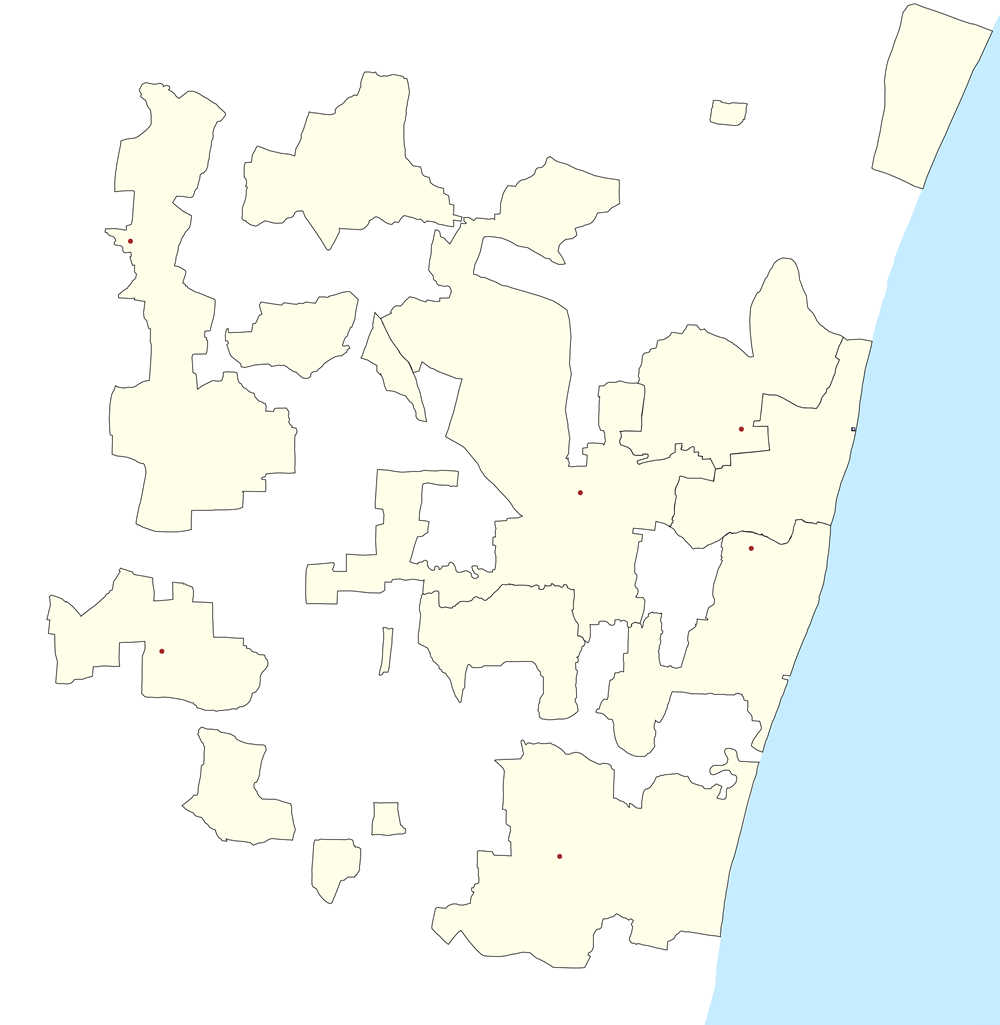
Puducherry district is one of the four districts that make up the union territory of Puducherry in southern India. It centers on the city commonly called Pondicherry or Puducherry, which serves as the territory's administrative capital. The district covers an area of about 290 square kilometres and is distinct for being scattered into a number of separate land parcels rather than forming a single contiguous territory.
Image gallery
4 Images


Geography and layout
The district's territory consists of several non-contiguous coastal and near-coastal enclaves located on or near the shores of the Bay of Bengal. These pockets of land lie within the state of Tamil Nadu, surrounded by districts of that state. The coastal position gives the district sandy beaches, lagoons, and fishing communities, while inland patches include agricultural villages and suburban neighbourhoods linked to the city.
History and development
Puducherry's modern identity was shaped by its long association with French colonial rule, which left a visible imprint on urban planning, architecture and legal traditions. The area changed hands and governance during the mid-20th century and was integrated into the Republic of India after the end of colonial administration. The visible mix of colonial streets, churches and government buildings sits alongside traditional Tamil settlements.
Culture, religion and attractions
The district is culturally Tamil in language and daily life but also reflects European influences in cuisine, building styles and some social institutions. It attracts visitors for spiritual centres and seaside leisure: the Sri Aurobindo Ashram and the nearby international township of Auroville draw pilgrims and long-term residents. The city's Promenade, colonial-era French Quarter and local markets make it a centre for tourism in southern India.
Economy and transport
The local economy combines tourism, small-scale industry, services, and coastal fishing. The city functions as a hub for administration, education and retail for the surrounding enclaves. Road and rail connections tie the district to larger urban centres in the region, and a modest local airfield and nearby major airports serve occasional commercial and charter flights.
Administration and notable facts
Administratively, the district is governed as part of the union territory and contains municipal wards, taluks and village panchayats that manage local affairs. Its fragmentation into multiple enclaves within Puducherry (Pondicherry) and neighbouring Tamil Nadu creates unique planning and service-delivery challenges, making intergovernmental coordination important for development and infrastructure.
Notable sites
- Sri Aurobindo Ashram and associated cultural institutions
- The French Quarter and colonial architecture of the capital
- Promenade Beach and coastal promenades popular with residents and visitors
- Auroville, the international township established in the late 1960s
- Local fisheries, markets and traditional temples that reflect the district's Tamil heritage
The district combines a compact urban core with dispersed rural and coastal enclaves, producing a blend of historic European and classical Tamil influences that continues to shape its identity and appeal.
Questions and answers
Q: What is Puducherry district?
A: Puducherry district is one of the four districts of Puducherry in southern India.
Q: How big is Puducherry district?
A: Puducherry district occupies an area of 290 square kilometres.
Q: Where is Puducherry district located?
A: Puducherry district is located in the state of Tamil Nadu in southern India.
Q: How many enclaves is Puducherry district spread over?
A: Puducherry district is spread over 11 non-contiguous enclaves.
Q: Is Puducherry district located near the Bay of Bengal?
A: Yes, Puducherry district is located on or near the Bay of Bengal.
Q: Is Puducherry district a compact area?
A: Yes, Puducherry district is a compact area.
Q: What is the total area of Puducherry district?
A: The total area of Puducherry district is 290 square kilometres or 110 sq mi.
Related articles
Author
AlegsaOnline.com Puducherry district (Union Territory of Puducherry) Leandro Alegsa
URL: https://en.alegsaonline.com/art/79938
Sources
- census2011.co.in : "District Census 2011"
- censusindia.gov.in : "Literacy Rates by Residence and Sex - U.T. District and Taluk – 2011"