
Psalms (the Book of Psalms)
A collection of Hebrew religious poems and songs found in Jewish and Christian scriptures. Explains structure, literary features, history, liturgical use, and variations in numbering and canon.
The Book of Psalms is an anthology of religious poetry and song traditionally known in Hebrew as Tehillim. It appears as a single book in most editions of the Bible and consists of a broad range of compositions whose primary themes are praise, lament, thanksgiving, royal celebration, wisdom reflection, and penitence. The work is central to both Jewish and Christian worship and has been transmitted in the Hebrew tradition and in Greek and Latin translations since antiquity: see the wider context of the Bible, the placement in the Jewish canon as part of the Ketuvim, and its role in the Old Testament for Christians.
Image gallery
10 Images


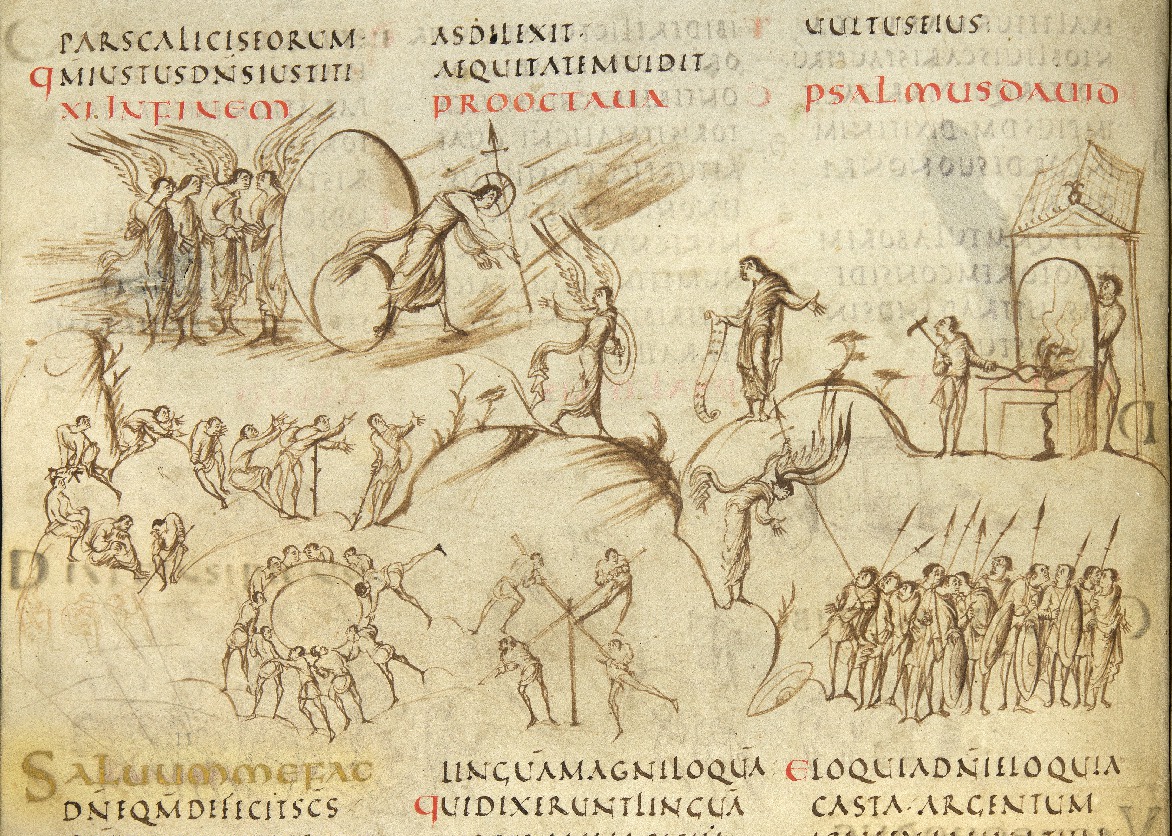

Form and contents
Psalms are distinctively Hebrew poetry, often built on parallelism, repetition, and vivid imagery rather than rhyme or fixed metre. The collection contains 150 psalms in the standard Masoretic edition, though numbering and contents vary: some Christian traditions follow the Septuagint numbering and other traditions include additional poems. Many psalms bear superscriptions that ascribe authorship or indicate musical use, and several are acrostic or otherwise structured for mnemonic recitation.
Structure and categories
The book is traditionally divided into five books (I–V), a shape long recognized by Jewish and Christian interpreters and often compared to the Pentateuch in its fivefold grouping. Psalms are commonly classified by type:
- laments (individual and communal),
- thanksgiving psalms,
- psalms of praise and hymns,
- royal psalms concerned with the king and covenant,
- wisdom psalms that resemble Proverbs, and
- imprecatory and penitential poems.
Authorship and historical development
Traditional attribution links many psalms to King David, and others carry names such as Asaph, the Sons of Korah, Solomon, and Moses on their headings. Modern scholarship sees the Psalter as a compilation spanning several centuries—from the monarchic era through the post-exilic period—and reflects varied communal and liturgical contexts. Important textual witnesses include the Hebrew Masoretic Text, the Greek Septuagint, and fragments preserved among the Dead Sea Scrolls; these witnesses also explain some numbering differences between traditions.
Liturgy, devotion, and influence
Psalms have been used in private prayer, synagogue and church worship, and in monastic and communal liturgies. Specific psalms, such as Psalm 23 with its opening, "The LORD is my shepherd," are widely known and often used at services and rites of passage. Musical settings across millennia range from ancient temple or temple-like performances indicated by instrumental directions in headings to elaborate choral and organ works in later Western art music. The Psalter remains a living source for prayer, preaching, and art.
Textual variants and canon
While most Jewish and Western Christian traditions accept 150 psalms as canonical, some Eastern churches include an additional Psalm 151, and other poetic pieces exist outside the canonical collection. Numbering differences arise because the Hebrew and Greek textual traditions sometimes split or combine individual poems; readers may consult guides that map Hebrew numbering to the Septuagint/Latin ordering. The Psalms occupy a special place in the Hebrew Bible and continue to shape devotional life among Jewish communities and multiple Christian communions. For further reference on the book as a whole see related entries on the book and its role within scripture, the Psalter's place in the canon, and traditions such as the Eastern Orthodox Church and other bodies.
Readers seeking introductions or translations should consult scholarly histories and annotated translations to follow issues of context, poetic technique, and how particular psalms were used in ancient and later worship. Additional resources can be found via reference collections and specialized commentaries on the Ketuvim and broader studies of the canonical Psalms in both Jewish and Christian traditions; for denominational perspectives see guides for Old Testament study and liturgical practice Tehillim collections used in daily prayer.
Questions and answers
Q: What is Psalms?
A: Psalms is a book of 150 Hebrew poems in the Bible.
Q: What is the origin of Psalms?
A: Psalms is part of the Hebrew Bible or Tanakh, and it is also in the Old Testament of the Christian translations.
Q: Who is believed to have written many of the Psalms in the Bible?
A: People traditionally believe that many of the Psalms in the Bible were written by King David to God.
Q: Which is the most famous Psalm?
A: Perhaps the most famous Psalm is Psalm 23, which starts "The LORD is my shepherd".
Q: For what is Psalm 23 often used?
A: Psalm 23 is often used for funerals.
Q: How many Psalms are in the Biblical canon of Jews, Protestants, and Catholics?
A: There are 150 Psalms in the Biblical canon of Jews, Protestants, and Catholics.
Q: What is Psalm 151?
A: Psalm 151 is part of canon of the Eastern Orthodox Church.
Related articles
Author
AlegsaOnline.com Psalms (the Book of Psalms) Leandro Alegsa
URL: https://en.alegsaonline.com/art/79807
Sources
- commons.wikimedia.org : Psalters