
Prosimian — informal grouping of early primates
Prosimian describes an informal, paraphyletic assemblage of early or 'primitive' primates that includes lemurs, lorises, tarsiers and several extinct lineages; used for comparison rather than formal taxonomy.
Prosimian is an informal term used to describe a collection of primates that retain many ancestral features. Historically this label grouped together the animal order broadly thought of as the earliest-diverging primate lineages, including various living and fossil types. The word often appears when comparing these animals with more derived primates; it is not a formal taxonomic rank used in modern classification. For context see primates.
Image gallery
2 Images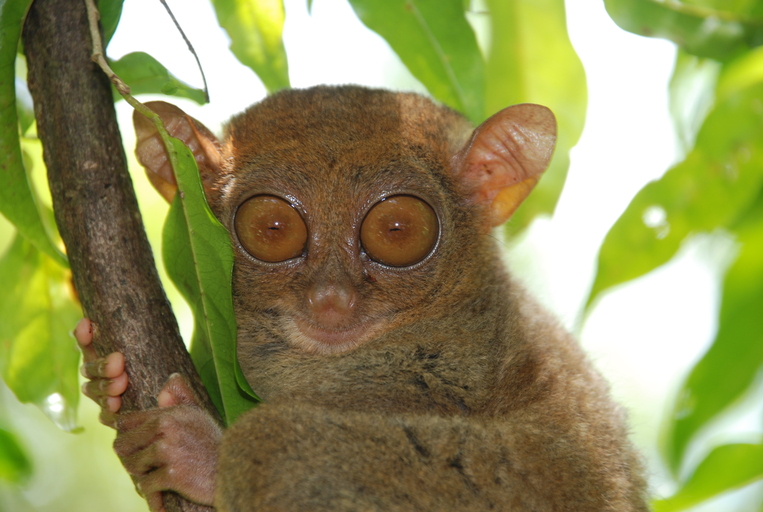

Overview and components
In conventional usage prosimians include the living strepsirrhines such as lemurs and lorises, extinct groups like the adapiforms, and the small, long‑legged tarsiers, which are part of the haplorhine side of the primate tree. The adjective "primitive" is often applied to prosimians to indicate that some of their traits are closer to those of early primates than are the traits of monkeys and apes (simians).
Key characteristics
- Many species are nocturnal and rely heavily on smell and hearing compared with most simians.
- Some strepsirrhines possess a dental comb and specialized grooming claws.
- Brain-to-body size ratios are generally smaller than those of monkeys and apes, and their eyes may be large to aid night vision.
- Locomotion varies: leaping, climbing and slow quadrupedal movement are common across different groups.
Evolution and taxonomy
From an evolutionary viewpoint the animals grouped as prosimians do not form a single clade. For example tarsiers share a more recent common ancestor with simians than with strepsirrhines, so modern systematists treat prosimians as paraphyletic. As a result the term remains useful in ecological and behavioral comparisons but is deprecated in strict phylogenetic classifications.
Distribution and conservation
Members traditionally called prosimians occur across parts of Africa and Asia, and one prominent lineage—the lemurs—is endemic to Madagascar. Many species face threats from habitat loss, hunting and introduced predators; their dependence on forest habitats and often limited ranges make conservation a priority for several genera and species.
Notable facts and usage
Although not a formal group in modern taxonomy, "prosimian" persists in popular and scientific writing because it succinctly contrasts these primates' ancestral traits with those of higher primates. Researchers use the term when discussing comparative anatomy, behavior, ecology and the fossil record, while recognizing the term's limitations for describing evolutionary relationships.
Questions and answers
Q: What is a prosimian?
A: A prosimian is a group of proto-primates that includes all living and extinct strepsirrhines, as well as the haplorhine tarsiers and their extinct relatives, the omomyiforms.
Q: How does the physical characteristics of prosimians compare with those of simians?
A: Prosimians have characteristics that are more "primitive" (ancestral or plesiomorphic) than those of simians (monkeys, apes, and humans).
Q: Is prosimian a clade or a paraphyletic group?
A: Prosimians are a paraphyletic group and not a clade (a group of an ancestor and all its descendants).
Q: With which primates do tarsiers share a more recent common ancestor?
A: Tarsiers share a more recent common ancestor with all simians than with the strepsirrhines.
Q: Is "prosimian" still an official term in taxonomy?
A: No, the term "prosimian" is no longer an official term in taxonomy.
Q: Are prosimians only found in Madagascar?
A: No, prosimians are the only primates native to Madagascar, but are also found throughout Africa and in Asia.
Q: For what purpose is the term "prosimian" still used?
A: The term "prosimian" is still used to compare their behaviour with that of other primates.
Related articles
Author
AlegsaOnline.com Prosimian — informal grouping of early primates Leandro Alegsa
URL: https://en.alegsaonline.com/art/79478
Sources
- books.google.com : Reproductive ecology and human evolution