
Azerbaijani Armed Forces: structure, history, and role
Comprehensive overview of the Azerbaijani Armed Forces: organization, branches, history, related units, modernization and regional roles, with links to related topics.
The Azerbaijani Armed Forces (in Azerbaijani Azərbaycan Silahlı Qüvvələri) are the state military organization responsible for defending the sovereignty and territorial integrity of the Republic of Azerbaijan. They perform national defense, disaster response and assist civil authorities in emergencies. The armed forces operate alongside other uniformed services and paramilitary formations that may be mobilized for national security.
Image gallery
10 Images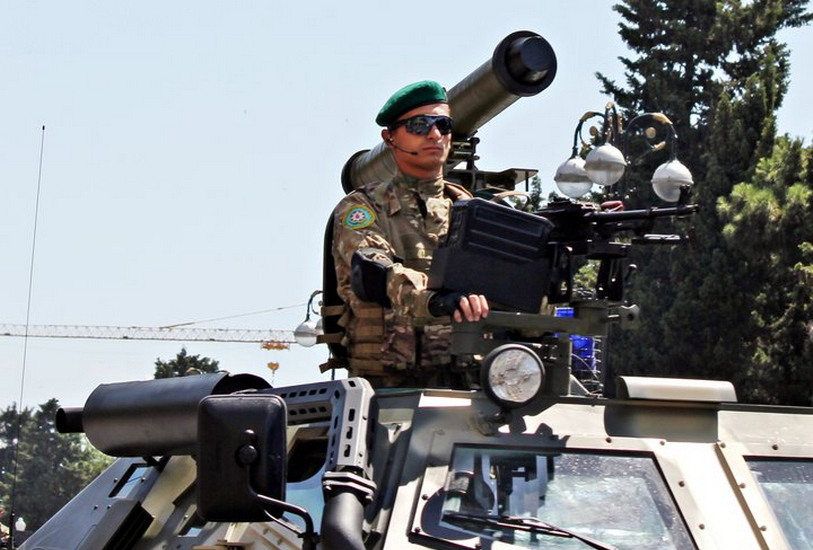


Branches and related formations
At their core the armed forces are organized into three conventional branches: the Land Forces (Azerbaijani Land Force), the Air Force (Azerbaijani Air Force) and the Navy (Azerbaijani Navy), which patrols and protects national interests on the Caspian Sea. Separate from these but closely tied to internal security are the National Guard (Azerbaijani National Guard / National Guard) and the Internal Troops (Internal Troops of Azerbaijan). The State Border Service (State Border Service) protects frontiers and cooperates with neighboring border agencies of Georgia, Russia, Iran, Turkey and Armenia.
Command, organization and service
Constitutionally the President serves as Commander-in-Chief and civilian political oversight is exercised by the Ministry of Defense. Operational control and professional military leadership rest with the General Staff, often led by a Chief of Staff. Military service in Azerbaijan combines conscription for a period of mandatory service with a professional officer corps and volunteer contracts; extensive reserve lists include former conscripts who can be mobilized in crises.
The force structure includes combat units, combat support and service branches (logistics, engineering, communications, air defence and intelligence). Training institutions, military academies and a growing domestic defense industry support force development and sustainment. Equipment types range from small arms and armored vehicles to air platforms and coastal craft, procured both through domestic production and international purchases.
Historical development and conflicts
Armed forces with an Azerbaijani identity first formed during the short-lived Azerbaijan Democratic Republic in 1918 (Azerbaijan Democratic Republic) following the collapse of the Russian Empire. That initial structure was dissolved after the 1920 invasion and annexation by the Soviet Union. Modern Azerbaijani forces were reconstituted in 1991 as Soviet control ended (Soviet Union), taking shape from units stationed in the Azerbaijan Soviet Socialist Republic (Azerbaijan SSR) and former Soviet formations (Soviet forces). Since independence the military has been shaped by periods of conflict, peacetime reform and efforts to professionalize and modernize.
During the post‑Soviet decades the armed forces were involved in the protracted conflict over Nagorno‑Karabakh and periodic escalations with neighboring forces; these events have driven doctrinal changes, force restructuring and priority investments in mobility, firepower and command-and-control capabilities. International cooperation in training, exercises and defence diplomacy has also become part of modernization efforts.
Size, reserves and role in society
Estimates of force size have varied over time. Historical figures from the 2000s placed active personnel in the tens of thousands, supplemented by paramilitary formations and a substantial pool of former conscripts who form the reserve. Conscription, reserve obligations and voluntary service continue to supply the manpower base. The armed forces also take part in civil defence tasks, national ceremonies and public disaster responses, reflecting their role beyond pure military missions.
Distinctive aspects and regional importance
The Azerbaijani military is notable for its focus on combined‑arms operations, investment in long‑range strike and surveillance capabilities, and the strategic importance of the Caspian littoral for naval and economic security. The State Border Service and National Guard provide layered security and internal stability. Azerbaijan’s reforms emphasize readiness, rapid mobilization and interoperability with partner forces through exercises and bilateral cooperation.
- Official Azerbaijani name
- Military overview
- Land Forces
- Air Force
- Navy
- Paramilitary forces
- National Guard details
- Internal Troops
- State Border Service / Georgia
- Russia
- Iran
- Turkey
- Armenia
- Commander-in-Chief
- President of Azerbaijan
- Presidential role
- Ministry of Defense
- Soviet Union context
- Force estimates
- Reservists and veterans
- 1918 independence
- Russian Empire
- Invasion 1920
- Annexation
- Former Soviet forces
- Azerbaijan SSR
Questions and answers
Q: What are the three branches of the Azerbaijani Armed Forces?
A: The Azerbaijani Armed Forces have three branches: the Azerbaijani Land Force, the Azerbaijani Air Force, and the Azerbaijani Navy.
Q: Who is in charge of political leadership for Azerbaijan's military?
A: The Ministry of Defense is in charge of political leadership. It is currently headed by Safar Abiyev.
Q: Who is the Commander-in-Chief of Azerbaijan's military?
A: The Commander-in-Chief of the military is the President of Azerbaijan, currently Ilham Aliyev.
Q: How many troops does Azerbaijan have according to 2007 statistics?
A: According to 2007 statistics, Azerbaijan has about 66,940 troops and a paramilitary force of 15,000 troops.
Q: When was the first independence of Azerbaijan declared?
A: The first independence of Azerbaijan was declared on June 26, 1918 with the establishment of both the Azerbaijani Armed Forces and a Ministry of Defense.
Q: What other forces are not part of the Azerbaijani Armed Forces? A: Other forces which are not part of the Azerbaijani Armed Forces include the paramilitary Azerbaijani National Guard, Internal Troops Of Azerbaijan and State Border Service Of Azerbaijan (who patrol borders with Georgia, Russia, Iran Turkey and Armenia).
Q: How many former service personnel have had military service in last fifteen years? A: There are 300,000 former service personnel who have had military service in last fifteen years.
Tags
Related articles
Author
AlegsaOnline.com Azerbaijani Armed Forces: structure, history, and role Leandro Alegsa
URL: https://en.alegsaonline.com/art/7929