
Preamble to the United States Constitution
A concise introduction to the Constitution that states its purposes, rhetorical themes, drafting history, legal status, and cultural role. Explains phrasing, listed objectives, and how courts and citizens use it.
The Preamble to the United States Constitution is a brief opening statement that declares the fundamental purposes and guiding principles of the document that follows. Written as a single, declarative sentence, it announces the source of political authority — "We the People" — and summarizes the major aims of the Constitution. The Preamble functions primarily as an expository and rhetorical introduction rather than as a clause that grants powers or creates specific rights.
Image gallery
6 Images


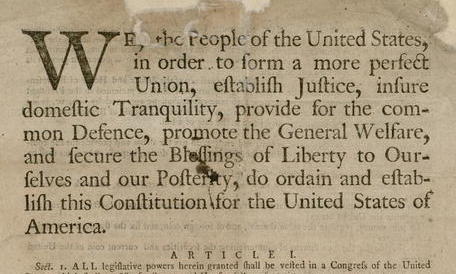


Text and central themes
The Preamble reads in full: "We the People of the United States, in Order to form a more perfect Union, establish Justice, insure domestic Tranquility, provide for the common defence, promote the general Welfare, and secure the Blessings of Liberty to ourselves and our Posterity, do ordain and establish this Constitution for the United States of America." Key themes include popular sovereignty (rule by the people), unity among the states, and a balance between collective security and individual liberty. Those phrases have been widely cited in civic education and public discourse as a concise statement of constitutional aims.
Purposes listed in the Preamble
- Form a more perfect Union: aim to strengthen and coordinate the separate states into a functioning national polity.
- Establish Justice: create a system of laws and institutions to fairly resolve disputes and apply law equally.
- Insure domestic Tranquility: preserve peace within the nation and prevent internal disorder.
- Provide for the common defence: organize collective protection against external threats.
- Promote the general Welfare: enable government actions that contribute to social and economic well‑being.
- Secure the Blessings of Liberty: protect freedoms for current and future generations.
Drafting and historical context
The Preamble was produced during the final phase of the Constitutional Convention. It was drafted by the committee responsible for style and arrangement rather than being the subject of an extended floor debate. For a concise account of the framers' intent and the Convention process see Founders' intent and the record of the Constitutional Convention. The final wording is often attributed to Gouverneur Morris, who worked on the Committee of Style and is credited with the Preamble's polished language and memorable opening.
Legal status and judicial use
Legally, the Preamble does not by itself confer powers or impose duties; it is not an operative provision that creates enforceable rights. Courts have long treated it as an interpretive aid that can illuminate the Constitution's objectives but not as a source of independent constitutional authority. For discussion of how courts view the Preamble and its role in constitutional interpretation, see commentary by the Supreme Court and legal scholars.
Importance, symbolism, and modern relevance
Beyond its interpretive use in legal contexts, the Preamble has substantial symbolic and educational value. It appears on governmental documents, is quoted in civic ceremonies and textbooks, and serves as a compact statement of national ideals. While short, its phrases have influenced political rhetoric, legal reasoning, and public expectations about the aims of government. The Preamble's emphasis on "We the People" continues to be invoked in debates about democratic legitimacy, federal authority, and the balance between collective goals and individual rights.
Questions and answers
Q: What is the Preamble to the United States Constitution?
A: The Preamble is a brief introduction to the Constitution's purposes and guiding principles.
Q: What does the Preamble reveal about the Founding Fathers' intentions for creating the Constitution?
A: The Preamble reveals the Founding Fathers' intentions for creating the Constitution and what they hoped the Constitution would achieve.
Q: When was the Preamble added to the Constitution?
A: The Preamble was added to the Constitution as an afterthought.
Q: Was the Preamble discussed on the floor of the Constitutional Convention?
A: No, the Preamble was not discussed on the floor of the Constitutional Convention.
Q: Who wrote and added the Preamble to the Constitution?
A: Gouverneur Morris, one of the writers of the Constitution, wrote and added the Preamble at the last moment.
Q: Did the Preamble have any legal meaning?
A: No, the Preamble itself did not have any legal meaning.
Q: Was the legal meaning of the Preamble upheld by the Supreme Court?
A: Yes, the legal meaning of the Preamble was upheld by the Supreme Court in Jacobson v. Massachusetts (1905).
Related articles
Author
AlegsaOnline.com Preamble to the United States Constitution Leandro Alegsa
URL: https://en.alegsaonline.com/art/78662
Sources
- heritage.org : "Preamble"
- usconstitution.net : "Misspellings in the U.S. Constitution"
- thewashingtonstandard.com : "What Our Framers Knew: The Constitution, Vattel, and "Natural Born Citizen""
- archives.gov : "The Constitution of the United States: A Transcription"
- public.gettysburg.edu : "Gender Roles in Colonial America"
- kids.laws.com : "Preamble"
- law.ou.edu : "The Articles of Confederation"
- let.rug.nl : "American History; from Revolution to Reconstruction"
- dailykos.com : "America's Misunderstood Mission: Promoting the general Welfare"
- thefederalistpapers.org : "The Anti-Federalist Papers"