
Prefrontal cortex: structure, functions, development, and clinical importance
The prefrontal cortex is the foremost part of the frontal lobes that supports planning, decision-making, social behavior and executive control. This entry outlines its anatomy, roles, development and clinical relevance.
Overview
The prefrontal cortex (PFC) occupies the anterior portion of the frontal lobes, positioned in front of primary motor and premotor regions. As a broadly connected region of cerebral cortex, it integrates information from sensory areas, limbic circuits and subcortical nuclei to guide goal-directed behavior. Modern neuroscience links the PFC to planning, problem solving, regulating emotions and controlling impulses rather than carrying out simple sensory or motor acts. For anatomical context see the frontal lobes.
Image gallery
7 Images


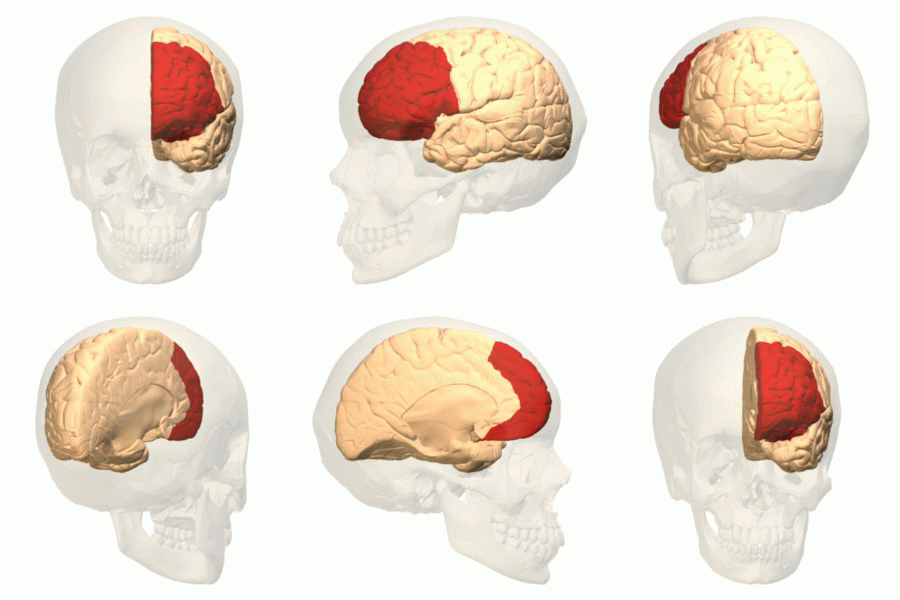
Major subdivisions and anatomy
The PFC is not a single homogeneous area; it contains several subregions with distinct connections and roles. Major compartments commonly described include:
- Dorsolateral prefrontal cortex (DLPFC) — involved in working memory, abstract reasoning and cognitive flexibility.
- Ventromedial and orbitofrontal cortex (vmPFC/OFC) — important for value-based decisions, reward processing and emotion regulation.
- Medial prefrontal cortex — contributes to self-referential thought, social cognition and aspects of moral judgment.
These subdivisions are characterized by dense reciprocal connections with the thalamus, basal ganglia, amygdala and other cortical regions, allowing the PFC to coordinate internal goals with sensory input and affective signals.
Core functions
The set of capabilities most often attributed to the PFC is called executive function. This umbrella term covers a range of cognitive processes that organize behavior over time. Typical functions include:
- Working memory: holding and manipulating information temporarily.
- Planning and decision-making: selecting actions that serve long-term goals.
- Inhibitory control and impulse regulation: suppressing inappropriate responses.
- Flexibility and problem solving: shifting strategies when conditions change.
- Social cognition and personality expression: interpreting social cues and modulating behavior to fit social norms; many authors link these capacities to aspects of personality.
The psychological label most closely associated with these abilities is executive function, which emphasizes the PFC's role in resolving competing choices and predicting outcomes.
Development and evolution
The PFC shows a protracted course of maturation in humans, with structural and functional changes continuing through adolescence into early adulthood. This delayed development is thought to underlie the gradual improvement of self-control, long-range planning and social judgment. From an evolutionary perspective, prefrontal expansion is pronounced in primates and especially in humans, supporting complex social behaviors and abstract thought.
Clinical relevance and notable examples
Damage or dysfunction of the PFC can produce a recognizable pattern often called frontal lobe syndrome: changes in personality, poor judgment, impulsivity, flattened affect or difficulty planning. Classic historical cases and modern clinical observations illustrate how focal injury to prefrontal areas alters social conduct and decision-making. Variations in prefrontal activity are also implicated in neuropsychiatric conditions such as attention-deficit/hyperactivity disorder, depression, schizophrenia and some forms of addiction.
Networks, chemistry and research methods
Physiologically, the PFC operates within distributed networks and is modulated by neuromodulators such as dopamine and noradrenaline, which influence attention, motivation and learning. Contemporary research uses imaging methods (for example, fMRI), lesion studies and electrophysiology to map PFC contributions to specific tasks. These approaches continue to refine our understanding of how this region supports the integration of thought, emotion and action necessary for adaptive behavior.
Notable facts: the PFC is central to delayed gratification and moral reasoning, plays a role in theory of mind, and its late maturation helps explain why adolescents may act more impulsively than adults.
Questions and answers
Q: What is the prefrontal cortex?
A: The prefrontal cortex is the front part of the frontal lobes of the brain that helps plan complex cognitive behaviours, personality expression, and decision making.
Q: Where is the prefrontal cortex located?
A: The prefrontal cortex lies in front of the motor and premotor areas of the brain.
Q: What is the basic activity of the prefrontal cortex?
A: The basic activity of the prefrontal cortex is to bring together thoughts and actions to help achieve internal goals.
Q: What is executive function?
A: Executive function is the most typical psychological term that refers to the functions carried out by the prefrontal cortex area, which involves the ability to work out conflicting thoughts, determine good and bad, better and best, same and different, consequences of current activities, working toward a goal, prediction of outcomes, and expectation of results.
Q: What is the critical function of the prefrontal cortex?
A: The critical function of the prefrontal cortex is 'social control,' which refers to the ability to suppress urges that could lead to socially unacceptable outcomes.
Q: Is there a link between a person's personality and the functions of the prefrontal cortex?
A: Yes, many authors have indicated an integral link between a person's personality and the functions of the prefrontal cortex.
Q: What does the prefrontal cortex help correct?
A: The prefrontal cortex helps correct social behaviour.
Related articles
Author
AlegsaOnline.com Prefrontal cortex: structure, functions, development, and clinical importance Leandro Alegsa
URL: https://en.alegsaonline.com/art/78655
Sources
- ncbi.nlm.nih.gov : "Prefrontal structural and functional brain imaging findings in antisocial, violent, and psychopathic individuals: a meta-analysis"
- doi.org : 10.1016/j.pscychresns.2009.03.012
- pubmed.ncbi.nlm.nih.gov : 19833485
- ncbi.nlm.nih.gov : "The prefrontal cortex: categories, concepts and cognition"
- doi.org : 10.1098/rstb.2002.1099
- pubmed.ncbi.nlm.nih.gov : 12217179
- ncbi.nlm.nih.gov : "Testing predictions from personality neuroscience"
- doi.org : 10.1177/0956797610370159
- pubmed.ncbi.nlm.nih.gov : 20435951