
Aye-aye (Daubentonia madagascariensis)
A nocturnal lemur endemic to Madagascar, the aye-aye is notable for its rodent-like teeth and an elongated middle finger used to extract insect larvae from wood, filling a woodpecker-like ecological role.
The aye-aye is an unusual nocturnal primate native to the island of Madagascar, located off the southeast coast of Africa. Classified as a lemur, the aye-aye bears the scientific name Daubentonia madagascariensis and is the only living species in its genus. It is often cited as the largest nocturnal primate and is recognizable by its lanky limbs, large eyes, and a single, highly specialized middle finger.
Image gallery
10 Images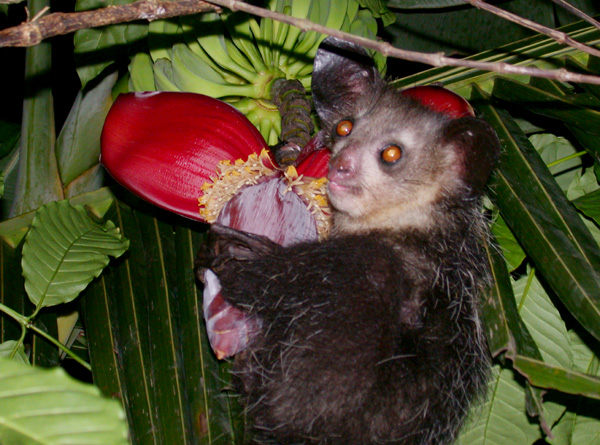


Physical characteristics
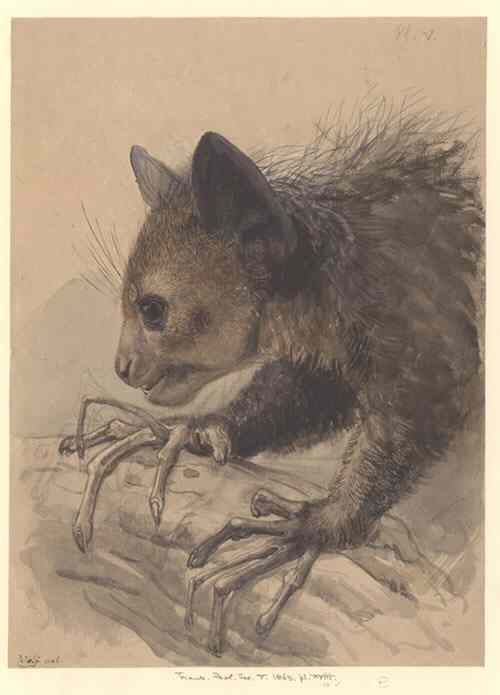
Distinctive features include continuously growing incisors that resemble those of a rodent, large ears that aid in acoustic foraging, and an abnormally thin, elongated middle finger on each hand. This slender digit is flexible and capable of extracting small prey from narrow cavities. The coat varies from dark to pale shades depending on habitat, and the tail is bushy relative to body size.
Behavior and foraging
Aye-ayes are primarily solitary and active at night. They sleep in leafy nests or hollows during daytime and travel through the canopy in search of food. Their signature foraging method—percussive or tap-foraging—combines listening, tapping, gnawing and probing: the animal taps on wood to locate hollow areas that may contain insect larvae, gnaws a hole with its incisors, then inserts the elongated middle finger to extract the prey. In this way they occupy an ecological niche analogous to that of woodpeckers elsewhere.
Diet
- Primary items: insect larvae and grubs found under bark.
- Supplementary foods: tree sap, fruit, and occasionally other invertebrates or plant materials.
- Foraging method: tapping to detect cavities, gnawing with incisors, probing with the middle finger.
Habitat and distribution
Aye-ayes inhabit a range of forested environments across Madagascar, from humid rainforests to drier coastal woodlands. They are largely arboreal, moving through and feeding from trees, and they construct simple sleeping nests in forks or sheltered branches. Local distribution is patchy because individuals are solitary and require territories with appropriate foraging resources.
Reproduction and social life
Reproduction is relatively slow compared with many small mammals; females typically rear one young at a time and parental care is prolonged. Social interactions are limited: individuals maintain separate home ranges that may overlap without forming stable groups. Communication relies on vocalizations, scent marking and visual cues suited to nocturnal life.
Conservation and cultural aspects
The aye-aye faces threats from habitat loss, fragmentation and, in some regions, persecution driven by local beliefs that regard it as an ill omen. Conservation measures include protected areas, habitat restoration and community outreach. Because lemurs are part of the primate order, the aye-aye is related to other primates, such as monkeys and apes, but it represents a distinctive evolutionary path found only on Madagascar.
Notable facts: the aye-aye's combination of rodent-like teeth and a percussion-based, finger-probing foraging technique make it one of the most specialized mammals for extracting concealed prey. Its uniqueness has made it a focus of scientific study and of conservation attention across Madagascar.
Questions and answers
Q: Where is the aye-aye found?
A: The aye-aye is found in the rain forests of Madagascar, a large island off the southeast coast of Africa.
Q: Is the aye-aye diurnal or nocturnal?
A: The aye-aye is nocturnal, meaning it is most active at night.
Q: Where does the aye-aye sleep during the day?
A: During the day, the aye-aye sleeps in a nest in the fork of a tree, which it builds out of leaves and twigs.
Q: What kind of teeth does the aye-aye have?
A: The aye-aye has rodent-like teeth.
Q: How does the aye-aye obtain insect grubs?
A: The aye-aye uses a special thin middle finger to get at the insect grubs under tree bark.
Q: What is the ecological niche filled by the aye-aye?
A: The aye-aye fills the same ecological niche as woodpeckers do elsewhere. It taps on trees to find grubs, then gnaws holes in the wood using its forward slanting incisors.
Q: What kind of animal is the aye-aye related to?
A: The aye-aye is a lemur and a primate, and so is related to monkeys, apes, and humans.
Related articles
Author
AlegsaOnline.com Aye-aye (Daubentonia madagascariensis) Leandro Alegsa
URL: https://en.alegsaonline.com/art/7865
Sources
- link.springer.com : link.springer.com/article/10.1023/A:1020363128240
- species.wikimedia.org : Daubentonia madagascariensis