
Poverty in India: measures, trends, causes and policy responses
Overview of poverty in India: measurement approaches, historical trends, causes, and major government and social responses, distinguishing monetary and multidimensional perspectives.
Overview
Poverty in India refers to the condition in which people lack sufficient resources to meet basic needs such as food, shelter, clothing, health care and education. India has experienced large reductions in the share of people classified as poor over the last few decades, but tens to hundreds of millions remain vulnerable to economic shocks, illness and job loss. Discussion of poverty in India typically distinguishes between monetary poverty (based on income or consumption) and broader, multidimensional measures that include nutrition, schooling and living standards.
Image gallery
7 Images


Measurement and official thresholds
Estimates of how many people are poor depend heavily on the definition and methodology. The government and researchers use different poverty lines and surveys to measure monetary poverty. For example, government notifications and reports have referred to an official poverty line expressed in monthly rupee amounts for rural and urban areas; separate documents and analysts refer to alternative income thresholds. International comparisons often use global benchmarks such as purchasing-power-adjusted US$1.25 or US$1.90 per day, which are sometimes cited as international lines for extreme poverty.
Non-monetary indicators are also important. Nutrition-based norms and minimum calorie requirements have been used in some studies and policy calculations. For instance, published figures refer to aggregate calorie norms and differentiated consumption standards, including higher recommended energy intake in rural settings compared with urban settings, though specific numbers vary with methodology and year.
Trends and historical context
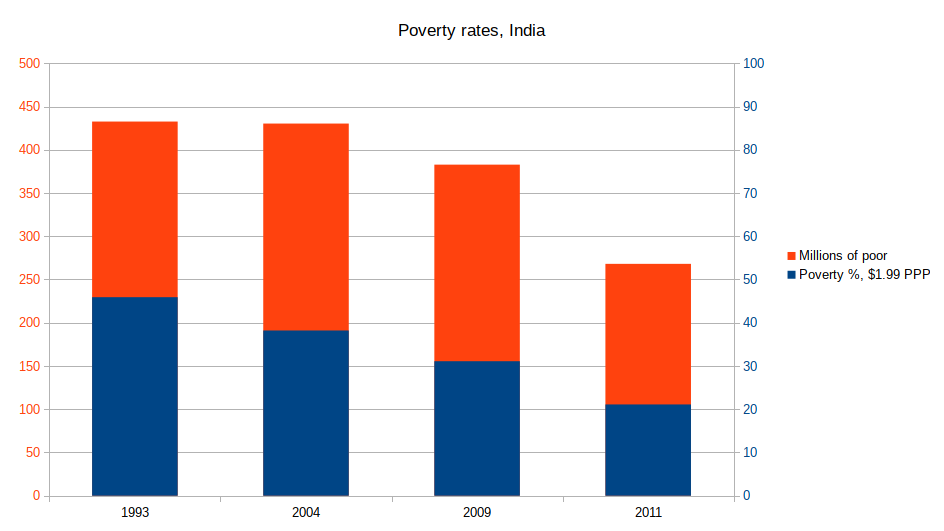
Over recent decades India has reduced its measured poverty substantially, driven by sustained economic growth, agricultural productivity gains, and expanded public services. National survey-based estimates have shown declines in poverty headcount ratios between the early 2000s and the 2010s. However, comparisons across time can be affected by changes in survey methods, price deflators and poverty-line definitions. Different agencies and studies sometimes report diverging levels and rates of decline because of these methodological choices.
Causes and drivers of poverty
Poverty in India is shaped by a mix of structural and immediate factors:
- Low and uneven income growth, especially where employment is informal and seasonal.
- Limited access to quality education, health care and sanitation, which affects long-term earnings potential.
- Landlessness and small, fragmented holdings that constrain rural incomes.
- Social inequalities and regional disparities—certain states and social groups have higher poverty rates.
- Shocks such as droughts, illness, and cycles of unemployment that push households back into poverty.
Policy responses and programs
Government responses have included direct poverty alleviation programs, subsidized food distribution, cash transfers, public employment guarantees, and schemes to expand rural electrification, sanitation and financial inclusion. Examples of such interventions are often evaluated for effectiveness in reducing both monetary poverty and multidimensional deprivation. Non‑governmental organizations and microfinance institutions have also contributed to services targeting the poor, while economic growth and urbanization have opened new employment opportunities for many households.
Notable considerations and debates
Key debates around poverty in India concern measurement choices, the balance between growth and redistribution, and how to target assistance efficiently without exclusion errors. Measuring multidimensional poverty—looking beyond income to health, education and living standards—has gained traction because it better captures everyday deprivation. Policymakers continue to refine poverty thresholds and data collection to produce more comparable and policy-relevant estimates.
For further reading on official thresholds, international comparisons and calorie-based norms, see the referenced government and research documents linked above via the official anchors.
Questions and answers
Q: What is the poverty line for rural areas in India?
A: The poverty line for rural areas in India is ₹816 per month.
Q: What is the poverty line for urban areas in India?
A: The poverty line for urban areas in India is ₹1000 per month.
Q: What is India's proposed official poverty line?
A: India's proposed official poverty line is ₹972 (US$14) a month in rural areas or ₹1,407 (US$21) a month in cities.
Q: What is the average calorie requirement for an average man in rural areas of India?
A: The average calorie requirement for an average man in rural areas of India is 2400 calories per day.
Q: What is the average calorie requirement for an average man in urban areas of India?
A: The average calorie requirement for an average man in urban areas of India is 2100 calories per day.
Q: What percentage of people in India fall below the international poverty line?
A: According to the Planning Commission of India (Tendulkar Committee) in 2012, 26% of all people in India fall below the international poverty line of US$1.25 per day.
Q: What has been the trend in poverty levels in India over the last decade?
A: Over the last decade, poverty levels in India have consistently declined, with levels dropping from 37.2% in 2004-05 to 29.8% in 2009-10.
Related articles
Author
AlegsaOnline.com Poverty in India: measures, trends, causes and policy responses Leandro Alegsa
URL: https://en.alegsaonline.com/art/78501
Sources
- object.cato.org : Socialism kills - the human cost of delayed economic reform in India
- swaminomics.org : Street hawking promise jobs in future
- ukibc.com : The India Report
- news.bbc.co.uk : India: the economy