
Potter's wheel: history, design, and throwing techniques
A concise encyclopedia entry on the potter's wheel — its history, parts and types, the throwing process (centering, pulling, trimming), and how it differs from turning lathes.
The potter's wheel is a rotating platform used to shape round ceramic objects by hand. Often called a potter's lathe in older sources, it serves as a central tool in the craft of throwing: as clay spins the potter uses hands and simple tools to form vessels symmetrically. The device is both a shaping aid and a working surface for trimming, decorating and refining the dried but leather-hard body.
Image gallery
6 Images


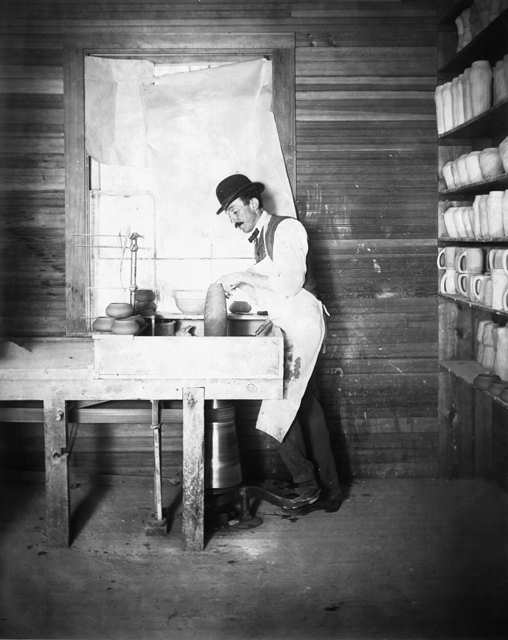
Design and main parts
Modern wheels vary from simple banding wheels to studio wheels with electric motors, but most share basic components: a rotating head or wheel-head, a drive system (kick, flywheel, or electric motor), a sturdy frame, and a removable bat or work surface. A typical set-up allows speed control, a splash pan to contain water and clay, and a foot pedal on electric models. The traditional foot- or leg-powered kick wheel remains valued for its direct physical feedback.
How it is used
Throwing on a potter's wheel follows a sequence of tactile steps. These are commonly taught as:
- Centering: compressing and balancing the clay on the rotating head.
- Opening: creating the initial cavity that will become the vessel's interior.
- Pulling: raising and thinning the walls to shape height and profile.
- Shaping: refining form and features with ribs, fingers, and trims.
- Trimming and finishing: removing excess clay and defining the foot once the piece is leather-hard.
History and development
Wheeled pottery appears early in the history of ceramics. Evidence suggests the potter's wheel was in use in ancient Near Eastern and Mediterranean cultures by the late 4th to early 3rd millennium BCE, where it accelerated production and allowed greater uniformity than hand-building alone. Over centuries the device evolved from manually powered wheels to complex, motor-driven studio equipment.
Types and distinctions
Distinctions are useful when comparing similar tools. The craft potter's wheel is specialized for forming clay; by contrast the term "lathe" in woodworking and metalwork refers to machines for turning rigid materials with cutting tools — a process that shares the term "turning" but differs in technique and tooling. Within ceramics, wheels range from simple banding stands to heavy-duty electric wheels designed for professional studios.
Importance and contemporary use
The potter's wheel remains central in both functional and artistic ceramics. It is used in education, artisan studios, and commercial workshops to produce tableware, architectural elements, and sculptural forms. Learning to use the wheel develops hand-eye coordination and an intuitive understanding of clay behavior, making it a cornerstone of ceramic practice worldwide. For further practical guidance, consult technical and instructional resources on machine operation and shaping techniques.
Questions and answers
Q: What is the potter's wheel?
A: The potter's wheel is a machine used to shape round ceramic wares.
Q: What is another name for the potter's wheel?
A: The potter's wheel is also known as the potter's lathe.
Q: What other shaping process is the potter's lathe used for?
A: The potter's lathe is also used for turning, which is similar to that used for the shaping of metal and wood articles.
Q: What is the purpose of using the wheel during the process of trimming excess body from dried wares?
A: The wheel may also be used during the process of trimming excess body from dried wares.
Q: What is incised decoration?
A: Incised decoration is decoration that is cut into a surface by carving or engraving.
Q: What can the wheel be used for applying?
A: The wheel can also be used for applying incised decoration or rings of colour.
Q: What is the potter's wheel made of?
A: The text doesn't provide information on what materials the potter's wheel is made of.
Related articles
Author
AlegsaOnline.com Potter's wheel: history, design, and throwing techniques Leandro Alegsa
URL: https://en.alegsaonline.com/art/78464