
Possum (Australasian marsupial)
Overview of possums: Australasian marsupials in the suborder Phalangeriformes, their traits, lifecycle, distribution, ecological role, history of introduction, and differences from opossums.
Overview
The term "possum" refers to a group of Australasian marsupials in the suborder Phalangeriformes. These animals are native to Australia, nearby islands and parts of Papua New Guinea, and together they comprise roughly sixty to seventy species. Possums vary widely in size and habits but are commonly known for their nocturnal activity, arboreal lifestyle, and the maternal pouch in which young develop.
Image gallery
10 Images


Characteristics and behaviour
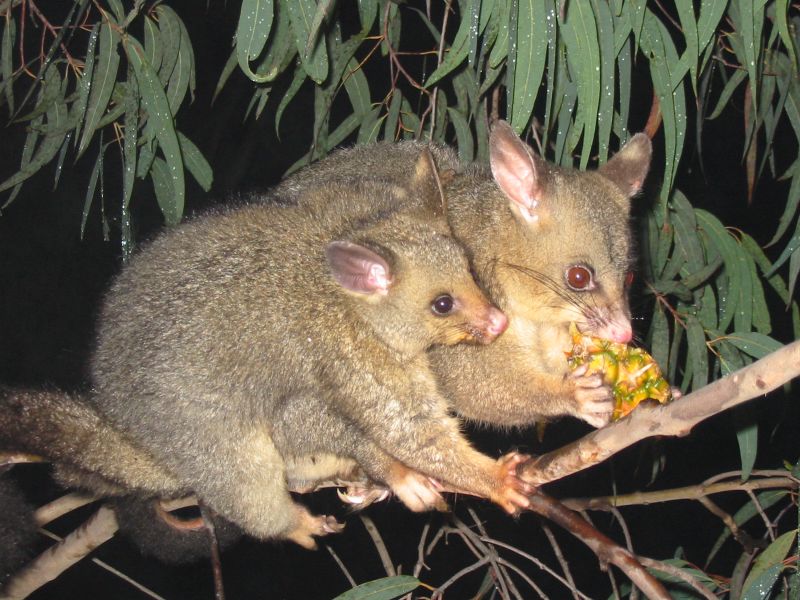
Possums are marsupials: females typically carry and nurse their undeveloped young in a pouch for the first months of life. Young remain in or near the pouch for about four months and are usually independent by six months. Most possums are nocturnal and spend much of their time in trees, using sharp claws and a prehensile or semi-prehensile tail for support and balance. Senses such as smell and hearing are well developed. Diets are generally omnivorous; many species feed on leaves, flowers, fruit and nectar, while others include insects, small vertebrates, eggs and carrion.
Anatomy and special adaptations
Members of this group show a range of adaptations to arboreal life. Some species have broad, flat feet for grasping branches; others possess a fully grasping tail. Several lineages include gliding forms that use a membrane of skin stretched between limbs to move between trees. Dental and digestive specializations reflect dietary differences: folivorous species often have complex gut flora to break down tough vegetation, while omnivores have dentitions suited to mixed diets.
Distribution, history and human interactions
Possums are native to Australia and surrounding regions. One well-known episode of human-assisted range change occurred when the common brushtail possum was introduced from Australia to New Zealand in the 19th century; initial introductions in 1837 and later releases led to thriving populations in the absence of natural predators. In places where they have been introduced, possums can become pests, damaging native vegetation, competing with indigenous species and preying on eggs and young birds. In their native range, many possum species are protected, while in areas where they are invasive, control programs such as trapping, exclusion fencing and other management methods are used to reduce ecological damage.
Classification and notable facts
Possums belong to the suborder Phalangeriformes within the diprotodont marsupials. They are related to other diprotodonts such as kangaroos and wallabies. The word "possum" is often confused with "opossum," the latter referring to several species of American marsupials in the order Didelphimorphia; while the names are similar, they denote different groups separated by geography and taxonomy. Possum species differ in conservation status: while many are common and adaptable, a number of island and specialized forest species face threats from habitat loss and introduced predators.
Ecological role and human significance
In native ecosystems possums serve as seed dispersers, pollinators and prey for larger predators, contributing to forest dynamics. Their feeding habits can aid regeneration by spreading fruits and seeds, but when populations are unnaturally high they may over-browse vegetation and harm bird populations. Possums also appear in cultural contexts and local economies: they are part of traditional knowledge and, in some regions, are subject to wildlife legislation and management programs. For further reading and resources, see the links below.
- Marsupial overview
- General mammal resources
- Introductions in China
- Introduction history in New Zealand
- Species lists and taxonomy
- Diprotodontia context
- Related groups: kangaroos
- Arboreal adaptations
- Gliding possums and membranes
- Australian distribution
- Phalangeriformes revisited
Distinction: remember that "possum" in Australasia and "opossum" in the Americas are different marsupial groups. For species-level information and conservation status consult specialized guides or regional wildlife authorities.
Questions and answers
Q: What is a possum?
A: A possum is an Australasian marsupial that is part of the suborder Phalangeriformes.
Q: How many species of possums are alive today?
A: There are about 69 species of possums alive today.
Q: Where are possums native to?
A: Possums are native to Australia and are protected there.
Q: What is the diet of possums?
A: Possums eat the leaves of trees, insects, berries, and bird's eggs.
Q: When were the first possums brought to New Zealand?
A: The first possums were brought to New Zealand in 1837 from Australia.
Q: Why are possums considered pest in New Zealand?
A: Possums have no natural enemies in New Zealand, so their numbers have increased, and they have done a lot of damage to the native plants, animals, and birds.
Q: Are possums nocturnal?
A: Yes, possums are nocturnal and at least partly arboreal.
Related articles
Author
AlegsaOnline.com Possum (Australasian marsupial) Leandro Alegsa
URL: https://en.alegsaonline.com/art/78353
Sources
- peskypossum.com.au : "Types of Possums found in Australia"