
Positronium
Positronium is a short-lived exotic atom composed of an electron and its antiparticle, the positron; it is used to test quantum electrodynamics and to probe materials via annihilation radiation.
Overview
Positronium is an exotic, hydrogen-like bound state formed by an electron and its antiparticle, the positron. As an example of an onium, it has no heavy nucleus: the positron plays the role that a positively charged nucleus would play in an ordinary atom, such as a hydrogen atom. Because the two constituents have equal mass, many properties of positronium differ from those of ordinary atoms.
Image gallery
1 Image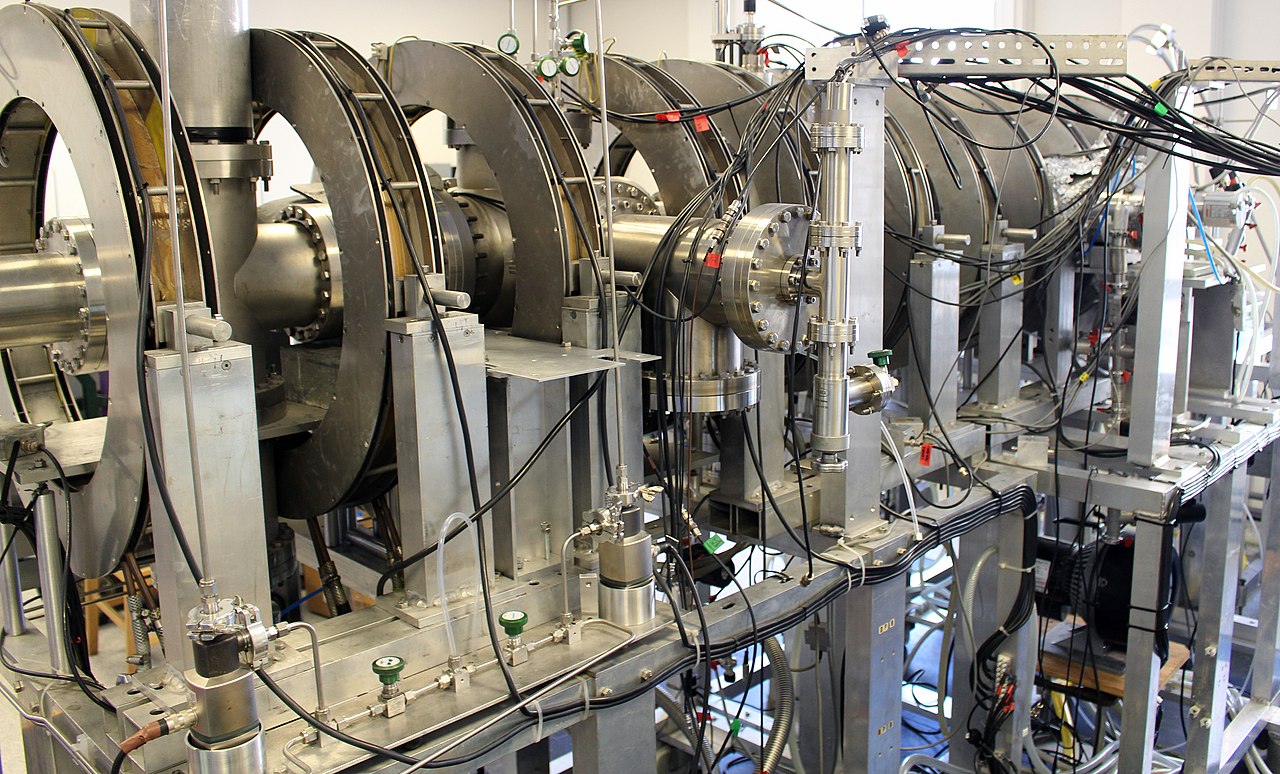
Structure and properties
Positronium occupies quantum orbitals much like other bound electron systems; the concept of an orbital applies to the relative motion of the pair. Key properties include a ground-state binding energy about half that of hydrogen and a Bohr radius roughly twice as large, reflecting the reduced mass of the system. Spin coupling produces two primary states: the singlet (para-positronium) and the triplet (ortho-positronium), which have different lifetimes and decay channels.
Formation and decay
Positronium forms when a low-energy positron captures an electron, either in the gas phase, in a vacuum chamber, or inside a material. It is intrinsically unstable: the electron and positron eventually annihilate and convert their mass into high-energy photons. Para-positronium typically annihilates into two gamma photons, while ortho-positronium most often decays into three photons; the two states differ markedly in lifetime due to conservation laws and quantum selection rules.
Uses and scientific significance
Positronium is a useful laboratory for precision tests of quantum electrodynamics (QED) because it is a purely leptonic system with no nuclear complications. Measurements of its energy levels and lifetimes probe QED corrections. In applied science, positron annihilation is exploited in materials characterization (positron annihilation spectroscopy) and in medical imaging research. Astrophysical detections of the characteristic 511 keV annihilation line also attest to positron–electron annihilation in space.
Notable facts and extensions
- Exotic molecules: More complex bound systems such as di-positronium (a molecule of two positronium atoms) have been created and studied experimentally.
- Precision tests: Discrepancies between measurement and theory for lifetimes or energy levels motivate improved QED calculations and experimental techniques.
- Practical detection: The annihilation photons provide direct signatures used in laboratory and astronomical observations.
For additional introductory material and experimental details, consult specialized reviews and laboratory summaries: onium overview, positron properties, electron basics, hydrogen comparison, atomic structure, and orbital theory.
Questions and answers
Q: What is Positronium?
A: Positronium is an exotic atom made of one positron and one electron that are bonded together.
Q: How does the structure of Positronium differ from that of a Hydrogen atom?
A: In Positronium, the positron replaces a proton that would normally be present in a Hydrogen atom.
Q: Is Positronium stable?
A: No, Positronium is unstable and only exists for a few nanoseconds after it is created.
Q: What happens to Positronium after it is created?
A: The positron and the electron collide, destroying the Positronium and forming two gamma rays.
Q: What is the name given to atoms made of a particle and its antiparticle?
A: Atoms made of a particle and its antiparticle are called oniums.
Q: Does both positron and the electron in Positronium stay in the same orbital?
A: Yes, both positron and the electron in Positronium stay in the same orbital.
Q: What is the result of Positronium's destruction?
A: Two gamma rays are formed as a result of Positronium's destruction.
Related articles
Author
AlegsaOnline.com Positronium Leandro Alegsa
URL: https://en.alegsaonline.com/art/78349