
Portuguese man o' war (Physalia physalis)
A siphonophore-like colonial marine organism with a gas-filled float and long venomous tentacles; known for painful stings and often mistaken for a jellyfish.
Overview
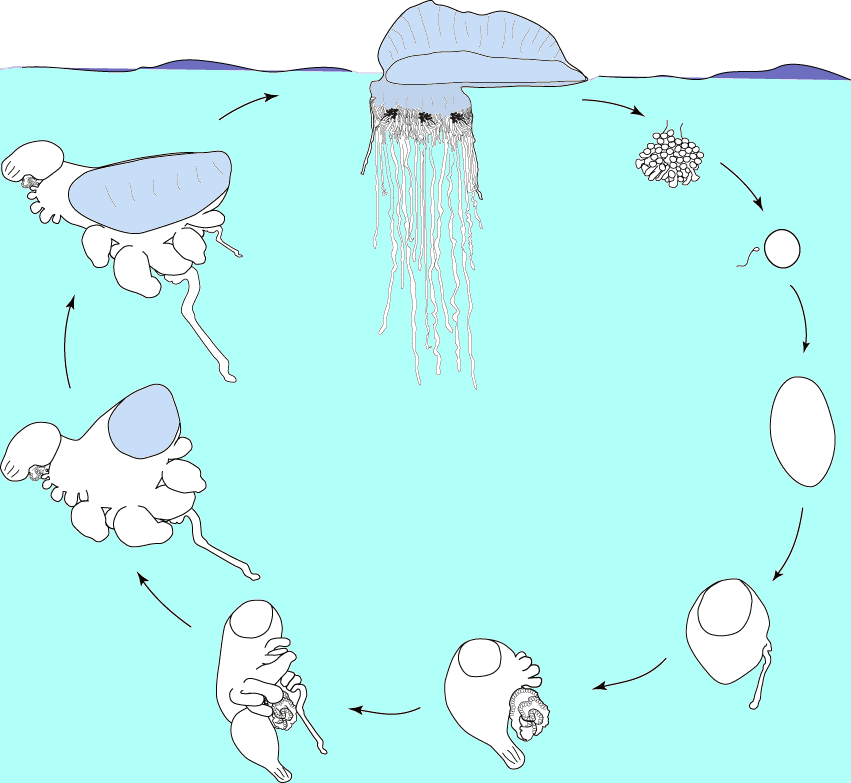
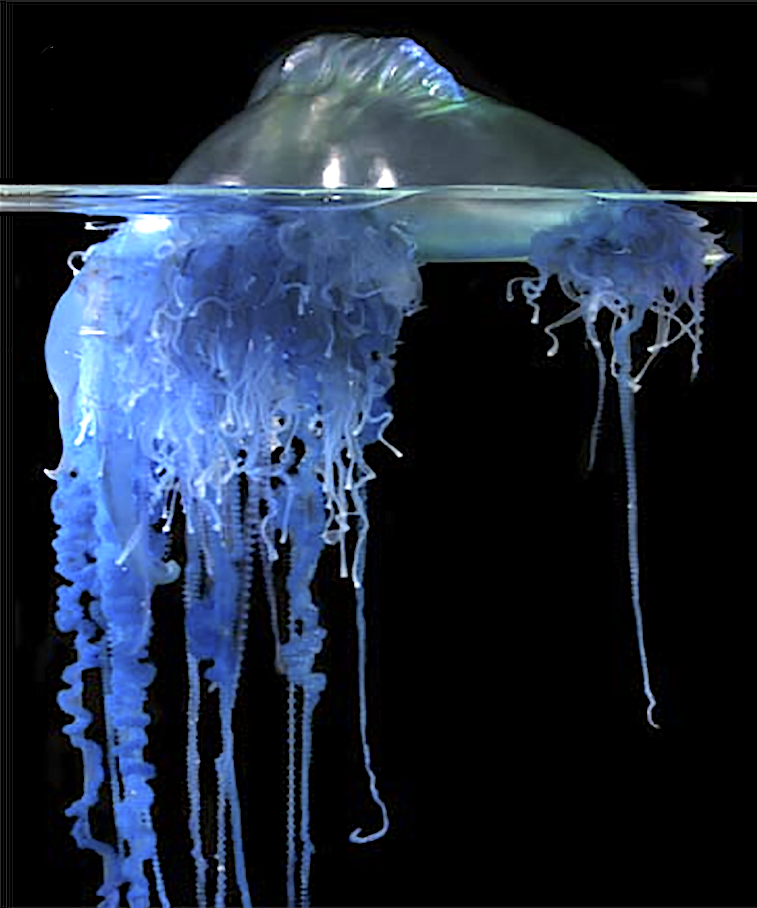
The Portuguese man o' war (Physalia physalis) is a marine colonial organism often mistaken for a single jellyfish. It belongs to the siphonophores, a group of related cnidarians whose bodies consist of many specialized individuals, called zooids, that cooperate as a single functional unit. The species floats at the sea surface, carried by winds and currents, and is recognizable by its translucent, bladder-like float and trailing tentacles.
Image gallery
10 Images



Anatomy and colony structure
What looks like a single animal is actually a colony of zooids specialized for different tasks: a gas-filled float (pneumatophore) keeps the colony buoyant, feeding zooids capture and digest prey, reproductive zooids produce offspring, and defensive zooids bear the stinging cells. The colony's long, thread-like tentacles are equipped with nematocysts that immobilize small fish and other prey; these tentacles may extend for many metres below the surface.
Distribution, behavior and ecology
Portuguese men o' war occur in warm temperate and tropical oceans worldwide and are most common where winds and surface currents concentrate floating organisms. They often appear in groups or patches; when conditions push them toward shore, stranded colonies can form dense collections on beaches. As surface drifters, they feed on small fish and plankton and are preyed upon by specialized predators that tolerate or avoid their stings.
Human interactions and medical notes
The sting of the Portuguese man o' war is painful to people and can cause local skin reactions, intense pain, and in some cases systemic symptoms. Reactions vary by individual and exposure; severe or allergic responses are uncommon but possible. Because practices for first aid and treatment differ by region, medical guidance should be sought from local health authorities or professionals after a sting.
History, name and notable facts
The common name derives from an old Portuguese warship, the caravel, whose sails were said to resemble the gas-filled float. Historically, sailors and coastal communities have recorded encounters with the organism for centuries. Despite popular belief, the Portuguese man o' war is not a single animal but a coordinated colony. It is often confused with true jellyfish, which are solitary animals rather than colonies.
Questions and answers
Q: What is the Portuguese man o' war?
A: The Portuguese man o' war is a Cnidarian invertebrate that lives in the sea and is sometimes called the blue bubble or man-of-war.
Q: Why is it called the man-of-war?
A: Its common name comes from a Portuguese war ship of the 15th and 16th century that had triangular sails, similar in shape to the bladder of the man o' war.
Q: What is the reputation of the Portuguese man o' war?
A: The Portuguese man o' war has a reputation for swarming in groups of thousands and is known for its powerful sting.
Q: What kind of animal is the Portuguese man o' war?
A: The Portuguese man o' war is a Cnidarian invertebrate.
Q: What is the scientific name of the Portuguese man o' war?
A: The scientific name of the Portuguese man o' war is Physalia physalis.
Q: What kind of environment does the Portuguese man o' war live in?
A: The Portuguese man o' war lives in the sea.
Q: Where did the name Portuguese man o' war come from?
A: The name Portuguese man o' war comes from a Portuguese war ship of the 15th and 16th century that had triangular sails, similar in shape to the bladder of the man o' war.
Related articles
Author
AlegsaOnline.com Portuguese man o' war (Physalia physalis) Leandro Alegsa
URL: https://en.alegsaonline.com/art/78325
Sources
- species.wikimedia.org : Physalia physalis
- commons.wikimedia.org : Physalia physalis
- thecephalopodpage.org : "Glaucus atlanticus, Blue Ocean Slug"
- tolweb.org : "Tremoctopus"