
Polonaise: Polish processional dance and musical form
A stately Polish dance in triple meter that became a noble procession and an important musical genre; notable in folk tradition, ballroom ritual, and Romantic piano repertoire.
Overview
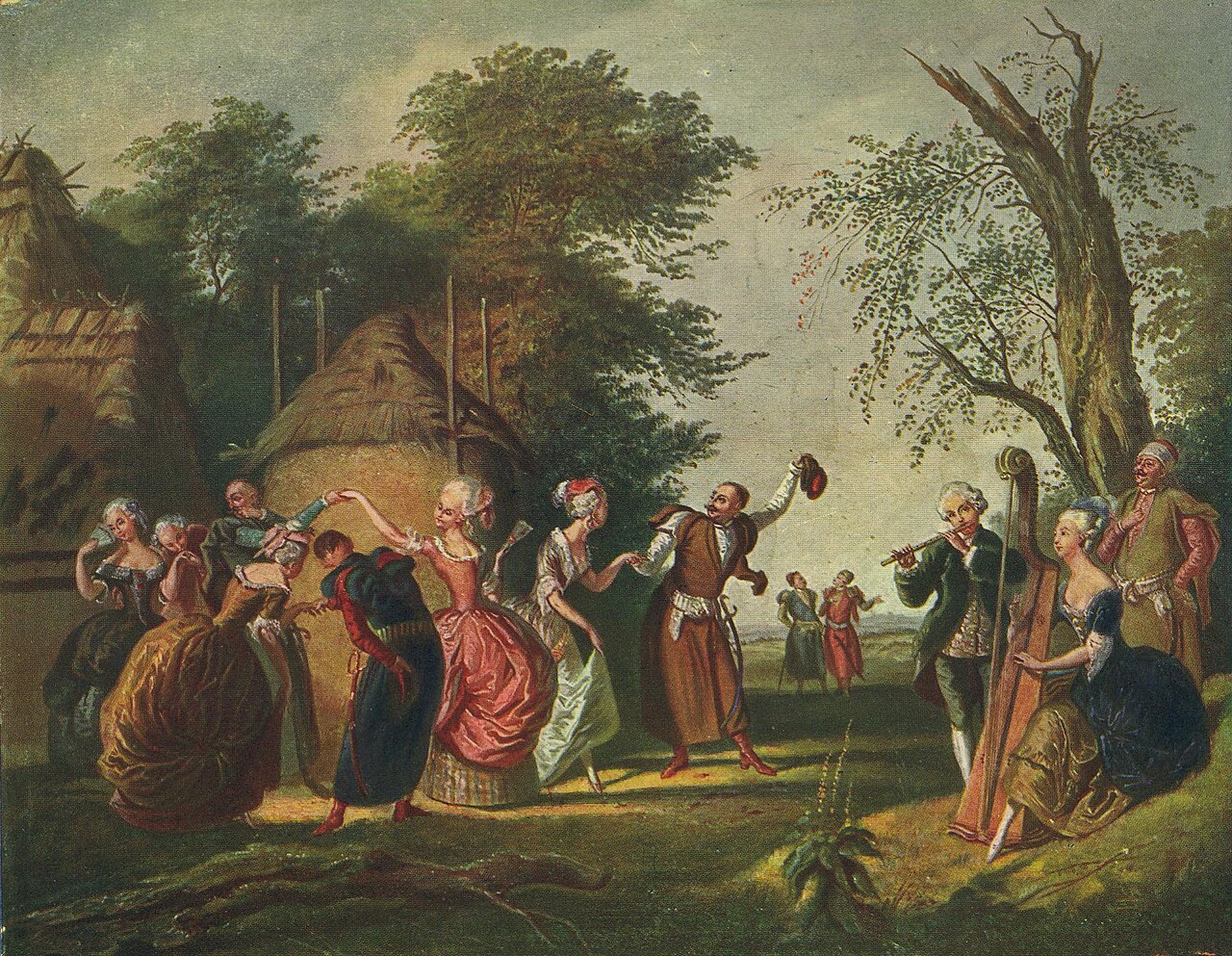
The polonaise is a dignified Polish dance and musical genre that developed from regional folk practice into a formal, processional court dance and later into a concert form. Typically set in 3/4 time, the polonaise is marked by a steady, measured step and a ceremonial character: dancers proceed in lines or promenades with an emphasis on stately carriage rather than rapid turns. Musically it preserves that sense of procession through characteristic accent patterns and recurring rhythmic figures that give the music forward momentum without the quickness of many folk dances.
Image gallery
6 Images



Musical characteristics
Polonaises are most often written in triple metre and commonly use a recurring rhythmic motif that listeners associate with the form. This motif is usually a short-long figure or a dotted emphasis that helps to underline the first beat of the bar and produces a march-like but flowing pulse. In composed examples, textures range from transparent accompaniment for dancers to highly elaborate piano writing. Many concert polonaises adopt a ternary (A–B–A) layout: an opening section, a contrasting middle episode, and a return of the opening material, a structure explained in general accounts of ternary form.
History and social context
The dance grew out of Polish folk and regional courtly customs and by the 17th and 18th centuries had become established as a ceremonial procession at balls and state occasions. In noble households and reception halls musicians often played the polonaise from a gallery while guests paraded below, an association with the aristocracy and the rituals of the Polish nobility. In the 19th century the polonaise acquired strong national and patriotic connotations: as Polish national sentiment and Romantic ideas spread across Europe, composers and audiences treated native dances as important symbols of identity, especially in and after the 1830s.
Choreography and performance
Choreographically the polonaise emphasizes walking figures, promenades, bows and simple paired steps rather than virtuosic turns. Formal social occasions used it as an opening procession for balls and ceremonies. In concert settings, especially on the piano, composers exploited the polonaise’s dignified character to craft pieces that range from salon miniatures to virtuosic showpieces; in such works, dynamics, dotted rhythms and accentuation all serve to recreate the ceremonial atmosphere.
Notable composers and examples
- Earlier composers occasionally included polonaise movements or pieces in baroque and classical collections; names associated with such pieces include Bach, Handel and François Couperin.
- The Polish-born composer Frédéric Chopin transformed the solo-piano polonaise into a central concert genre. His polonaises combine virtuosity, harmonic invention and national sentiment; among these, the Polonaise in A-flat major, Op. 53 is one of the most famous and technically demanding.
- In the 19th century and later, non-Polish composers used the polonaise to evoke Polish character. Several Russian composers, for example, inserted polonaise episodes in larger works, as in Tchaikovsky’s processional in The Sleeping Beauty and in scenes from Eugene Onegin.
Comparisons and legacy
The polonaise differs from other Central European dances in both rhythm and social use. Unlike the lively duple-time polka, the polonaise is in triple meter and reserved in tempo; compared with the mazurka, which often stresses off-beats and rustic accents, the polonaise is more processional and ceremonious. In classical and Romantic concert life, the polonaise remained a favored vehicle for expressing dignity, pride and national identity, and it continued to appear in orchestral suites, ballets, operas and piano recitals.
Further reading and study
General overviews of traditional Polish dances and histories of the nobility and court ceremony provide useful background. For musical form and analytical perspective see treatments of the ternary layout and essays on 19th-century reception in period sources. Surveys of European musical taste in the 1830s explain how Polish culture spread abroad. Readers interested in composers and repertoire may consult studies of composers, specific works by figures like Chopin, and accounts of how Russian and other continental artists used the polonaise as an emblem of place and character.
Questions and answers
Q: What is a polonaise?
A: A polonaise is a Polish dance that started as a folk dance and became popular among the Polish nobility. It is in 3/4 time and follows a distinctive rhythm.
Q: How does the music of a polonaise typically follow?
A: Polonaises are often composed in ternary form, song form, or minuet and trio which all follow an A-B-A pattern. The music of the A sections is similar if not identical while the B section provides contrast in some way to the A sections.
Q: Where was Polish culture popular during the 19th century?
A: Polish culture was very popular in Europe during the 1830s so it became known in other countries as well.
Q: Who wrote famous Polonaises for piano during this time period?
A: Frédéric Chopin wrote several Polonaises for piano which became famous during this time period.
Q: How difficult are these pieces to play?
A: Most of these pieces are very difficult to play, especially Chopin's famous Polonaise in A flat, Op. 53.
Q: What other composers wrote polonaises to give a Polish atmosphere?
A: Several Russian composers such as Tchaikovsky wrote polonaises to give a Polish atmosphere, e.g., Tchaikovsky's ballet The Sleeping Beauty and his opera Eugene Onegin .
Related articles
Author
AlegsaOnline.com Polonaise: Polish processional dance and musical form Leandro Alegsa
URL: https://en.alegsaonline.com/art/77822