
Pole Position (1982 arcade racing game)
Pole Position is a 1982 Namco arcade racing game in which players qualify with a time trial then race at Fuji Speedway. It popularized realistic racing controls and was a top-selling arcade title in 1983.
Overview
Pole Position is an early arcade racing video game released by Namco in 1982. Designed by Toru Iwatani, the game places the player behind the wheel of a Formula One–style car and blends a qualifying time trial with head-to-head competition on a real-world circuit. Widely credited with helping define the racing genre in arcades, Pole Position combined speed, a pseudo-3D perspective, and realistic controls for its era.
Image gallery
3 Images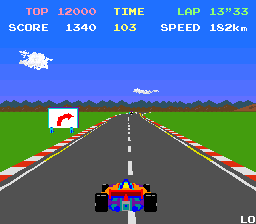

Gameplay and mechanics
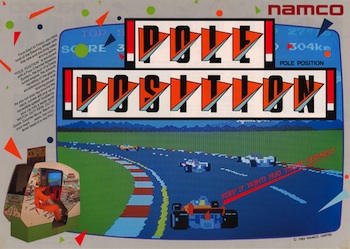
The core session begins with a single-lap time trial that serves as a qualifying run. Completing the qualification within the time limit allows progression to the championship race at the Fuji circuit, loosely modeled after the actual Fuji Racetrack. During the race, players must finish before the allotted time expires while avoiding collisions with other cars and roadside hazards. The arcade cabinet typically featured a steering wheel, acceleration and brake pedals, and a gear shift to simulate a driving experience more advanced than many contemporaries.
Distinctive features
- Track naming and layout inspired by a real F1 venue, giving players a recognizable setting.
- Split gameplay: a qualifying lap followed by the race proper, introducing a new competitive structure to arcades.
- Visual approach using sprite scaling to create the illusion of depth and speed.
- Physical cabinet controls that enhanced immersion compared with joystick-only games.
Development, release and impact
When it arrived in arcades, Pole Position quickly became influential. It was the highest-selling arcade game in North America in 1983, with reports that Namco and distributors moved more than 21,000 cabinets and generated roughly $61 million in machine receipts. Its success prompted ports and inclusion in multiple Namco compilations over later decades, bringing the title to home systems such as the PlayStation, Nintendo 64, Xbox and other platforms.
Legacy and sequels
Pole Position's combination of qualifying mechanics, realistic presentation and accessible but challenging gameplay helped shape subsequent arcade racers. Namco followed with an updated edition titled Pole Position II in 1983, which added additional tracks and refinements while preserving the original's structure. Collectors and retro players still seek the original cabinet for its driving feel and historical significance within the arcade era.
Why it matters
Although modern racing games are far more complex, Pole Position introduced concepts that persist: circuit-based competition, qualifying sessions that affect starting position, and hardware designed to simulate driving. Its commercial success proved the viability of realistic racing simulations in arcades and helped establish Namco as a major developer and publisher of arcade entertainment.
For further context on arcade-era racing and related titles, see additional resources at racing game histories and publisher pages such as those maintained by North American distributors and collectors.
Questions and answers
Q: Who developed Pole Position?
A: Pole Position was developed by Toru Iwatani and released by Namco in 1982.
Q: What is the objective of Pole Position?
A: The objective of the game is for the player to control a Formula One race car and complete a time trial lap to compete in an F1 race at the Fuji Racetrack. After qualifying, the player races against other cars in a championship race, while avoiding crashing into other cars and objects.
Q: What did Pole Position achieve in terms of sales?
A: Pole Position was the highest selling arcade game of 1983 in North America. It sold over 21,000 machines for $61 million.
Q: Has Pole Position been released for any video game consoles?
A: Yes, Pole Position has been released for many video game consoles as part of Namco game collections, including the PlayStation, Nintendo 64, Nintendo GameCube, and Xbox.
Q: Was there a sequel to Pole Position?
A: Yes, in 1983, a sequel called Pole Position II was released. It features three new tracks in addition to the one from the first game.
Q: What kind of car does the player control in Pole Position?
A: The player controls a Formula One race car in Pole Position.
Q: What kind of race is held at the Fuji Racetrack in Pole Position?
A: The F1 race held at the Fuji Racetrack is the championship race that the player competes in after completing the time trial lap.
Related articles
Author
AlegsaOnline.com Pole Position (1982 arcade racing game) Leandro Alegsa
URL: https://en.alegsaonline.com/art/77709
Sources
- magweasel.com : "Final Lap Twin"
- atarigames.com : "Inter Office Memo"