
Polar circle
Either of two parallels near 66°33′38″ latitude that mark where the sun can stay continuously above or below the horizon for 24+ hours each year.
Overview
A polar circle is one of two major parallels of latitude on Earth that encircle the globe near the poles. The northern line is the Arctic Circle and the southern line is the Antarctic Circle. Each lies at roughly 66°33′38″ north or south of the equator; this value is conventionally expressed as a latitude and identifies the boundary of certain solar phenomena centered on the North Pole and South Pole.
Image gallery
4 Images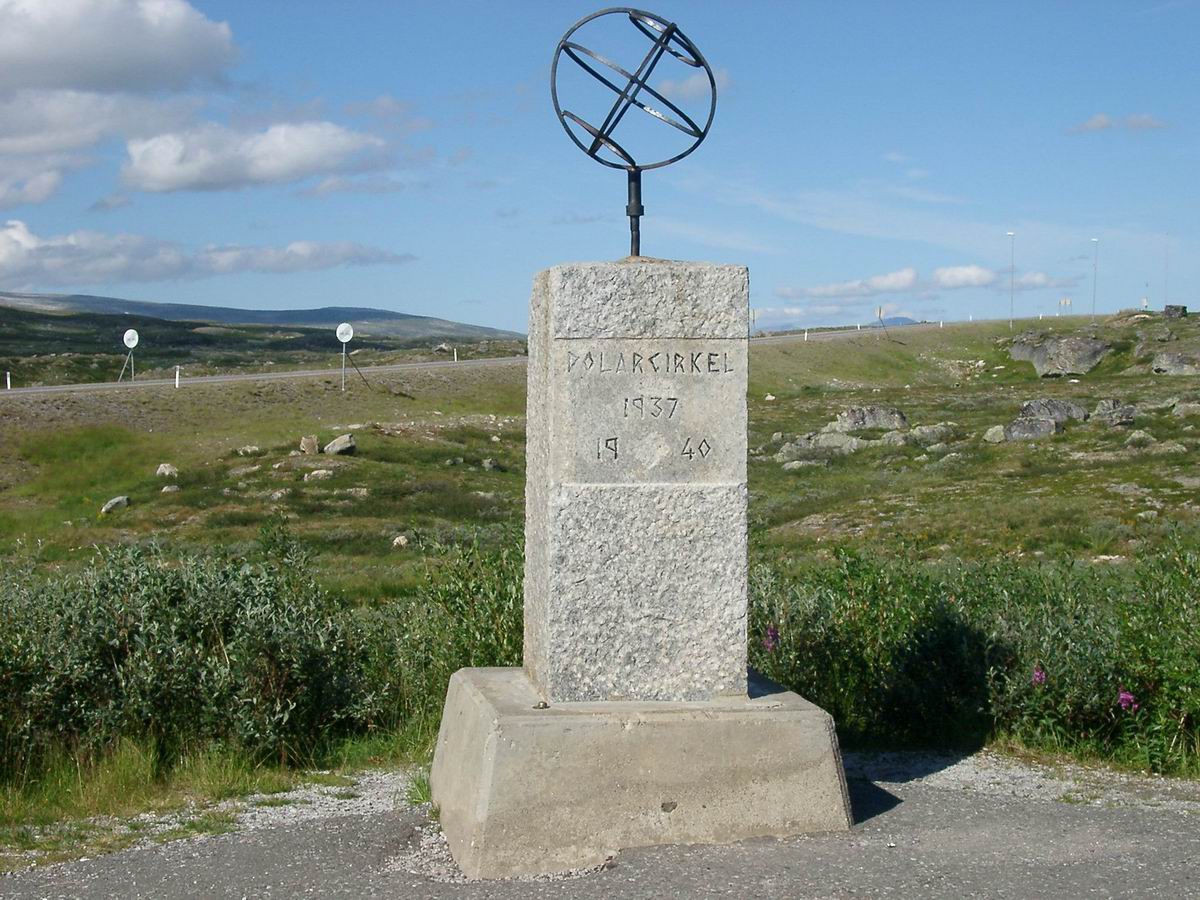


Defining characteristics
Areas within each polar circle experience, at minimum, one day per year when the sun remains continuously above the horizon and at least one day when it remains continuously below the horizon. These events are commonly called the "midnight sun" and the "polar night." Near the boundary, twilight conditions can vary, so a location may have prolonged periods of bright or dim twilight even when the sun does not rise or set normally; see continuous daylight and darkness for the basic phenomenon.
Cause and movement
The polar circles result from Earth’s axial tilt: they mark the most northerly and southerly latitudes at which the sun can be directly overhead at the solstices, and they correspond to the maximum solar declination. Because the tilt (obliquity) of Earth’s axis changes slightly over years and centuries, the exact latitude of each polar circle shifts gradually; the lines are therefore theoretical, not fixed, on any geodetic grid.
Human, ecological and practical significance
The two polar regions differ markedly. The Arctic is an ocean surrounded by land and supports indigenous peoples, towns and economic activities such as fishing and increasingly shipping and tourism. The Antarctic is a high, icy continent governed by international treaty and occupied mainly by temporary research stations. Both regions host distinctive ecosystems adapted to extreme light cycles and cold climates and are sensitive indicators of climate change.
Notable facts and distinctions
- Polar circles are conceptual parallels, used on maps and in astronomy to predict solar behavior.
- They are distinct from the broader terms "polar regions," which refer to ecological, climatic and geopolitical units rather than a single latitude.
- Because the latitude value slowly changes with Earth's tilt, the nominal position of each circle is an approximation used for navigation, education and public signage.
Questions and answers
Q: What is a polar circle?
A: A polar circle is either the Arctic Circle or the Antarctic Circle.
Q: Where is the Arctic Circle located?
A: The Arctic Circle is at a latitude of 66° 33' 38" N.
Q: Where is the Antarctic Circle located?
A: The Antarctic Circle is at a latitude of 66° 33' 38" S.
Q: What happens in areas located between a polar circle and its corresponding pole?
A: In areas between each polar circle and its pole, there will be at least one 24 hour period when the sun is continuously above the horizon and at least one 24 hour period when the sun is continuously below the horizon.
Q: Can the sun be continuously above the horizon in polar regions?
A: Yes, in areas located between a polar circle and its corresponding pole, there will be at least one 24 hour period when the sun is continuously above the horizon.
Q: Can the sun be continuously below the horizon in polar regions?
A: Yes, in areas located between a polar circle and its corresponding pole, there will be at least one 24 hour period when the sun is continuously below the horizon.
Q: What are the two poles referred to in the text?
A: The two poles referred to in the text are the North Pole and the South Pole.
Related articles
Author
AlegsaOnline.com Polar circle Leandro Alegsa
URL: https://en.alegsaonline.com/art/77696